



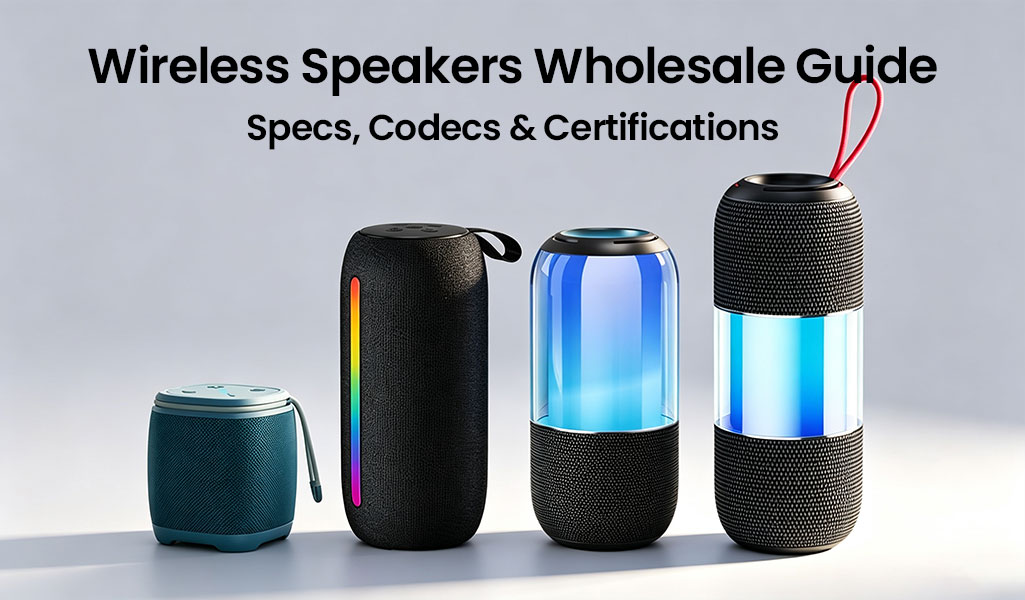
Wireless speakers remain one of the most consistent volume categories in consumer electronics, and in 2026 the buying criteria are shifting. Wireless 6.0 is rolling out, multi-device pairing features are becoming standard, and B2B buyers are moving beyond “just loud enough” toward a proper specification discipline. For wholesalers and distributors, a solid wireless speaker wholesale strategy means knowing which specs to prioritize, which codecs actually matter, and which certifications will keep your stock legal and sellable across markets. This guide gives you a practical 2026 selection framework, from power and battery life to audio codecs and regional compliance.
The 2026 Wireless Speaker Market in One Paragraph
The market is no longer a single “speaker” category. It has segmented into mini portable, indoor home, outdoor rugged, and party/loudspeaker tiers, each with its own buyer profile. At the same time, Wireless 6.0 upgrades and better multi-point connections are becoming genuine selling points. Wholesalers who can match the right tier to the right retail channel — and prove the spec on the box — win shelf space and repeat orders.
Core Specifications Every Wholesaler Should Master
Before comparing models, build a shared vocabulary. These are the specs that decide whether a speaker fits a target retail price point.
Output Power and Audio Performance
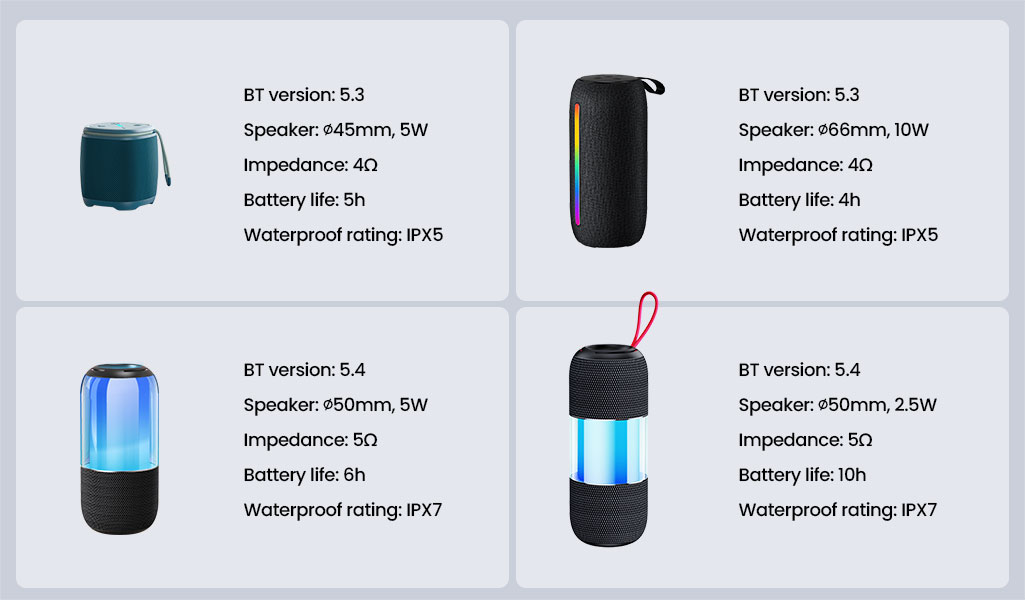
Output power, measured in watts, sets the loudness tier but not the quality. Look at the full picture: RMS power, frequency response, and driver configuration. A speaker with a dedicated passive radiator will sound fuller at the same wattage than one without. For wholesale, the practical rule is to match power tier to usage: 5-10W for desk and personal, 10-30W for room and outdoor, 30W+ for party and events.
Battery Life and Charging Convenience
Battery life is a headline spec buyers read first. Check both the runtime at moderate volume and the charging time, plus whether the unit supports fast charging or power-bank output. Speakers that can double as a power bank are increasingly popular with travel and outdoor channels. Also verify the claimed runtime test condition — marketing numbers are often measured at low volume.
Water Resistance and Ruggedness
The IP rating (e.g., IPX5, IPX6, IP67) is a certification-style shorthand buyers trust. IPX5 resists water jets, IPX6 resists more powerful jets, and IP67 adds dust protection plus short immersion. For outdoor, marine, and travel channels, a strong IP rating is a must-have; for indoor home speakers it is optional. Be careful to distinguish splash-proof from waterproof in your marketing claims.
Wireless Version and Connectivity Features
Wireless 6.0 brings better connection stability, lower latency, and improved coexistence in crowded wireless environments. Beyond the version number, check feature-level details: multi-point connection (connecting two devices at once), TWS pairing (two speakers for stereo), and the codec support. A speaker can claim Wireless 6.0 yet still matter most on whether it pairs instantly and holds the connection.
Codecs: What Actually Matters for Wholesale
Audio codecs determine how music is transmitted between phone and speaker. For B2B buying, three terms cover most of the ground.
SBC and AAC — The Universal Baseline
SBC is mandatory and works everywhere; AAC is the standard choice for iOS devices and is supported by most modern phones. For most retail channels, SBC + AAC is a perfectly adequate baseline, and you do not need to pay a premium for more.
aptX and aptX HD / Adaptive
aptX family codecs offer lower latency and better quality for Android devices and are common selling points in mid-to-high tier speakers. Low latency matters if the speaker is used for gaming or video sync. If your target channel emphasizes these use cases, aptX support is worth specifying.
LDAC and Hi-Res Claims
LDAC supports high-bitrate audio and is often bundled with Hi-Res Audio marketing. It only matters for listeners with compatible source devices and premium content. For mass retail, treat LDAC as a differentiator for the top tier only, and make sure the speaker’s drivers actually justify the claim to avoid perception problems.
The Practical Codec Rule
Match codec investment to price tier and channel. Entry speakers: SBC + AAC. Mid-tier: add aptX. Flagship: add aptX Adaptive or LDAC with honest driver quality. This keeps your bill of materials competitive and your claims credible.
Certifications That Keep Your Stock Legal
Certification errors are among the most expensive mistakes a wholesaler can make, because they surface only at customs or retail listing review. Build certification into your selection checklist from day one.
Wireless and Safety Certifications
Wireless speakers need the wireless approvals of their target markets — FCC, CE, UKCA, and others depending on region — plus battery and safety compliance such as UN38.3 for the lithium cell and relevant battery transport rules. Confirm the supplier holds these at the model or family level and can provide copies.
Environmental and Retail Compliance
Many retail channels and markets now require RoHS and REACH declarations, and packaging must carry correct recycling and material marks. As sustainability expectations rise in 2026, some buyers also ask for packaging material declarations. Ask your supplier for the compliance package before ordering, not after.
Certification Verification Checklist
Check | What to verify | Where it matters |
Market wireless approval | FCC / CE / UKCA etc. per target market | Customs clearance, retail listing |
Battery safety | UN38.3, battery transport documents | Air/sea freight, customs |
Chemical compliance | RoHS, REACH declarations | EU retail, brand audits |
Packaging marks | Recycling symbols, material statements | Retail compliance, sustainability buyers |
Codec/feature claims | Actual codec support, IP rating truth | Brand trust, fewer returns |
Building a Balanced Speaker SKU Range
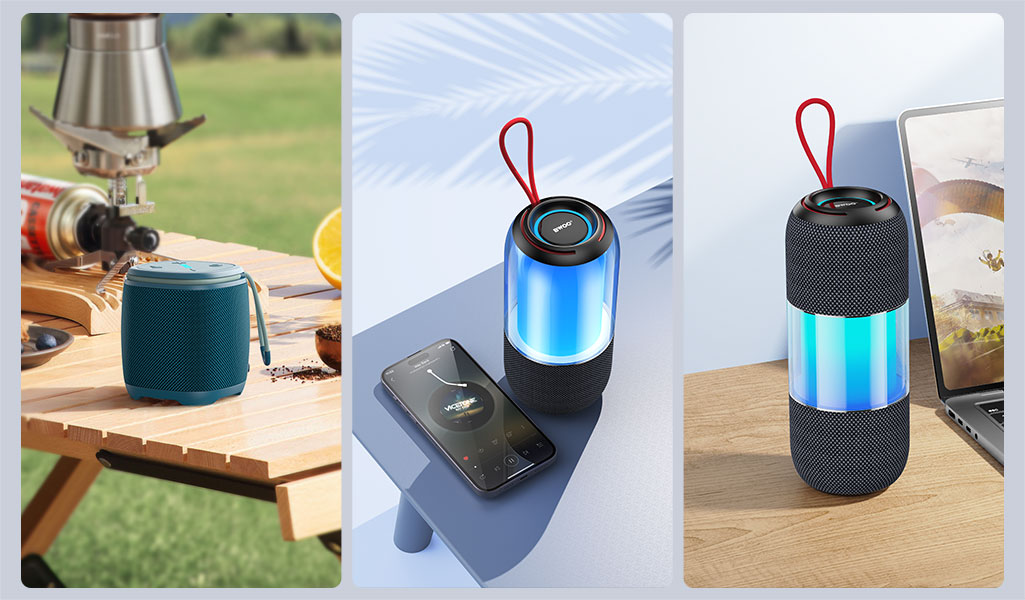
A strong wholesale range mirrors the market segments rather than stacking similar models. A practical 2026 starter range covers four tiers: a compact 5-10W personal speaker, a 10-20W indoor/outdoor mid tier, a rugged IP-rated outdoor model, and a 30W+ party speaker with strong bass and TWS. This lets retailers serve different customers without competing against their own shelf.
Matching Tiers to Retail Channels
Gift and travel shops favor compact, colorful, travel-friendly models with power-bank output. Sports and outdoor channels want rugged IP67 units with hooks and straps. Electronics chains and online marketplaces favor spec-transparent mid-to-high tiers with strong codec support. Align your range to the channels you actually serve, and label specs clearly on the box to reduce support load.
How BWOO's Speaker Series Covers the Whole Range
BWOO's BO-BS82 through BO-BS97 speaker family spans this full spectrum, from compact entry models to higher-output units, with the BO-BS97 leading on Wireless 6.0 connectivity. Because the series is coordinated, wholesalers can build a complete speaker range from one partner with consistent quality, packaging, and certification management.
Frequently Asked Questions
What Wireless version should I buy for wholesale in 2026?
Prioritize Wireless 6.0 for new stock where your channel cares about stability and low latency, and confirm multi-point and TWS support at the feature level. For budget tiers, Wireless 5.3/5.4 units are still viable, but expect the market to shift to 6.0 as the headline standard through 2026.
Is a higher IP rating always better for wholesale?
Not always. IP67 rugged models cost more and matter mainly for outdoor, travel, and sports channels. For indoor home speakers, a high IP rating adds cost customers will not pay for. Match the rating to the channel and the price tier.
Do I need aptX or LDAC on every speaker?
No. SBC + AAC covers the mass market. Add aptX for mid-to-high tiers where Android users and low-latency use cases dominate, and reserve LDAC/Hi-Res for flagship units with drivers that justify it. Over-claiming codec support creates perception and return problems.
How do I verify a speaker supplier's certifications?
Request the model-level or family-level FCC, CE, UKCA, RoHS, REACH, and UN38.3 documents before ordering, and confirm they match the exact SKU and target market. A supplier with a series-level certification strategy can typically cover multiple models under one compliance framework, which saves you time and money.
Build a Sellable Speaker Range in 2026
Wireless speakers reward disciplined buying: the right spec mix, honest codec claims, and complete certifications turn a commodity into a dependable retail category. BWOO's BO-BS82-97 series gives wholesalers a coordinated range with Wireless 6.0 options and a single quality and compliance framework. Send Inquiry with your target power tiers, channels, and markets, and the BWOO team will help you spec a range that sells.


