



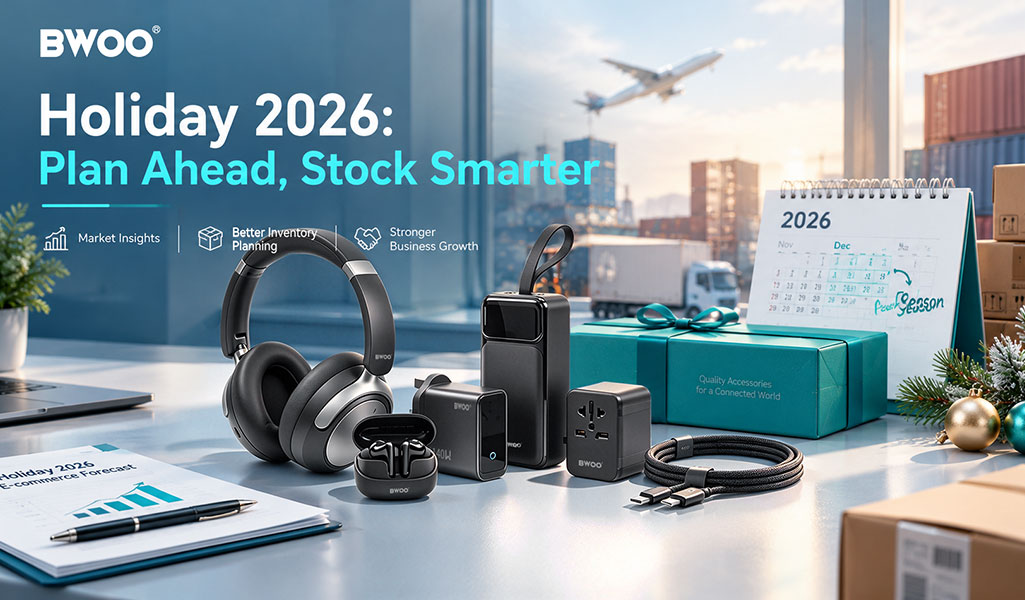
The final quarter brings a familiar challenge for mobile accessory distributors: demand can rise quickly, but the wrong assortment can leave cash tied up in slow-moving stock. A holiday forecast helps with planning, yet it should be treated as a market signal—not a promise that every product or region will grow at the same rate.
In its September 28, 2026 forecast, Adobe expects U.S. online sales from November 1 through December 31 to reach US$275.1 billion, up 6.7% year over year. Electronics are projected to generate US$63.3 billion, up 5.9%. Adobe also forecasts US$47.5 billion in online spending during Cyber Week, up 7.4%, and US$12.9 billion on Black Friday, up 9.2%. These are U.S. forecasts based on Adobe Analytics—not global mobile-accessory sales figures.

1. Turn a broad holiday forecast into a product plan
A category-level forecast does not tell a buyer which exact charger, power bank or earbud model will sell. Start with your own sales history, customer requests, price bands and delivery lead times. Then use the broader forecast to pressure-test the plan.
Build an assortment around customer jobs
Assortment group | Potential products | B2B planning question |
Everyday charging | USB-C wall chargers, multi-port chargers, cables | Which output levels and plug types match the customers and regions served? |
Power on the move | Power banks, magnetic power banks, models with built-in cables | What capacity, output, form factor and local labeling are required? |
Personal audio | TWS earbuds, open-ear earbuds, over-ear headphones | Which price tier and wearing style best fit the retailer's audience? |
Travel and gifting | Travel charging accessories, compact chargers, multi-device accessories | Are the packaging, plug format and use-case claims clear for the target market? |
The goal is not to stock every category equally. It is to create a coherent assortment with a clear entry point, a reliable core range and a limited number of differentiated products. BWOO buyers can review the charger range and power bank collection as examples of categories that may fit different travel and gifting needs.
2. Separate sell-through evidence from seasonal assumptions
A market forecast describes expected consumer spending across a broad category. Your business still needs to estimate sell-through at SKU level. Review at least the same period last year, the latest eight to twelve weeks of sales where available, customer reorders, stockouts, returns and current inventory. Where last year's assortment was different, compare product roles and price tiers instead of using raw units alone.
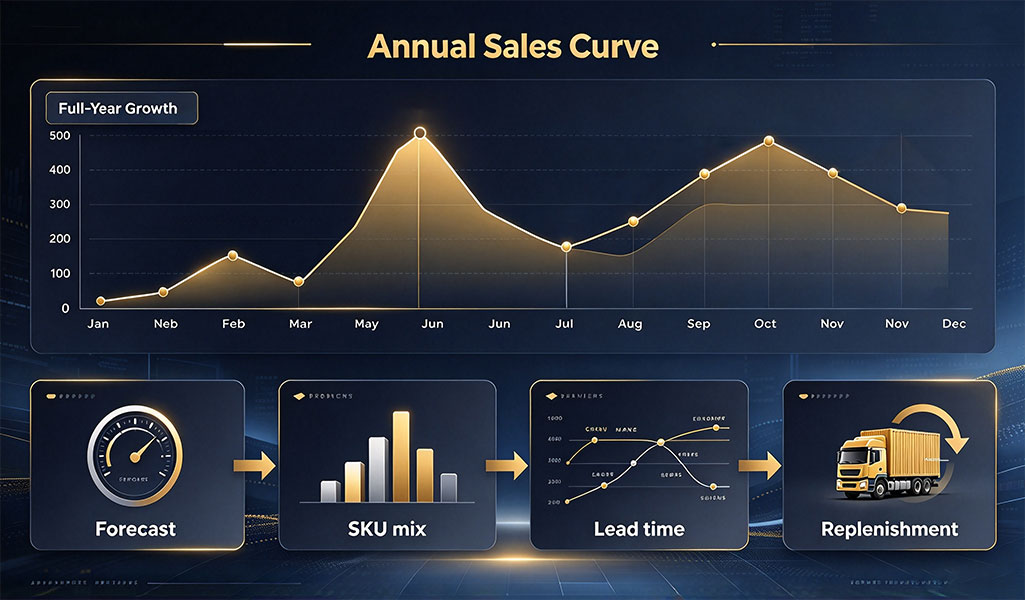
Avoid treating Black Friday as the only demand peak. Some customers order early to secure stock; others wait for promotional signals or replenish after a campaign. Build a planning calendar backwards from the date inventory must be available in the destination warehouse. Include production, inspection, transport, customs clearance and time needed to correct labeling or packaging issues.
3. Check the details that can delay a shipment
Holiday planning often fails at the product-detail level rather than the headline trend. Before confirming a bulk order, align the following details with the destination market and sales channel.
Charging products: confirm plug type, rated output, supported charging protocols, port-by-port output and the total output when multiple ports are used simultaneously. Do not assume a port's maximum rating is available in every multi-device scenario.
Power banks: verify rated capacity, output, built-in cable details where applicable, package markings and the documentation required for the intended market and transport route.
Audio products: select wearing styles, microphone features, battery-life claims and packaging that match the expected user scenario. Make sure claims are supported by the model's own specification and test conditions.
Travel accessories: confirm region-specific plug compatibility and clarify whether a device is a plug adapter, a charger or a voltage converter. These are not interchangeable descriptions.
For a concrete example of a compact charging format, the BWOO 45W GaN retractable charger combines a built-in retractable USB-C cable with charger functionality. Buyers should still check whether the exact plug, output and package version matches the intended market.
4. A practical pre-season checklist for B2B buyers
Confirm the target countries, sales channels, key customer profiles and expected retail price bands.
Rank SKUs using historical sell-through, current stock, confirmed orders and replenishment lead time—not trend headlines alone.
Agree on model-specific specifications, plug types, packaging language, labels and compliance documents before the purchase order is locked.
Define the first shipment quantity and a replenishment trigger; avoid committing the full forecast to one initial order unless demand evidence supports it.
Keep product pages, product images and channel listings consistent with the final production version.
Review actual sell-through and customer feedback during the season so later replenishment can respond to evidence rather than assumptions.
Conclusion
Adobe's 2026 forecast suggests another large U.S. online holiday season, with electronics remaining a significant category. For mobile accessory distributors, the practical opportunity is to prepare a focused assortment, secure the right versions early and keep room for evidence-led replenishment. The best plan combines market context with SKU-level sales, supplier lead time and destination-market requirements.
FAQ
Does Adobe's holiday forecast apply to every country?
No. The cited figures are for U.S. online retail sales. Buyers serving Europe, the Middle East or other markets should use local market data and their own customer histories.
Does growth in electronics mean every mobile accessory will grow?
No. Electronics is a broad category. Demand can vary by product type, price point, compatibility, brand and channel.
When should distributors place holiday orders?
Work backward from the required in-market date using confirmed production, inspection, shipping and customs timelines. Supplier lead time and route conditions matter more than a generic calendar rule.
Is it better to stock more product variations for the holiday season?
Not automatically. A clear core assortment with a small number of differentiated options is often easier to forecast and replenish than a long tail of untested SKUs.
What should be checked before confirming a bulk order?
Confirm the model, specifications, destination plug and label requirements, package contents, compliance documents, lead time and replenishment options.
For distributors building an end-of-year assortment, explore BWOO's mobile accessory catalog and compare product specifications with the requirements of your target market.


