



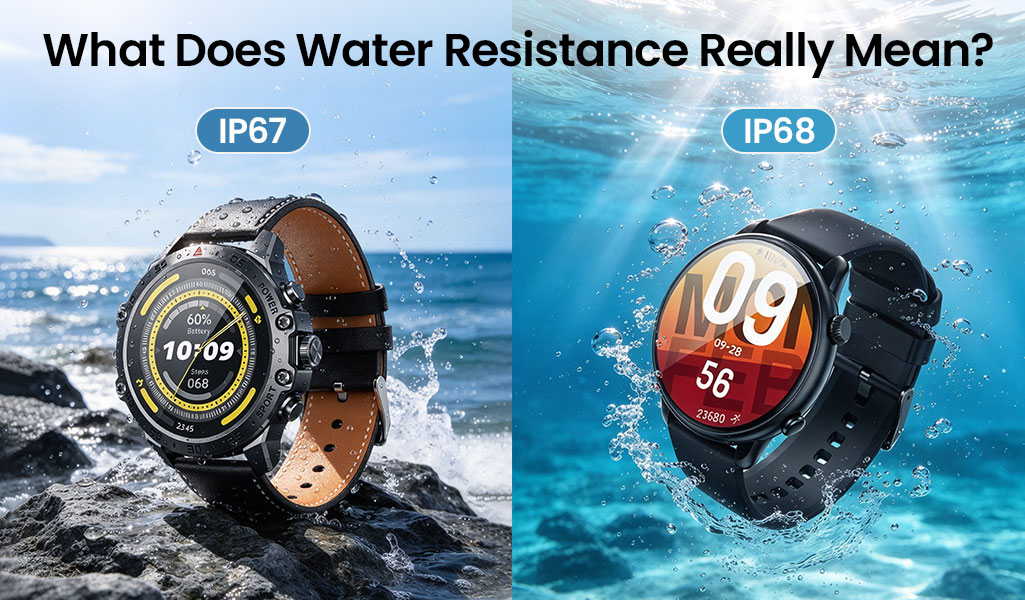
“IP67” and “IP68” are common specifications on smartwatches, earbuds, phones, and other consumer electronics.
However, the two numbers are often misunderstood.
An IP rating does not simply mean “waterproof.” It describes a product's resistance to the ingress of solids and liquids under specified test conditions.
For smartwatches, understanding the difference matters because buyers may use products in rain, during workouts, in the shower, or around water—and these situations do not create identical conditions.
1. What Does IP67 Mean?
The first digit of an IP code relates to protection against solid particle ingress.
The second digit relates to protection against water.
For IP67:
6 = dust-tight protection
7 = protection against temporary water immersion under specified test conditions
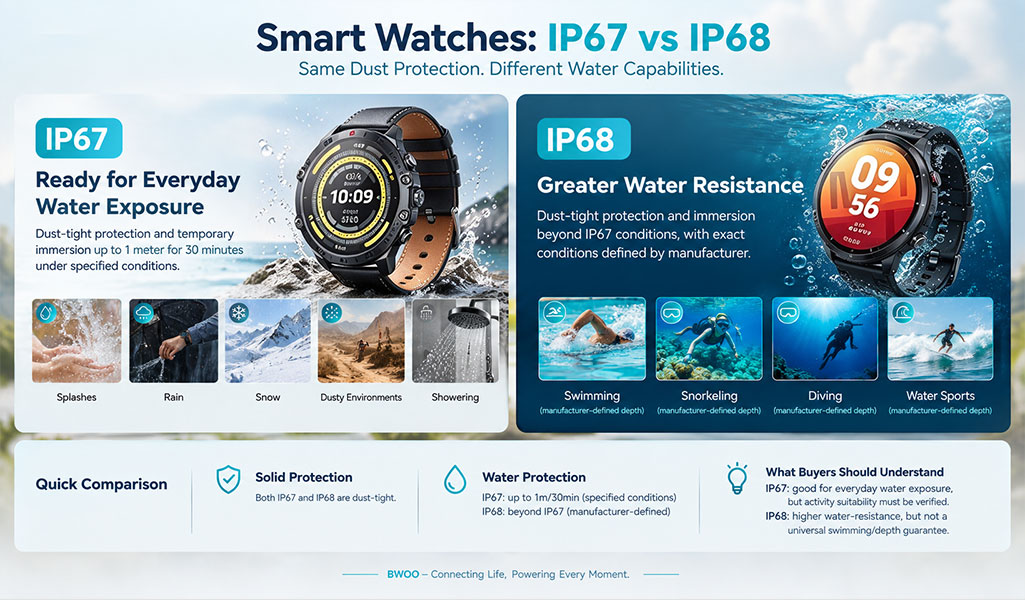
Garmin's published water-rating definitions describe IP67 as dust-tight and capable of withstanding incidental exposure to water up to 1 meter for up to 30 minutes. Garmin also lists use cases such as splashes, rain, snow, dusty environments, and showering.
However, this does not mean that every IP67 smartwatch is suitable for every type of swimming or water sport.
2. What Does IP68 Mean?
IP68 provides the same level-6 dust protection but a higher water-ingress rating.
The important detail is that IP68 does not define one universal immersion depth.
Garmin notes that IPX8 products can be submerged beyond 1 meter, but the exact depth is defined by the manufacturer for the specific product.
That means buyers should not interpret IP68 as:
“All IP68 watches can be used to the same depth.”
Instead, the exact manufacturer's test conditions should be checked.
3. IP67 vs IP68: What Is the Practical Difference?
Rating | Solid Protection | Water Protection | What Buyers Should Understand |
IP67 | Dust-tight | Temporary immersion up to 1m/30min under specified conditions | Useful for everyday water exposure, but activity suitability must still be verified |
IP68 | Dust-tight | Immersion beyond IP67 conditions, with exact conditions defined by manufacturer | Higher ingress-resistance rating, but not a universal swimming/depth guarantee |
The key difference is therefore not simply “67 is weak, 68 is strong.”
The more accurate interpretation is:
IP68 provides a higher water-ingress classification, but the exact use conditions depend on the product specification.
4. Why IP Rating Does Not Automatically Mean “Suitable for Swimming”
This is one of the most important points for product buyers.
Water exposure can involve:
Static immersion
Shower spray
Rain
Sweat
Swimming movement
Water pressure
High-speed water
Temperature changes
Chemical exposure
These conditions are not equivalent.
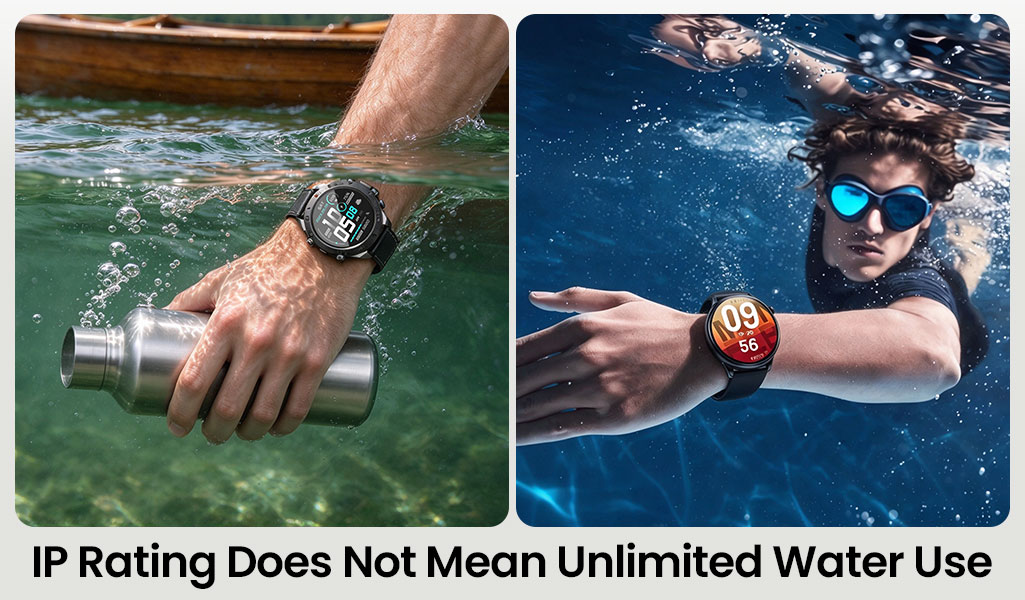
Garmin, for example, distinguishes IP ratings from specific water-use categories. Its IP67 definition includes showering, but its published guidance does not classify IP67 as suitable for swimming.
Therefore, a product page should avoid turning an IP rating into a broader water-use promise that the actual test does not support.
5. What Should B2B Buyers Ask Suppliers?
When sourcing smartwatches with IP67 or IP68 ratings, buyers should ask for more than the rating number.
Test Conditions
Ask:
What standard was used?
What immersion depth was tested?
How long was the device immersed?
Was the test performed on production samples?
Is testing documented?
Product Configuration
Water resistance can depend on physical construction.
Check:
Sealing structure
Buttons
Charging interfaces
Sensor openings
Speaker openings
Case construction
Marketing Claims
Make sure product claims match the actual rating and testing documentation.
A safer product description is:
“IP68 water resistance for daily use”
rather than making a broad claim such as:
“Waterproof for swimming”
unless the specific product has been tested and documented for that use.
6. Why This Matters for Smartwatch Positioning
Water resistance is especially useful when connected to a specific use case.
IP67 Positioning
Potential positioning:
Everyday wear
Rain
Sweat
Outdoor activities
Daily commuting
IP68 Positioning
Potential positioning:
Everyday wear
More demanding water exposure
Outdoor activities
Fitness and lifestyle use
The final positioning should still follow the product's actual documented test conditions.
7. BWOO IP67 and IP68 Smartwatch Examples
BWOO's current smartwatch portfolio includes both IP67 and IP68 products.
BO-WA08
The BO-WA08 is listed as a 1.43-inch IP67 waterproof Smart Watch with Fitness Tracker. Its current product information highlights an AMOLED display, health tracking, sports modes, and iOS/Android compatibility.
BO-WA10
The BO-WA10 is listed as a 1.43-inch HD Touchscreen IP68 Smart Watch. Its current product page specifies IP68 water resistance, multiple sports modes, call and notification support, and up to 20 days of standby time.
This creates a useful comparison for B2B buyers:
Product | Rating | Positioning Reference |
BO-WA08 | IP67 | Everyday wearable use with dust/water resistance |
BO-WA10 | IP68 | Higher water-ingress rating for broader everyday use |
8. Is IP67 or IP68 More Important for Buyers?
The answer depends on the target product positioning.
IDC forecasts worldwide smartwatch shipments at approximately 159.7 million units in 2026, down 2.8% year over year, with the category expected to return to modest growth from 2027 onward. IDC also identifies smart glasses as one of the faster-growing wearable form factors.
In a mature smartwatch category, clearly communicated functional differentiation can therefore matter.
Water resistance can be one useful specification, but it should be considered together with:
Display + Battery + Sports Modes + Connectivity + Comfort + Water Resistance
Conclusion
IP67 and IP68 are technical ingress-protection classifications, not universal guarantees for every water activity.
IP67 provides dust-tight protection and temporary immersion resistance under specified conditions, while IP68 supports greater immersion resistance with exact conditions defined by the manufacturer.
For B2B buyers, the most useful sourcing approach is to verify the rating, test conditions, documentation, and actual intended-use claims before placing an order.
BWOO's BO-WA08 and BO-WA10 provide two current smartwatch examples with different IP ratings, making them useful products for comparing positioning and target use cases.
FAQ
Is IP68 better than IP67?
IP68 represents a higher water-ingress classification than IP67, but the exact conditions for IP68 are defined by the manufacturer.
Can an IP67 smartwatch be used while swimming?
Do not assume that it can. IP67 describes a specific immersion test and does not automatically establish suitability for swimming.
Does IP68 mean a smartwatch can go to any depth?
No. The exact immersion depth and test conditions for IP68 are defined by the manufacturer.
What do the two digits in IP67 mean?
The first digit represents protection against solid particle ingress, while the second digit represents protection against water ingress.
What should B2B buyers request from a smartwatch supplier?
Request the IP rating, test standard, test conditions, supporting documentation, and clear intended-use guidance.
What are BWOO's current IP67 and IP68 smartwatch examples?
BWOO lists the BO-WA08 as an IP67 smartwatch and the BO-WA10 as an IP68 smartwatch.


