



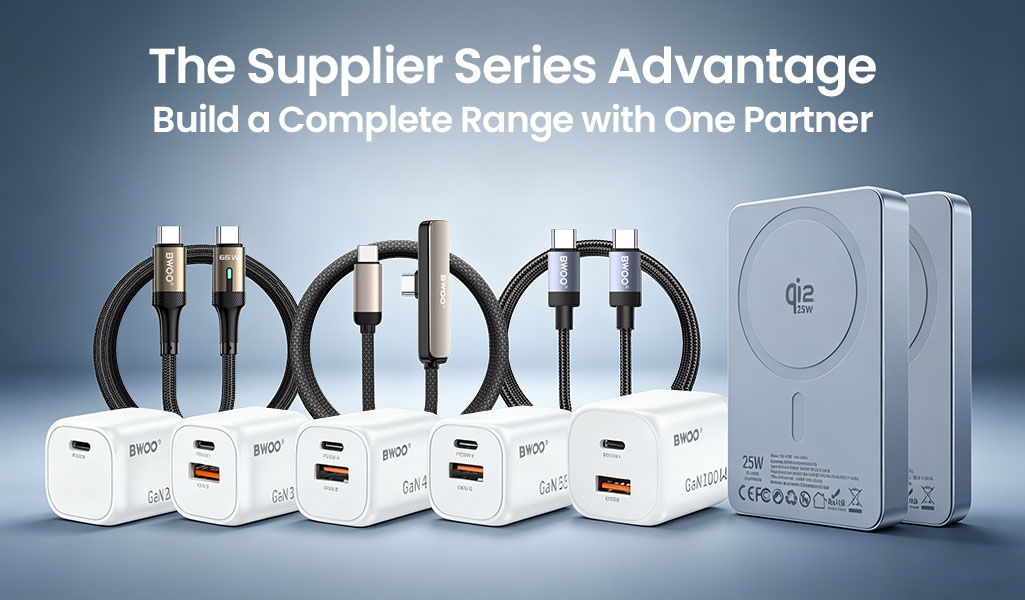
When wholesalers evaluate a new supplier, the first questions usually focus on price, MOQ, and lead time. But in the mobile accessory business, where product lifecycles are short and retail shelves change every season, there is a quieter question that separates good partners from great ones: does this supplier build a complete product line? A supplier with a series-based product portfolio — chargers, cables, wireless chargers, speakers, and trackers that share design language, quality standards, and supply chain discipline — offers advantages that a single-product factory cannot. This guide explains why series-oriented suppliers win on scale, R&D, supply stability, and consistency, and how to build a sourcing checklist around them.
What a Series Product Line Really Means in Mobile Accessories
A product series is more than a list of SKUs with a shared name. It is a coordinated portfolio: each model fills a specific price-performance slot, all models share core components and manufacturing processes, and the whole family carries one consistent design language and quality standard. For a wholesaler, buying from a series-based supplier is like buying from a platform rather than a collection of one-off deals.
Series vs. Single-Product Suppliers
A single-product factory may be excellent at one SKU, but it leaves the wholesaler to stitch together multiple vendors for a complete range. That fragmentation creates hidden costs: different quality bars, different packaging languages, and multiple freight and customs lines. A series supplier consolidates the range, so one purchase order, one quality system, and one brand story cover an entire category.
How Series Architecture Lowers Risk
When models within a series share components and tooling, the supplier's inventory and production planning become more predictable. That predictability flows directly to the buyer in the form of steadier lead times, fewer stock-outs, and faster response to seasonal demand. The supplier's internal failure modes are also better understood, because every new model builds on proven foundations rather than starting from scratch.
Why a Series-Oriented Supplier Wins on Scale
The first structural advantage of a series supplier is scale. Because components are shared across many models, the factory buys materials in higher volumes and negotiates better pricing. The wholesaler benefits from economies of scale without committing to giant single-order volumes.
Capacity and Cost Position
A factory running multiple related production lines can rebalance capacity when one model spikes and another softens. That flexibility protects the wholesaler from the two classic pain points of small suppliers: being unable to scale up for a big retail order, or being stuck with a supplier whose only product is suddenly obsolete.
Component-Level Quality Consistency
Shared sourcing also means shared quality. The same charging IC, the same connector batch, and the same testing fixtures that pass quality checks for one model are reused across the family. For the buyer, this translates into fewer field failures and more predictable complaint rates across the whole range.
The R&D Advantage of a Product Series
A series is a product roadmap made visible. Series-based suppliers invest in a platform and then release variations — new power levels, new port combinations, new form factors — rather than redesigning from zero each time.
Faster Iteration and Faster Time to Market
Because the core architecture is proven, the supplier can bring a new model to market faster and with fewer engineering risks. For wholesalers competing on trend timing — such as catching a new GaN standard or a new Qi generation — that speed is a commercial advantage, not just a convenience.
Complete, Coordinated Upgrades
When a standard shifts, such as a new Bluetooth version or a new wireless charging spec, a series supplier upgrades the entire family at once. The wholesaler's whole range stays current together, instead of ending up with half the SKUs on a new standard and half stranded on the old one. This is especially valuable in 2026, when connectivity and charging standards are moving quickly across categories.
Supply Chain Stability and Delivery Reliability
Buyers rarely see the supply chain behind their orders, but they feel it in lead times and fill rates. Series-oriented suppliers run more stable operations because their production is not hostage to a single product's fortunes.
Better Forecasting and Inventory Buffers
With a full series, demand is diversified across models, so the factory's overall production plan is smoother. That smoothness means the wholesaler is less likely to face a sudden "material shortage" or a long queue behind one hot product. Inventory buffers can be held at the component level and assembled to order, which keeps the buyer's cash less tied up in finished-goods stock.
Fewer Single Points of Failure
If one model has a temporary issue, a series supplier can shift production and keep the rest of the range flowing. A single-product supplier has no such fallback. For B2B buyers whose retail commitments depend on delivery reliability, this resilience is a decisive selection criterion.
Consistency: One Design Language, One Quality Bar
Consistency is the visible face of the series advantage. When every product a wholesaler stocks shares a coherent design language — similar finishing, coordinated colors, a recognizable brand mark — the whole range looks premium and intentional.
Building a Stronger Retail Shelf Story
Retail buyers and end customers read consistency as professionalism. A shelf where chargers, cables, and speakers all look like one family tells a stronger brand story than a random assortment from five factories. For private-label distributors, a series supplier can also coordinate packaging and artwork across SKUs, so the wholesaler's own brand looks complete even before a single unit is customized.
Fewer Support and Quality Headaches
Uniform quality standards mean the distributor's team deals with one set of failure patterns, one warranty process, and one return procedure across the range. That reduces the operational overhead of managing multiple vendors and gives the wholesaler confidence when promising consistency to downstream retailers.
How BWOO's Series Portfolio Delivers This Advantage
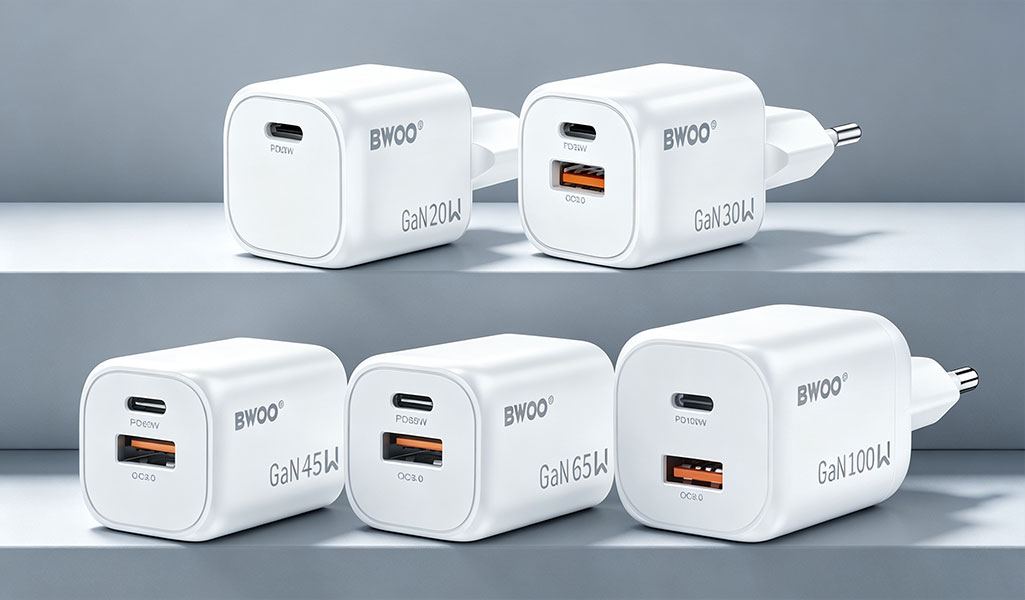
BWOO is built as a series-oriented manufacturer across the mobile accessory categories that wholesalers actually bundle. The clearest recent example is the new BO-CDA281-285 family, five tiers of 2-Port GaN chargers that share one design language and one certification strategy while spanning different power levels and price points. The same logic runs through the wider BWOO range: wireless chargers, data cables, Bluetooth speakers, smart trackers, and power banks are developed as coordinated families rather than isolated products.
This means a wholesaler can build a complete range from one partner — the same packaging language, the same quality bar, and the same stable supply chain from one order to the next. When you build a sourcing checklist around series completeness, BWOO's product families give you a concrete way to verify it. See the full charger series here, the wireless charging family here, and the wireless speakers audio line here.
A Sourcing Checklist for Series-Based Supplier Evaluation
Selection factor | What to check | Why it matters |
Portfolio completeness | Does the supplier cover a full category with coordinated SKUs? | Reduces vendor fragmentation and integration cost |
Shared components | Do models reuse proven platforms and components? | Improves cost position and quality consistency |
Roadmap speed | How fast does the supplier ship a new model or standard upgrade? | Keeps your range current on trend timing |
Supply resilience | Can production shift across models when one SKU spikes or softens? | Protects delivery reliability and fill rates |
Design consistency | Is there a unified design language and packaging system? | Strengthens retail shelf story and brand perception |
Certification strategy | Are series-level certifications reused across models? | Cuts per-model compliance cost and lead time |
Frequently Asked Questions
How is a series-based supplier different from a large generic manufacturer?
A large generic manufacturer makes many products, but often as unrelated SKUs with separate tooling and quality systems. A series-based supplier coordinates a family of products around shared platforms, components, and design standards. That coordination is what produces the scale, R&D speed, supply stability, and consistency described above.
Does buying from a series supplier mean fewer options?
No. Series architecture usually means more useful options, because new models are variations on a proven platform rather than isolated experiments. You get a wider price-performance spread with lower per-model risk and faster availability.
Can a series supplier support private-label branding across the whole range?
Most series-oriented manufacturers offer coordinated OEM and ODM programs. Because packaging, artwork, and finishing follow one system, private-label distributors can extend their own brand across the entire range consistently, which is harder to achieve when mixing multiple single-product vendors.
How do I verify a supplier's series-level certification strategy?
Ask which certifications are held at the platform or family level rather than per model, and request certification copies for several SKUs in the same series. If the same certification structure repeats across models, the supplier can typically add a new series model to certification faster and at lower cost.
Build Your Range Around a Series Advantage
A complete product line is not just a catalog convenience — it is a strategic answer to scale, R&D speed, supply stability, and consistency. Wholesalers who evaluate suppliers on series completeness build ranges that are cheaper to source, faster to refresh, and more convincing on the shelf. BWOO's coordinated families across chargers, wireless charging, audio, and trackers are built exactly for that purpose.
Send Inquiry with your target categories and retail positioning, and the BWOO team will help you assemble a series-based range with stable supply and consistent branding.


