



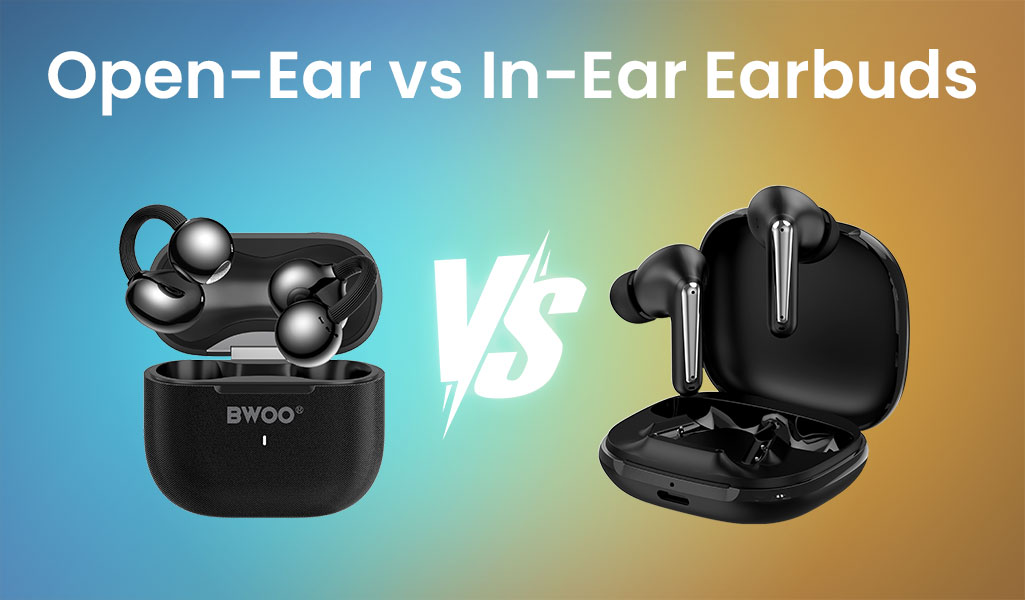
Open-ear and in-ear earbuds can both serve the everyday audio market, but they solve different wearing and listening needs. The right choice depends on where the customer listens, how much outside sound they need to hear, how securely the earbuds fit, and whether isolation is a priority. For distributors, offering both designs can make an audio assortment more useful than treating one style as a replacement for the other.
The category split is also worth watching. In its September 17, 2026 report, Omdia estimated that global true wireless stereo (TWS) shipments fell 0.7% year over year to 82.1 million units in Q2 2026. Within that market, open wireless stereo (OWS) shipments grew 12% to 11.1 million units, reaching 13.5% of total TWS shipments. These shipment figures show a growing product segment, but they do not prove that every consumer or channel will prefer open-ear products.
1. How the two designs differ
Factor | Open-ear design | In-ear design |
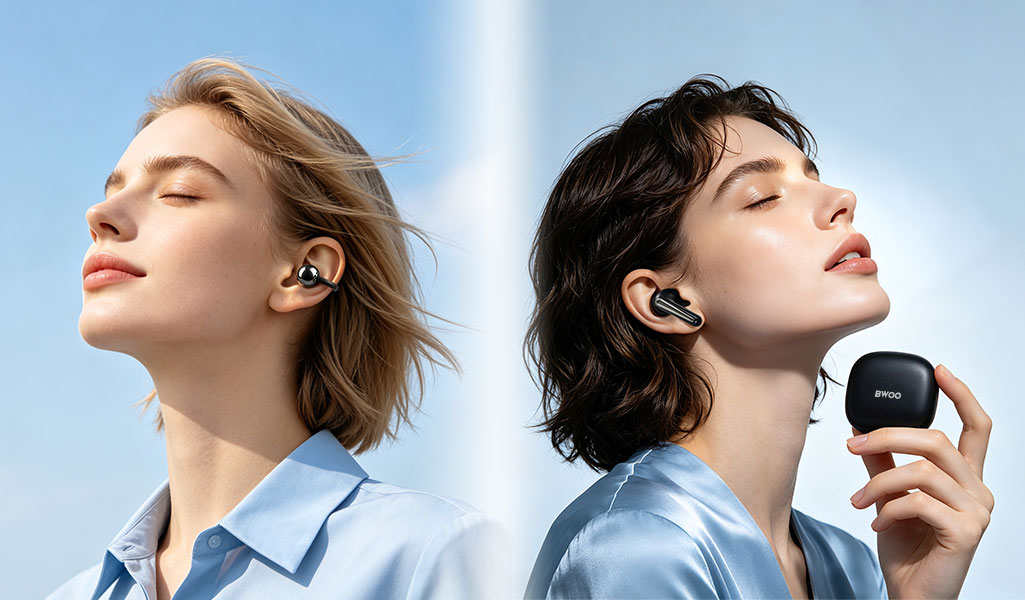
Fit | Rests around or near the outer ear without sealing the ear canal. Fit depends on clip, hook or other structure. | Sits in the ear canal, usually with ear tips or a semi-in-ear form. Fit and seal vary by model. |
Awareness of surroundings | Often allows more outside sound to be heard because the ear canal is not sealed. Actual awareness depends on volume, fit and environment. | A sealed fit can reduce some outside sound; the amount varies by tip design and passive/active noise control. |
Isolation and privacy | Generally less isolation; sound leakage can become noticeable at higher volume or in quiet rooms. | A good seal can improve isolation and reduce leakage, but neither is guaranteed for every model. |
Comfort | May appeal to users who dislike ear-canal pressure, but clip or hook pressure can bother some ears. | Can feel secure and compact, but tip size and long-wear comfort vary by user. |
Typical use cases | Walking, light exercise, office use and situations where hearing nearby sounds is useful. | Commutes, focused listening, calls in noisy places and users who prefer a more compact fit. |
Sound in noisy environments | Ambient noise may compete with audio, so listeners should avoid raising volume excessively. | A better seal may help maintain clarity at lower volume in some environments. |
Neither design is universally better. Open-ear products may suit people who want music while remaining more aware of their surroundings. In-ear products may suit customers who prioritize isolation or a compact earbud profile. Even within one style, drivers, tuning, fit, microphone placement and software processing affect the experience.
2. Match the design to the scenario
Commuting and daily errands
For walking through a city, a customer may value being able to hear traffic cues, announcements or conversations around them. An open-ear design can make that more natural, but it does not guarantee safety: users still need to keep the volume moderate and follow local rules. In a noisy train or airplane cabin, in-ear models may deliver a more immersive experience because the fit can reduce outside sound.
Office work and voice calls
Open-ear earbuds can feel convenient for light calls when a user wants to hear colleagues nearby. In-ear models can be a better fit for shared spaces with steady background noise, depending on microphone quality and noise-reduction performance. Buyers should test call clarity in realistic settings rather than relying only on a microphone count or a feature label.
Fitness and movement
For exercise, fit stability and sweat resistance matter as much as the open-ear or in-ear label. Clip-on and ear-hook formats may keep the earbuds in place for some users, while properly sized in-ear tips can also provide stable retention. Check the exact IP rating and test conditions; do not assume every open-ear product is sweatproof or suitable for every sport.

3. What should B2B buyers check before sourcing?
Fit and wearing structure: request samples from the target audience, including users who wear glasses or move frequently, and collect feedback on comfort over time.
Audio and call performance: listen to music and test calls in a quiet room and a realistic noisy environment. Ask for the conditions behind any noise-cancellation or call-clarity claim.
Battery claims: check whether the stated duration refers to continuous music playback, talk time or total time including charging-case capacity. Use the same test condition when comparing models.
Durability and controls: confirm water-resistance rating, button/touch-control behavior, charging interface and the package contents of the exact model.
Target customer and price band: open-ear and in-ear models can coexist within an assortment. Let customer use cases and sell-through determine the range instead of assuming a single design will replace the other.
As one example of an open-ear option, the BWOO BO-OS02 open-ear wireless earphone lists an open-ear clip design, a 15 mm dynamic driver, BT 6.0 and a stated 15-hour total battery duration, with 7 hours of music playback and 5 hours of talk time under the product's specified conditions. Buyers should verify performance with production samples and use the latest official product data when preparing listings.
Explore the BWOO product catalog to compare audio formats and build a selection that maps to different retail audiences.
Conclusion
Open-ear and in-ear earbuds are best understood as complementary designs. Market shipment data shows that OWS has recently grown faster than the overall TWS category, but the commercial decision still comes down to fit, sound, calls, isolation and the end user's routine. For a durable B2B assortment, define each model's target scenario and verify its performance rather than marketing one wearing style as the universal winner.
FAQ
Are open-ear earbuds better for every active lifestyle?
No. They can help users hear more of the surrounding environment, but fit, volume, local rules and activity type matter. They are not a guarantee of safety.
Do open-ear earbuds prevent sound leakage?
No. Leakage depends on design, fit, volume and the listening environment. Test samples in quiet spaces as well as typical use scenarios.
Do in-ear earbuds always have better sound quality?
No. An effective ear-tip seal can help bass response and isolation, but driver tuning, acoustics and fit all affect perceived quality.
Can open-ear earbuds make calls clearly in noisy places?
They can, depending on microphone placement and processing. Test call samples in realistic noise instead of relying on a feature label alone.
What does OWS mean in market reports?
Omdia uses open wireless stereo (OWS) to describe an open-ear-oriented segment within the broader TWS market. Always check the research provider's category definitions when comparing reports.
To compare open-ear formats with other audio products, visit the BWOO BO-OS02 product page and the BWOO product catalog.


