



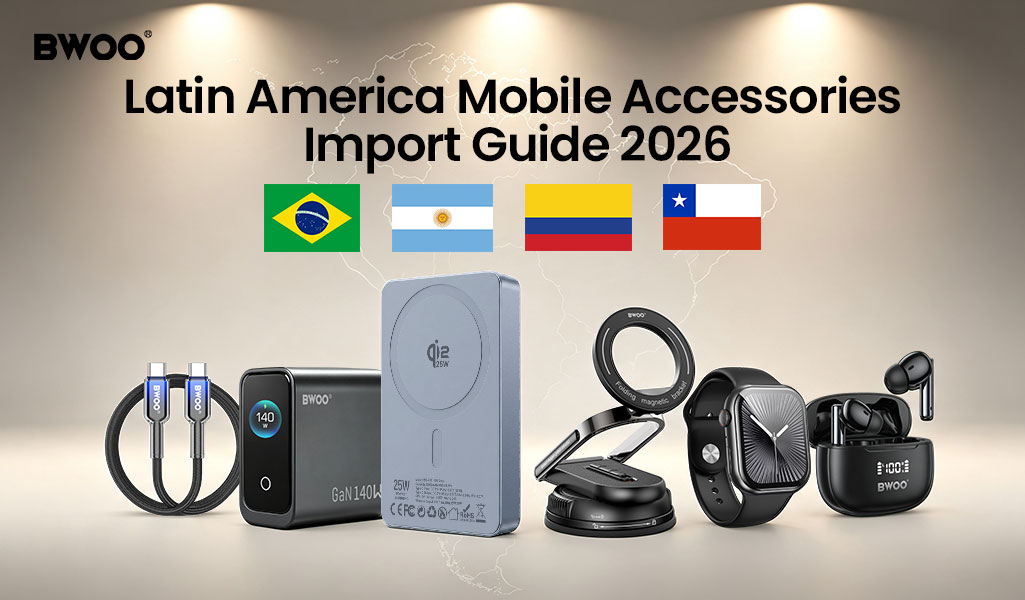
Latin America represents the final frontier in BWOO's regional import guide series, following our coverage of the Middle East market and Southeast Asia market. With a combined population of over 650 million and smartphone penetration exceeding 75% across Brazil, Mexico, and Argentina, Latin America is one of the fastest-growing markets for mobile accessories imports. For B2B distributors and wholesalers targeting this region, understanding the unique regulatory landscape of each country is essential to avoiding costly customs delays and rejected shipments.
This guide covers the three largest Latin American markets—Brazil, Mexico, and Argentina—with a focus on import regulations, certification requirements, tariffs, and logistics considerations for mobile accessories importers in 2026.
Latin America Mobile Accessories Market Overview
The Latin American mobile accessories market is projected to reach $12.8 billion by 2028, growing at a CAGR of 8.2% from 2024. Brazil accounts for approximately 40% of regional demand, followed by Mexico (25%) and Argentina (12%). Key growth drivers include rising smartphone adoption in tier-2 and tier-3 cities, the expansion of e-commerce platforms like Mercado Libre, and increasing consumer willingness to pay for branded accessories over unbranded alternatives.
For B2B importers, the sweet spot is mid-range accessories—products with recognizable branding, proper certifications, and price points 20-30% below premium international brands. BWOO's full product line, with its comprehensive international certification portfolio, is ideally positioned for this market segment.
Brazil: INMETRO Certification and Import Requirements
Brazil is the most regulated market in Latin America for electronics imports. All mobile accessories that connect to mains power—including chargers, power banks, and charging cables—must carry INMETRO (Instituto Nacional de Metrologia, Qualidade e Tecnologia) certification. This is not optional: Brazilian customs will detain and potentially destroy uncertified shipments.
The INMETRO certification process requires: product testing at an INMETRO-accredited laboratory (typically in Brazil, though some international labs have mutual recognition), factory inspection by an INMETRO-authorized body, and registration with INMETRO's database. The full process takes 3-6 months and costs $3,000-$8,000 per product family. For importers, partnering with a supplier that already holds INMETRO certification—as BWOO does for its charger lineup—eliminates this upfront investment.
Brazil also imposes complex import taxes: the IPI (Industrialized Products Tax), ICMS (state-level VAT, typically 12-18%), PIS/COFINS (social contribution taxes at ~9.25%), and the II (Import Tax at 16-20% for electronics). Combined, the effective tax burden on imported mobile accessories can reach 60-80% of the CIF (Cost, Insurance, Freight) value, making competitive pricing challenging. Strategic HS code classification and utilizing Brazil's drawback (tax suspension) programs can reduce the effective rate.
Mexico: NOM Certification and USMCA Advantages
Mexico's regulatory framework is comparatively more accessible for international importers. The key certification is NOM (Norma Oficial Mexicana), specifically NOM-001-SCFI for electronic devices. Power-related accessories require NOM-001 certification, while non-powered accessories (cases, screen protectors, cables) generally need only NOM-024-SCFI for labeling compliance.
Mexico's membership in USMCA (United States-Mexico-Canada Agreement) provides significant advantages for B2B importers. Goods that meet USMCA rules of origin can enter Mexico duty-free, and Mexico's logistics infrastructure—particularly the Laredo/Nuevo Laredo border crossing, which handles 40% of US-Mexico trade—is among the most efficient in Latin America. For importers serving both North American and Latin American markets, Mexico is a natural logistics hub.
Import duties on mobile accessories from China (where Mexico does not have an FTA) range from 0-15% depending on HS classification. However, Mexico's IVA (VAT) at 16% applies universally. Compared to Brazil, the certification burden is lighter: NOM certification typically takes 4-8 weeks and costs $1,500-$4,000 per product family. BWOO's FCC and UL certifications, while not direct substitutes for NOM, often streamline the NOM application process by satisfying technical documentation requirements.
Argentina: IRAM Certification and Import Licensing
Argentina presents the most challenging import environment in Latin America. In addition to IRAM (Instituto Argentino de Normalización y Certificación) safety certification (based on IEC standards with national deviations), importers must navigate the SIMI (Sistema Integral de Monitoreo de Importaciones) licensing system, which requires pre-approval for each import shipment.
Argentina's import restrictions are driven by foreign currency reserve constraints. In 2026, the government maintains strict controls on import volumes through SIMI quotas, and importers must demonstrate that their imports do not negatively impact Argentina's trade balance. For mobile accessories, this means importers should be prepared for: 1) 30-60 day SIMI approval timelines; 2) potential shipment volume caps; and 3) a parallel exchange rate that can make imported goods 30-50% more expensive than the official rate suggests.
IRAM certification for chargers follows IEC 62368-1 with Argentine national deviations. The process takes 8-12 weeks and costs $2,500-$6,000. Import duties on mobile accessories average 16-20%, plus 21% IVA. Despite these challenges, Argentina remains an attractive market due to its high smartphone penetration (over 80%) and strong consumer demand for quality accessories that are not readily available from domestic manufacturers.
Logistics and Distribution: Getting Products to Latin America
Shipping to Latin America requires careful logistics planning. Key considerations include:
Ocean freight from Shenzhen/Yantian to Santos (Brazil) takes 35-45 days; to Manzanillo (Mexico) 20-25 days; to Buenos Aires (Argentina) 40-50 days.
Air freight options through Miami consolidation hubs can reduce transit times to 7-10 days for premium products or time-sensitive launches.
Free Trade Zones: Uruguay's Zonamerica and Panama's Colon Free Zone serve as regional distribution hubs, allowing importers to store goods duty-free and ship to final destinations as needed.
Last-mile delivery in Latin America can be challenging; partnering with regional logistics providers like Mercado Envios (Mercado Libre's logistics arm) or Loggi (Brazil) is recommended.
BWOO: Your Certified Partner for Latin American Markets
BWOO's charger and accessory product lines carry international certifications that serve as the foundation for Latin American market entry. Our IEC 62368-1, FCC, and CE certifications provide the technical documentation required for INMETRO, NOM, and IRAM applications, significantly reducing your time-to-market. Our product catalog spans chargers, power banks, cables, audio accessories, and smartwatch products—all manufactured under ISO 9001 quality management and available with Spanish/Portuguese packaging and documentation.
Frequently Asked Questions
Q: Do I need INMETRO certification for phone cases and screen protectors?
A: No. INMETRO applies only to electrical/electronic products that connect to mains power. Non-powered accessories like cases, screen protectors, and passive cables do not require INMETRO, though they should comply with Brazil's general consumer product safety regulations.
Q: Can I use the same certification for all three countries?
A: No. Each country requires its own national certification: INMETRO for Brazil, NOM for Mexico, and IRAM for Argentina. However, having IEC 62368-1 and FCC certifications significantly streamlines each national application by satisfying technical testing requirements.
Q: What is the best entry strategy for the Latin American market?
A: Start with Mexico as a test market due to lower certification barriers and USMCA advantages. Once established, expand to Brazil (largest market but higher barriers) and then Argentina. Consider using Panama's Colon Free Zone as a regional hub to minimize upfront inventory investment across multiple countries.
Expand your mobile accessories business into Latin America with BWOO's certified product line. Request our Latin America market entry kit, including full certification documentation, Spanish-language product catalogs, and regional logistics recommendations.


