




Why Are Portable Electric Air Dusters Becoming More Relevant?
Dust is easy to ignore until it begins affecting the way a device works.
Keyboards collect particles between the keys. Laptop vents accumulate dust that can restrict airflow. Camera equipment, earbuds, charging ports, car dashboards, and other small surfaces can become difficult to clean with a traditional cloth alone.
This is where a portable electric air duster becomes useful.
Unlike disposable compressed-air cans, an electric air duster uses a motor and battery-powered airflow to move dust and loose particles away from surfaces. According to Grand View Research, the global electric air duster market was estimated at USD 334.9 million in 2026 and is projected to reach USD 586.7 million by 2033, representing a 8.3% CAGR. The research also identifies electronics cleaning as the largest application segment, while cordless models accounted for 69.0% of market revenue in 2025.
That makes the category relevant not only to consumers, but also to electronics retailers, computer accessory channels, repair shops, and distributors looking for practical complementary products.
What Can You Clean With an Electric Air Duster?
A portable electric air duster is most useful when dust or small loose particles are trapped in areas that are difficult to reach manually.
Cleaning Target | Typical Problem | Why Airflow Helps | Suitable Use |
Keyboard | Dust between keys | Blows particles out of narrow gaps | Home, office, gaming |
Laptop vents | Dust around ventilation openings | Reaches recessed areas | PC maintenance |
Desktop PC | Loose dust inside the chassis | Reaches corners and openings | DIY and maintenance |
Camera body | Fine dust around buttons and gaps | Non-contact cleaning | Photography |
Earbuds & cases | Fine particles around small surfaces | Reaches small gaps | Daily maintenance |
Phone exterior | Dust around speakers and seams | Contact-free surface cleaning | Everyday use |
Car interior | Dust around air vents and seams | Handles hard-to-reach areas | Automotive |
Desk equipment | Dust around ports and corners | Faster than wiping every gap | Office |
Small appliances | Surface and opening dust | Useful for recessed areas | Home maintenance |
The most important distinction is that an air duster is designed primarily to move loose dust and debris with directed airflow. It is not a universal replacement for a brush, cloth, vacuum, or chemical cleaner.
1. Cleaning Computer Keyboards
Keyboards are one of the easiest places to understand the value of an air duster.
Dust, hair, crumbs, and other particles can fall between keys where a cloth cannot reach. Repeated typing then pushes those particles deeper into the keyboard.
A portable electric air duster can be used to direct airflow between keycaps and around the outer edges of the keyboard.
Best practice
Before cleaning: - Disconnect the keyboard or shut down the computer. - Hold the keyboard at an angle where appropriate. - Use short bursts rather than continuously blasting one area. - Direct particles away from other sensitive equipment. - Finish with a soft brush or cloth if surface residue remains.
For gaming keyboards, mechanical keyboards, and office keyboards, this creates a simple maintenance routine that can be repeated regularly.
2. Cleaning Laptop Vents and PC Components
Heat management is one reason dust matters in computing equipment.
A laptop or desktop computer relies on airflow through vents and cooling structures. Dust accumulation does not automatically mean a device will overheat, but keeping external ventilation areas free of dust is a practical part of routine maintenance.
An air duster can help clean: - Laptop ventilation openings - Desktop case vents - Exterior fan grilles - Heat sink surfaces - USB ports and connection areas - Monitor ventilation openings
For internal PC maintenance, users should follow the equipment manufacturer’s maintenance instructions. Fans should also be handled carefully rather than being spun unnecessarily at very high speed.
The key idea is simple: airflow is most useful for removing loose particles, not for replacing proper hardware maintenance.
3. Cleaning Phones, Earbuds and Small Electronics
Modern electronics often contain small gaps that are inconvenient to clean manually.
Examples include: - Speaker grilles - Charging-port areas - Earbud cases - Keyboard switches - Camera accessory mounts - Cable connectors - Smartwatch straps and external surfaces
For these applications, the main benefit is contact-free cleaning.
A cloth requires physical access to the surface. A brush may not reach a narrow opening. An electric air duster can direct airflow into areas where physical tools are inconvenient.
However, users should avoid forcing debris deeper into an opening. The purpose of cleaning is to move contamination out and away from the device.
4. Camera and Photography Equipment
Camera equipment is another useful application because fine particles can be difficult to handle safely.
An air duster can be useful for cleaning: - Camera body surfaces - Lens exterior areas - Tripod connection areas - Camera bags - Small accessories - External buttons and switches
The important distinction is between external dust removal and sensor cleaning.
Camera sensors require specialized procedures. A general-purpose electric air duster should not automatically be treated as a substitute for manufacturer-approved sensor-cleaning equipment.
For consumer accessory content, this is an important point because product capability should not be exaggerated simply to increase the number of use cases.
5. Car Interior Cleaning
The use case extends beyond electronics.
Automotive interiors contain many narrow spaces: - Dashboard seams - Air vents - Seat rails - Console gaps - Door-panel gaps - Around switches and buttons
A portable electric air duster can help loosen dust before it is wiped or vacuumed away.
This is particularly useful for users who want one compact maintenance tool that can move between the office, home, computer desk, and car.
Air Duster vs. Traditional Compressed Air
The shift from disposable compressed-air cans toward reusable electric tools is one reason the category is attracting attention.
Factor | Electric Air Duster | Disposable Compressed Air |
Power source | Rechargeable battery or external power | Pressurized can |
Reusability | Designed for repeated use | Single-use container |
Airflow control | Often adjustable | More limited |
Long-term convenience | High | Requires replacement |
Portability | High for cordless models | High |
Electronics cleaning | Strong use case | Strong use case |
Waste after use | Lower recurring container waste | Requires disposal |
Initial cost | Higher | Lower |
The purpose is not to claim that one solution is always superior.
For occasional cleaning, a traditional compressed-air product may still be adequate. For users who clean electronics frequently, a reusable electric solution can make more sense from a convenience perspective.
What Should Buyers Look for in a Portable Electric Air Duster?
A strong product is not defined by motor speed alone.
For B2B buyers, the following specifications deserve more attention.
Evaluation Factor | What to Check | Why It Matters |
Airflow | Strength and stability | Determines actual cleaning performance |
Motor | Motor type and efficiency | Affects performance and durability |
Speed control | Multiple levels if available | Helps match different surfaces |
Battery | Capacity and charging method | Determines operating convenience |
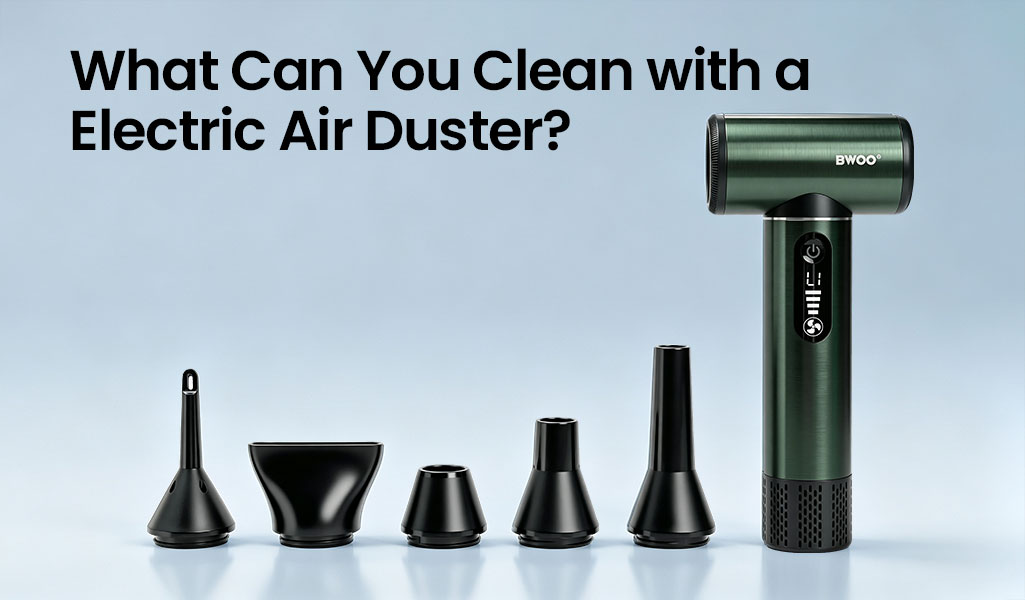
Nozzles | Number and shape | Expands application range |
Noise | Operating noise level | Important for home and office use |
Ergonomics | Weight and grip | Influences repeated use |
Thermal control | Heat management | Important during continuous operation |
Housing | Material and structure | Affects durability |
Accessories | Nozzles, brushes, storage | Adds practical value |
Safety | Protection and charging design | Important for consumer distribution |
For a B2B buyer, the product should be evaluated as a complete use-case solution, not simply by the headline motor specification
What About High-Speed Air Dusters?
High-speed motor technology has become an important product-development direction in this category.
A stronger airflow can be useful for stubborn dust, PC maintenance, keyboards, car interiors, and workshop applications. But higher airflow also means the product needs to be evaluated for: - Airflow stability - Heat generation - Battery endurance - Noise - Nozzle design - User control - Mechanical durability
In other words, maximum speed is only one specification.
For distributors, a balanced product is often easier to position because it can cover multiple scenarios rather than serving only one extreme use case.
A More Useful Way to Position the Product
Instead of selling an electric air duster simply as a “high-speed blower,” retailers and distributors can position it around specific problems.
Positioning 1: Electronics Maintenance — Clean keyboards, laptops, PC vents and small electronics without disposable air cans.
Positioning 2: Home Office Cleaning — Keep desks, keyboards, monitors and workstation equipment cleaner with one compact tool.
Positioning 3: Automotive Cleaning — Reach dashboard gaps, vents and difficult-to-clean interior spaces.
Positioning 4: Multi-Use Personal Tool — One rechargeable cleaning tool for electronics, home and car maintenance.
This creates more opportunities for product placement across different retail categories.
Portable Electric Air Duster: A Practical B2B Product Opportunity
The electric air duster market is still much smaller than mainstream categories such as chargers or power banks, but its use cases overlap naturally with electronics and mobile-accessory channels.
That makes the category interesting for distributors looking to expand beyond traditional charging products.
The opportunity is particularly relevant when the product offers: portable design + reusable operation + multiple nozzles + strong airflow + easy storage + multiple cleaning scenarios.
Rather than treating it as a niche cleaning gadget, distributors can position it as a complementary accessory within a broader electronics lifestyle product range.
Conclusion
A portable electric air duster can be useful across far more situations than keyboard cleaning alone.
Its strongest applications include electronics maintenance, PC cleaning, camera equipment, small accessories, office equipment and automotive interiors.
The market data also supports the category's growing relevance: Grand View Research estimates an 8.3% CAGR from 2026 to 2033, with electronics cleaning representing the leading application segment.
For buyers, the key is not simply choosing the product with the highest advertised airflow. A better evaluation considers airflow, battery performance, nozzle design, noise, ergonomics, durability and safety together.
FAQ
What is a portable electric air duster used for?
It is mainly used to remove loose dust and debris from keyboards, computers, electronics, cameras, car interiors and other hard-to-reach spaces.
Can an electric air duster replace a vacuum cleaner?
No. An air duster moves dust with airflow, while a vacuum removes and collects debris. They serve different purposes.
Is an electric air duster better than compressed air cans?
For frequent users, the reusable electric format can offer greater convenience and less recurring container waste. However, suitability depends on the application.
Can I use an air duster on a laptop?
It can be useful for external vents and accessible areas, but the laptop should be powered off and users should follow manufacturer maintenance recommendations.
What matters most when buying an electric air duster?
For B2B procurement, evaluate airflow, motor performance, battery life, speed control, nozzle selection, noise, ergonomics and safety rather than focusing on one headline specification.


