



A weaker smartphone shipment quarter does not automatically mean that every mobile accessory category will decline. For distributors, the more useful question is how changing device shipments, retail demand and regional price sensitivity affect the mix of accessories customers are likely to buy.
Counterpoint Research's preliminary estimate for Q3 2026 showed global smartphone sell-in shipments falling 20% year over year, the lowest Q3 level since 2012. The research firm linked the decline to memory shortages, higher DRAM and NAND costs and supply constraints. It also described a widening gap between premium and price-sensitive market segments.
However, a separate early-sales signal shows why the market should not be read as one uniform trend. Reuters reported on October 27, citing Counterpoint, that iPhone 18 Pro series sales during the first three weeks after launch were 3.1% higher globally than the comparable iPhone 17 Pro period. China was up 29%, while the United States was down 4% and Japan down 27%. This is a specific early-sales comparison for the Pro series, not a measure of all smartphone demand.
For mobile accessory buyers, the message is not to increase or reduce every category by the same percentage. It is to plan around regional device mix, replacement behavior, price bands and the difference between universal accessories and model-specific products.
1. Separate Shipments from Retail Demand
A shipment report measures devices entering the channel, while sell-through measures what consumers actually purchase. The two can move differently because of inventory adjustments, supply availability, launch timing, pricing and retailer replenishment. A fall in sell-in shipments should therefore trigger a closer review of local market data—not an automatic 20% reduction in accessory orders.
For distributors, useful signals include recent retailer sales, reorder frequency, stockouts, returns, device model mix and the price bands customers still accept. When possible, compare the same sales channel and region rather than relying on a single global headline.
2. Divide the Accessory Range into Universal and Model-Specific Products
Universal or broadly compatible accessories may be less dependent on one smartphone launch. Chargers, USB-C cables and many power banks can serve multiple device generations, provided the specifications and supported protocols match the connected devices. This makes them useful core products, although demand and price competition still vary by channel.
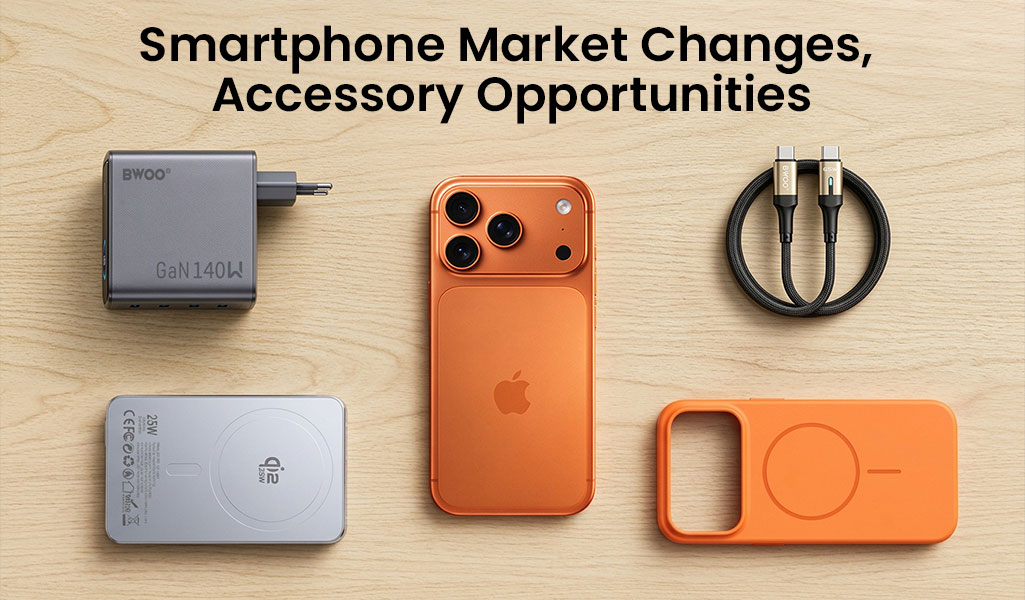
Examples from the BWOO range include the BO-CDA265 67W three-port GaN Smart Display Charger, the BO-P85 Qi2.2 25W magnetic power bank, and the BO-P84 Qi2 15W 5000mAh magnetic power bank. They represent different charging and mobility needs; distributors should match the exact output, charging protocol and supported devices to their own customer base.
Model-specific accessories have a different demand pattern. Cases and screen protectors need accurate dimensions, camera openings, button positions and edge coverage. A launch can create a concentrated window for new model-specific SKUs, but buyers should validate fit and confirm the likely installed base before committing to large quantities.
For model-specific protection, BWOO's BO-KI17M701 Magnetic Clear Phone Case for iPhone 17 and BO-KI17M703 All-Around Defense Phone Case for iPhone 17 show why fit and compatibility should be treated as model-specific. For in-car use, the BO-ZJ163 15W wireless charging magnetic car phone holder is another example of an accessory that can serve the same smartphone installed base across device generations, subject to phone and vehicle compatibility.
Accessory group | What can drive demand | What buyers should verify |
Chargers and cables | Daily replacement, device charging needs, multi-device use | Output protocols, power rating, cable specification and compatibility. |
Power banks | Travel, commuting, backup power and multi-device use | Capacity, rated output, charging method, size and relevant battery documents. |
Cases and screen protectors | New model launches and replacement of worn protection | Exact device model, dimensions, camera layout, screen shape and case fit. |
Car accessories | Navigation, hands-free use and in-car charging | Mounting position, phone size, charging method and vehicle socket compatibility. |
3. Regional Mix Matters More Than a Single Global Average
The early iPhone 18 Pro sales data illustrates how the same launch can perform differently across markets. China's stronger first-three-week result and the weaker comparisons in the United States and Japan suggest that regional pricing, supply and customer response should be reviewed separately. This does not establish a universal trend for every smartphone brand; it is a reminder to avoid copying one market's SKU plan into another.
Before adding a model-specific accessory range, distributors should check:
Which smartphone brands and model families are most common in the target channel?
Are customers buying flagship devices, mid-range models or budget devices?
Are local customers prioritizing protection, fast charging, magnetic convenience or lower-cost basics?
How quickly can the distributor validate a new accessory sample and replenish proven SKUs?
Do product images and listings identify the supported device models clearly?
4. Build Accessory Plans Around the Device Lifecycle
A useful assortment combines products that serve a device throughout its ownership period. A customer who buys a new phone may need a case and screen protector immediately, while charging cables, wall chargers, car holders and power banks can remain relevant as daily-use accessories. Some customers will replace protection products during the year even when they do not replace the phone.
This is why the accessory opportunity is not limited to launch week. A distributor can keep core charging products available across model generations, then add model-specific protection products according to local demand. For a practical example of the launch-related compatibility issues, see BWOO's iPhone 18 accessories guide for B2B buyers. For broader seasonal planning, the related 2026 holiday mobile accessory planning article discusses how forecasts should be balanced with actual SKU-level sales.
5. A More Resilient Planning Approach for Distributors
Instead of reacting to a single shipment headline, review the assortment in three groups:
Core universal products: keep a focused range of charging and power accessories that match several device generations.
Model-specific products: introduce cases and screen protectors only after physical samples and compatibility details are checked.
Market-specific opportunities: adjust colors, feature levels and price tiers using local sales and customer requests.
Review sell-through and reorder data regularly. If a flagship model performs well in one market but not another, the accessory mix should reflect that difference. Keep the first order proportionate to evidence and preserve flexibility for replenishment.
Conclusion
Q3 2026 smartphone shipments show that the global device market is under pressure, but early sales of specific flagship models also show that demand can vary sharply by region. Mobile accessory distributors should not translate a smartphone shipment decline directly into a forecast for every accessory. A more useful strategy is to separate universal from model-specific products, assess local device mix and adjust the range with real sell-through information.
Explore BWOO's Power Bank, Charger, Data Cable and Phone Case collections to review accessory options for different device and channel needs.
FAQ
Does a 20% decline in smartphone shipments mean accessory sales will also fall 20%?
No. The Counterpoint figure is a preliminary global sell-in shipment estimate for smartphones, not retail sell-through and not accessory sales. Accessory demand depends on device mix, installed base, replacement behavior, channel inventory and local customer needs.
Why can smartphone demand differ by country?
Pricing, supply, exchange rates, promotions, local brand preference and the mix of flagship versus mid-range devices can all influence market performance. Buyers should use regional data where possible.
Which accessories are less dependent on a new phone launch?
Chargers, cables and many power banks can serve multiple device generations, provided specifications and compatibility are appropriate. Cases and screen protectors generally require exact model validation.
Should distributors stock every accessory for a new smartphone immediately?
Not necessarily. Validate samples, identify the most relevant device models and price bands, then scale orders based on customer demand and sell-through.
How often should an accessory assortment be reviewed?
Review it whenever important device launches, regional price changes, stockouts or clear changes in sell-through occur. A monthly review can be a useful operating rhythm, but the best frequency depends on sales velocity and replenishment lead time.


