



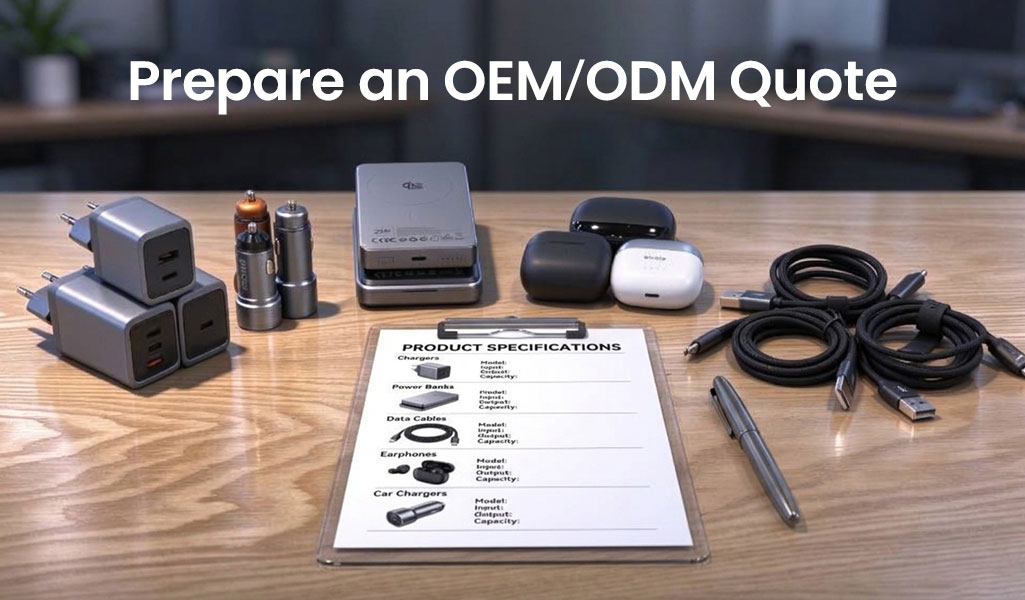
A useful OEM/ODM quotation starts with a clear brief. If a buyer sends only a product photo and asks for the lowest price, the supplier may have to guess the target specification, order quantity, branding scope and destination market. Those missing details can lead to incomparable quotations, unexpected tooling or packaging costs, and avoidable delays later.
Before contacting a supplier, prepare a short request for quotation (RFQ) that explains the product you need, where it will be sold, how much you expect to order and what should be customized. You do not need a finished engineering package for every project. You do need enough information for the supplier to identify a suitable existing model or explain what additional development would be required.
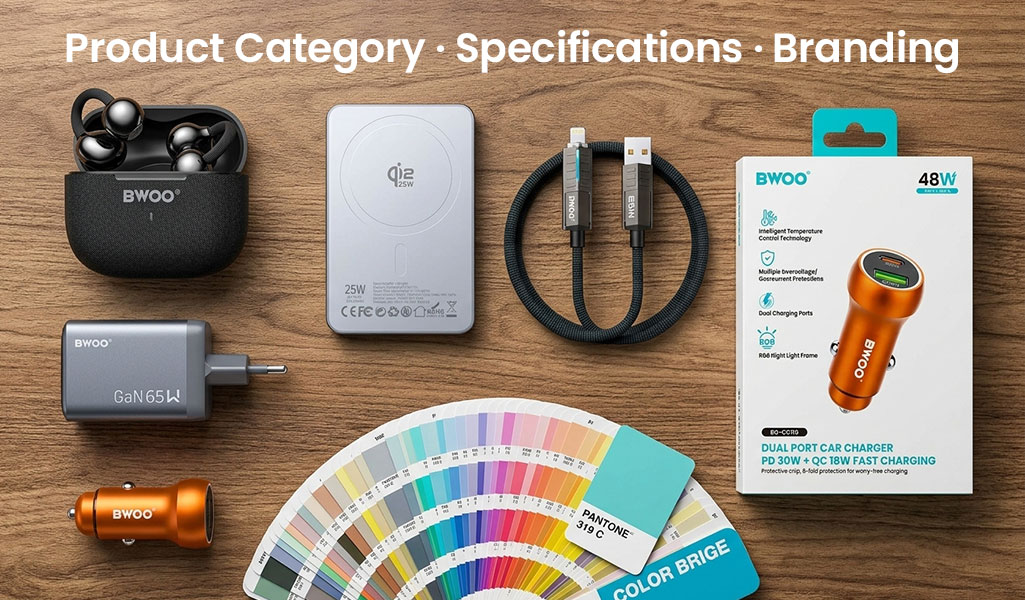
The Eight Details That Make an RFQ More Useful
1. Product category and reference model
Start with a precise product type: for example, a 65W USB-C charger, a magnetic power bank, a USB-C charging cable with an LED display, or a retractable cable car charger. If a supplier's current model looks suitable, include the model number or product-page link. If you have a reference sample, photo, drawing or competitor product specification, identify what is a must-have requirement and what is only a visual reference.
2. Target market and sales channel
State the destination country or countries and the channel you plan to use, such as regional distribution, retail, e-commerce, corporate gifting or a brand-owned website. This affects plug type, packaging language, labels, relevant compliance evidence and the way the product should be positioned. If the target countries are still being finalized, say so rather than presenting an assumption as a fixed requirement.
3. Quantity range and launch plan
Give the anticipated first order quantity or a reasonable range, along with an estimate of future reorder potential if you have one. A supplier needs to know whether you are evaluating a small trial, a standard wholesale order or a project that may require a custom mold or other non-recurring cost. Do not assume the same MOQ applies across power banks, chargers, cables and audio products; request the MOQ for the exact model and customization level.
4. Technical requirements
List the specifications that matter: interfaces, output power, supported protocols, dimensions, material, colors, display or lighting features, battery capacity, cable type, data-transfer needs, supported devices, or other must-have features. Avoid vague words such as “fast,” “premium” or “universal” unless you also define what they mean in measurable terms. If you are uncertain, label the item as a question for the supplier instead of inventing a requirement.
5. Customization scope
Separate branding from engineering. Logo printing and custom packaging may be different from changing the enclosure, color, cable length, output behavior, firmware or internal design. Tell the supplier which level you need: existing model with a logo, existing model with packaging changes, selected specification changes, or a new design. This helps the supplier identify possible tooling, test, artwork and minimum-quantity implications.
6. Packaging and brand assets
Prepare the logo in the requested file format, brand colors, packaging language, required warnings, barcode/serial-number expectations and any artwork guidelines you already have. If the artwork is not ready, state who will provide it and by when. If the supplier is asked to help with packaging, clarify whether you need a design proposal, dieline, mock-up or just printing against supplied artwork.
7. Compliance and documentation
Name the target market and ask what model-specific documents are available or required. Depending on the product and market, relevant items may include safety or EMC test reports, declarations, material information, battery transport documentation, quality-system records and other evidence. A supplier should not be asked to promise “all certifications worldwide”; the exact documents depend on product design, claims and destination.
8. Timing, shipping and commercial terms
State the target sample date, required in-market date, expected shipping destination and preferred Incoterms if known. Ask for the current sample schedule, estimated mass-production lead time, payment terms and shipping options for the actual quantity. A target launch date helps the supplier identify whether a standard model is more realistic than a new design.
RFQ Preparation Table
RFQ field | What to include | What it helps clarify |
Product | Category, model number or reference image; required quantity of product types. | Whether an existing model is suitable or new development is needed. |
Market & channel | Countries, sales channel, retail/customer profile and target price range if known. | Compatibility, labelling, compliance and positioning. |
Quantity | Trial order estimate, expected reorder range and target launch timing. | MOQ, price tier, setup cost and production planning. |
Specifications | Must-have features, interfaces, power, capacity, dimensions, material and color. | Technical fit and comparable quotations. |
Customization | Logo, colors, packaging, spec changes, tooling or new design. | Work scope, non-recurring costs and sample requirements. |
Documents | Required reports/certificates and questions about applicable standards. | What evidence exists for the exact model and target market. |
Sample & quality | Number of samples, test scenarios, acceptance criteria and packaging approval. | How product approval will be assessed. |
Delivery & terms | Destination, Incoterms if known, required date and payment requirements. | Schedule feasibility and landed-cost calculation. |
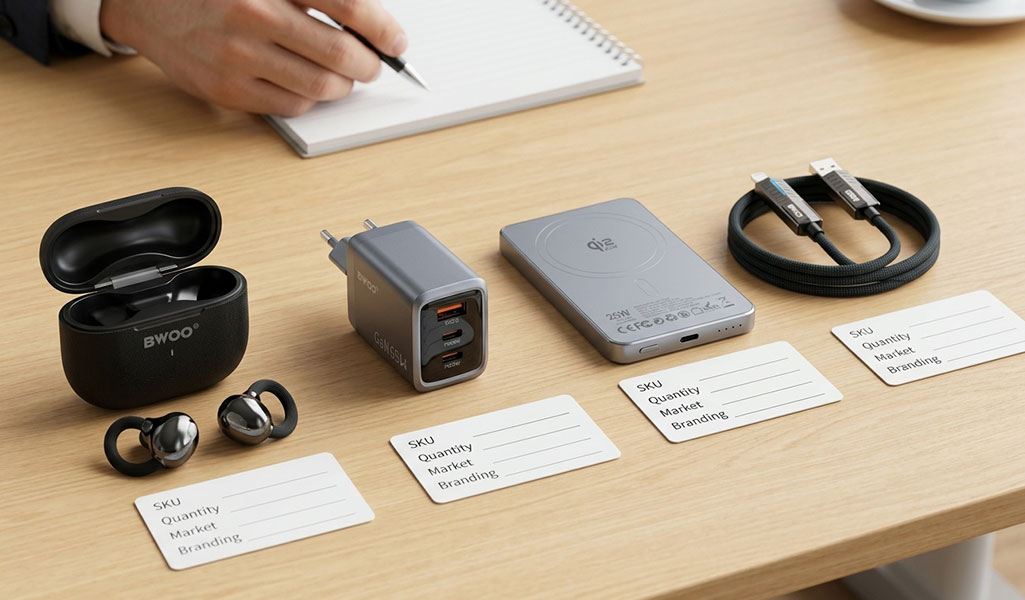
A Copy-Ready RFQ Message
Use the following as a starting template and replace each bracketed field with the information you know. It is acceptable to mark undecided items as “please advise” rather than guessing.
Subject: RFQ – [Product Category / Model] for [Target Market]
Hello BWOO Team,
We are evaluating [product category / model] for [country or market] and would like to request a quotation.
- Product / reference model: [model or product link]
- Initial quantity: [quantity or range]
- Expected reorder volume: [if known]
- Target market and channel: [country / distributor / retail / online / brand project]
- Required specifications: [ports, power, capacity, features, colors, material]
- Branding and packaging: [logo only / custom packaging / specification changes]
- Compliance documents: [requirements or documents to review]
- Sample requirement: [quantity and key tests]
- Target sample and delivery dates: [dates]
- Delivery destination / Incoterms: [details]
Please advise the suitable model, MOQ, unit price by quantity tier, sample cost and timing, customization costs, available documentation and estimated lead time. If any requirement is not feasible with a standard model, please identify the alternatives.
Best regards,
[Name / Company / Contact details]
How This Fits into the Full OEM/ODM Process
Preparing an RFQ is the entry point, not the entire project. After the initial quote, a buyer may still need to compare model options, validate samples, approve artwork, confirm documentation, agree inspection criteria and align on delivery terms. BWOO's existing OEM/ODM Complete Guide: From Sampling to Bulk Delivery covers the ccwider journey; this article is intended to help buyers send a clearer first request.
Buyers who are still exploring brand and supplier options can start with the mobile accessory brand comparison guide. Once the project scope is clearer, use the relevant charger, power bank or data cable category to select specific reference models.
Conclusion
A good RFQ does not have to be long; it has to remove ambiguity. The product, target market, quantity, specification, customization scope, documentation needs and timing should be clear enough for the supplier to identify the next step. A more complete enquiry helps both sides compare options and reduces the risk of discovering critical requirements after the quotation has been issued.
When you are ready, submit the scope through the BWOO OEM/ODM page or contact form, and include the information available at this stage.
FAQ
Do I need complete product drawings before requesting a quote?
Not always. For an existing model with branding or packaging changes, a model number and clear requirements may be enough to begin. A new design or technical change usually requires more detailed specifications.
Should I state an exact order quantity?
Give the most useful estimate available. A range can help suppliers quote tiers, but the final purchase order should confirm exact quantities and terms.
Can I request OEM/ODM for any product in a catalogue?
Do not assume so. Ask whether the exact product supports logo, packaging, specification changes or new development, and confirm the MOQ, cost and feasibility for each option.
Which compliance documents should I request?
That depends on the product and target market. Tell the supplier where the product will be sold and ask which model-specific documents are available and which additional testing may be needed.
How does this RFQ checklist differ from an OEM/ODM process guide?
This checklist focuses on the information needed to start a quotation. The full OEM/ODM guide explains later stages from sampling to delivery.


