



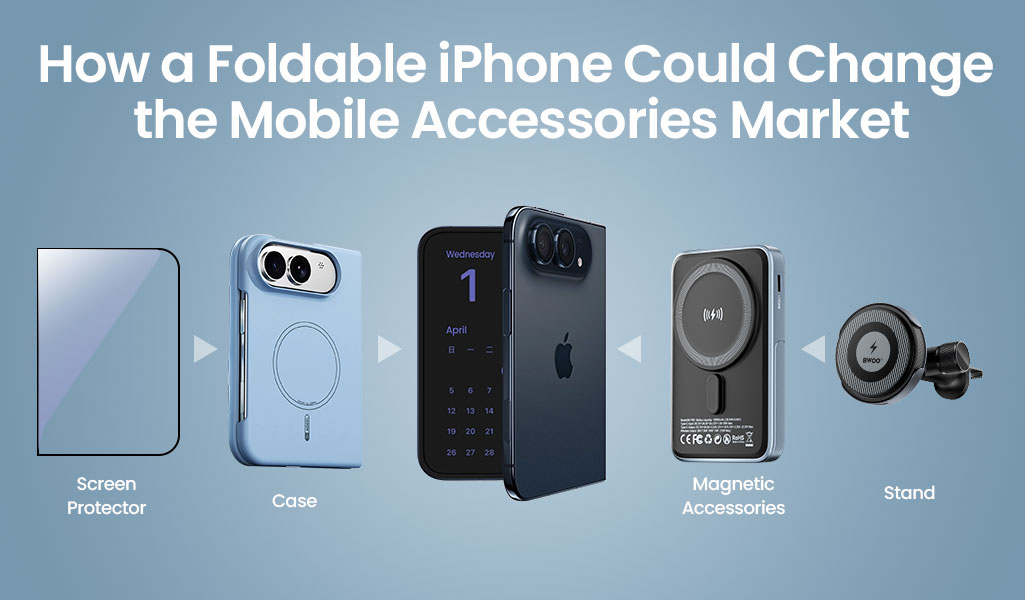
Cover Image / Featured Image: Use the same image for both the blog cover and the first image. Recommended cover concept: An abstract foldable smartphone silhouette surrounded by accessory outlines such as a protective case, hinge area, wireless charger, power bank and stand. Avoid using Apple's logo or official product photography.
Apple Has Entered the Foldable Smartphone Market
On September 9, 2026, Apple officially introduced its first foldable smartphone, the iPhone Duo.
Apple describes the device as a book-style foldable iPhone with a 7.6-inch inner display and a 5.4-inch outer display. The company also highlights a precision hinge and a design intended to combine a large-screen experience with a pocketable folded form.
Reuters reported that the device launched at $1,999, making it a premium product positioned at the high end of the smartphone market.
For the mobile-accessories industry, the significance is bigger than one new phone model.
A foldable iPhone introduces a different physical structure.
And whenever the physical structure of a smartphone changes, accessory design must change with it.
The likely impact will be felt across: phone cases, screen protection, hinges, charging accessories, magnetic accessories, stands, holders, bags and travel products.
Why a Foldable iPhone Is Different for Accessory Manufacturers
A conventional smartphone has a relatively simple accessory geometry: one body + one display + fixed camera area + standard charging position.
A foldable smartphone adds: hinge + two display sections + changing dimensions + folding clearance + moving components.
This creates new engineering requirements.
Accessory Category | Traditional Smartphone | Foldable Smartphone |
Case | Fixed shell | Must accommodate folding |
Screen Protector | One main screen | Multiple display surfaces |
Camera Protection | Fixed module | Different positioning/clearance |
Hinge Protection | Usually irrelevant | Critical design area |
Stand | Flat phone geometry | Different center of gravity |
Car Holder | Standard dimensions | Width/thickness considerations |
Power Bank | Conventional attachment | Attachment surface may differ |
Magnetic Accessories | Back alignment | Folded/open position must be considered |
Bag/Pouch | Standard phone size | Greater folded thickness |
The result is not simply “a new phone case.” It is a new accessory architecture.
1. Foldable Phone Cases Will Need New Design Thinking
Traditional cases often use a single-piece or relatively simple dual-layer structure.
Foldable phones cannot always use the same approach.
The case needs to protect the device without preventing the hinge from functioning.
That creates several design challenges.
Hinge Clearance — A foldable case must leave sufficient space for the hinge mechanism to move. Too much material can interfere with folding. Too little protection can expose the hinge to impact or particles.
Folding Stress — When the phone opens and closes repeatedly, the case itself experiences movement. The case material therefore needs an appropriate balance between: flexibility + durability + dimensional stability.
Open and Closed Protection — The accessory should remain functional in both configurations. This can influence: Case thickness, Hinge coverage, Camera cutouts, Edge protection, Grip, Magnetic attachment, Wireless charging compatibility.
2. The Hinge Could Become a New Accessory Design Category
The hinge is perhaps the most interesting new component from an accessory perspective.
Apple describes the iPhone Duo as featuring a precision hinge designed for repeated folding and unfolding.
For accessory manufacturers, that immediately raises questions: How should the hinge be protected?
There is no universal answer yet.
Possible approaches include: - Flexible protective sections - Sliding hinge covers - Segmented protection - Raised edge structures - Dust-management solutions - Reinforced frame construction
But any hinge-protection mechanism must work without restricting the device’s folding movement.
This creates an opportunity for accessory suppliers with stronger industrial-design and tooling capabilities.
3. Screen Protection Becomes More Complicated
Screen protection has historically been one of the largest phone-accessory categories.
Foldable phones change that equation.
A book-style foldable phone has at least two major display surfaces: outer display + inner folding display.
The inner display introduces a different physical requirement from a conventional rigid smartphone screen.
An accessory manufacturer therefore needs to consider: - Flexibility - Adhesion - Surface durability - Folding cycles - Installation precision - Compatibility with the hinge - Touch performance - Bubble formation - Long-term deformation
This means foldable screen protection may become a specialized accessory category rather than simply another size of tempered glass.
4. Charging Accessories Must Adapt to New Usage Patterns
A foldable phone changes not only how the device looks, but also how users interact with it.
A user may use the phone: folded → for quick communication, and then: opened → for reading, multitasking, video or productivity.
That creates opportunities for accessories that support both modes.
Charging Stands — A charging stand needs to accommodate the phone’s changing center of gravity.
Magnetic Chargers — The position and strength of magnetic alignment become more important when the phone has multiple physical sections.
Power Banks — A magnetic power bank must remain stable when attached to a thicker or differently shaped device.
Cable Position — Cable placement can become more important when the phone is used in both open and folded states.
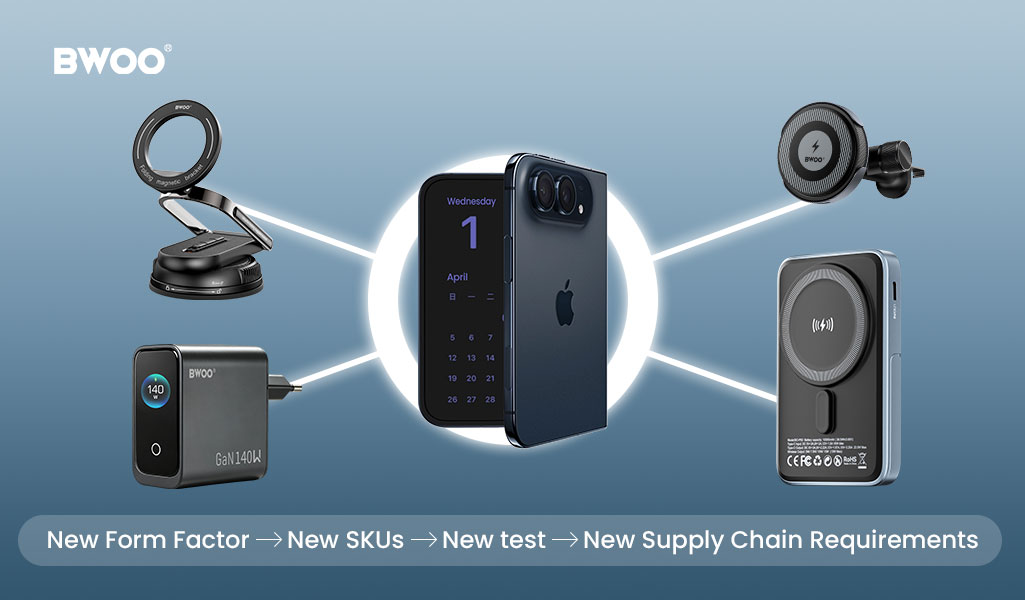
BWOO already has a range of magnetic charging and power products that can provide relevant internal content pathways.
For example, its 10000mAh Magnetic Wireless Power Bank with Foldable Holder combines magnetic charging with a stand function.
Another relevant product is the BWOO 15W 3-in-1 Wireless Charging Station, designed to charge a smartphone, smartwatch and earbuds in one setup.
5. Magnetic Accessories May Need to Evolve
Magnetic accessories have become an increasingly important part of the mobile-accessory ecosystem.
BWOO's existing content already discusses the broader Magnetic Ecosystem 2026, including magnetic power banks and car mounts.
The foldable-phone opportunity adds another question: Can a magnetic accessory remain useful across both folded and unfolded configurations?
That could influence future product designs such as: - Foldable magnetic stands - Adjustable magnetic holders - Dual-position charging stations - Magnetic power banks with flexible positioning - Multi-angle desktop stands
The industry may therefore move from simple magnetic attachment toward adjustable magnetic ecosystems.
6. Car Holders Face a New Design Challenge
A conventional phone mount usually assumes a relatively predictable: width + thickness + center of gravity.
Foldable phones challenge these assumptions.
A car mount must be stable when: - The phone is folded - The phone is partially opened - The user changes orientation - The device becomes thicker - The center of gravity changes
For accessory designers, this favors: strong magnetic attachment + adjustable structure + stable mounting base.
BWOO already offers magnetic car-mounted products with adjustable viewing angles and strong magnetic attachment.
The product page highlights adjustable viewing angles, strong magnetic attachment and suction-cup installation, which are useful concepts when considering future device-form-factor changes.
7. Foldable Phones Could Expand Premium Accessory Opportunities
A foldable smartphone is typically positioned at a higher price point than mainstream smartphones.
The iPhone Duo's $1,999 starting price places it clearly in the premium device segment.
That has an important B2B implication.
When the end device is expensive, buyers may place greater value on accessories that protect the investment.
This can create opportunities for: - Premium protective cases - Hinge protection - Advanced screen protection - Premium charging stations - Travel cases - Multi-function stands - High-output portable chargers
However, the accessory itself still needs a clear value proposition.
Higher phone price does not automatically guarantee demand for every premium accessory.
8. How Large Could the Foldable Opportunity Become?
TrendForce estimates that global foldable smartphone shipments could reach approximately 20.2 million units in 2026, with Apple’s iPhone Duo accounting for about 5 million units and an estimated 24.8% share of the global foldable smartphone market in 2026. TrendForce describes Apple’s entry as a factor driving supply-chain upgrades around foldable devices.
At the same time, TrendForce estimates that foldables would represent only around 2% of the global smartphone market in 2026.
These numbers suggest an important distinction.
Foldables Are Still a Specialized Segment — The total foldable market remains much smaller than the overall smartphone market. Therefore, B2B buyers should not immediately replace conventional smartphone-accessory SKUs with foldable products.
A more practical approach is: maintain the mainstream accessory portfolio + selectively develop foldable-compatible SKUs.
9. What Should B2B Buyers Ask Suppliers?
The foldable-phone category requires more detailed product validation than standard phone accessories.
Product Area | Key Questions for Suppliers |
Case | Does the case support the full folding cycle? |
Hinge | Does protection interfere with hinge movement? |
Material | How does the material behave after repeated bending? |
Screen Protector | Is the material designed for flexible displays? |
Adhesive | Does adhesion remain stable through folding cycles? |
Magnetic Accessory | Is magnetic attachment stable in different configurations? |
Wireless Charging | Does the case interfere with charging efficiency? |
Holder | Can the mount securely support different orientations? |
Power Bank | Is the magnetic attachment stable with the device/case combination? |
Testing | What folding, drop and durability tests have been performed? |
This is particularly important for brand owners and distributors that need to maintain consistent product quality across batches.
10. What Should Accessory Brands Prepare for?
The arrival of Apple's first foldable iPhone does not mean that every accessory category needs an immediate foldable version.
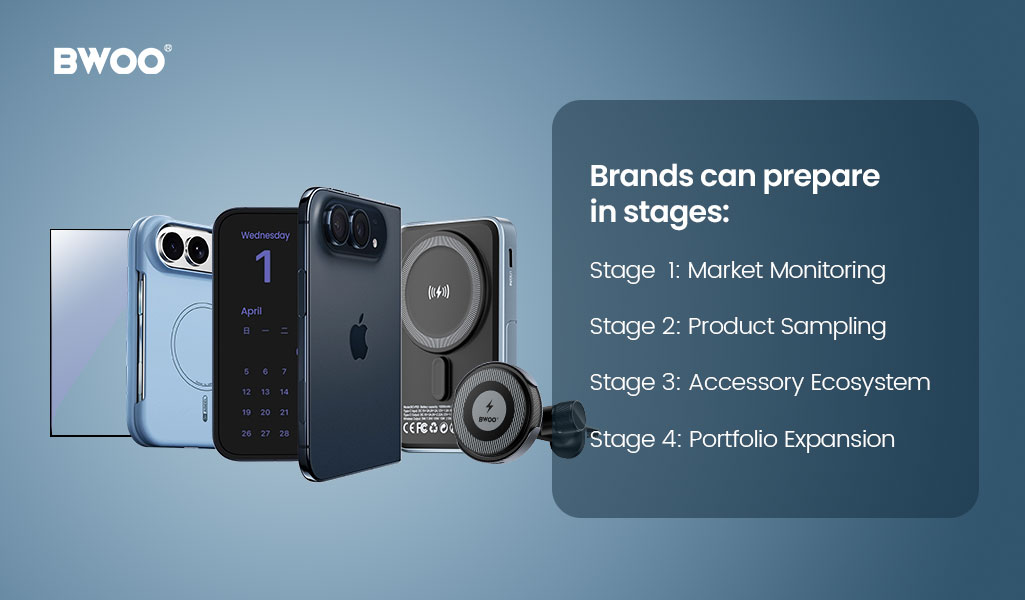
Instead, brands can prepare in stages.
Stage 1: Market Monitoring — Track: shipment volume + device adoption + case demand + accessory compatibility issues.
Stage 2: Product Sampling — Test: cases + screen protection + charging accessories + stands + holders.
Stage 3: Accessory Ecosystem — Develop combinations rather than isolated products: case + charger + power bank + stand + holder.
Stage 4: Portfolio Expansion — Increase foldable-specific SKUs when demand data supports the additional tooling and inventory investment.
This reduces the risk of overcommitting to a new form factor too early.
11. What Could Change for Mobile-Accessory Supply Chains?
Foldable devices may introduce more variation into accessory production.
Traditional phone accessories often benefit from high-volume, relatively stable dimensions.
Foldable products can require: more complex tooling + different materials + more testing + tighter tolerances.
That can influence: - Tooling cost - MOQ - Product development time - Quality-control procedures - Inventory management - SKU planning
For B2B buyers, foldable accessories should therefore be evaluated as a product-development project, rather than simply another phone-case SKU.
This is especially relevant for distributors considering private-label products or brands planning their own accessory portfolios.
12. The Bigger Trend: Smartphone Form Factors Are Expanding
Apple's entry is significant, but the broader trend is not limited to one brand.
Samsung, Huawei and other manufacturers have already developed foldable smartphone lines.
The result is the gradual expansion from: standard smartphone to: foldable + flip + larger-screen mobile formats.
This increases the importance of adaptable accessory design.
Instead of developing accessories around one fixed shape, manufacturers may increasingly need to consider: flexibility + adjustability + modularity + compatibility.
That is likely to be more valuable over time than designing accessories around a single device generation.
How Existing BWOO Content Can Support This Topic
The foldable-phone trend connects naturally to several BWOO content assets.
Magnetic Charging — [Internal Link Anchor: Magnetic Ecosystem 2026: From Car Mounts to Power Banks]
iPhone Charging Heat — BWOO has already published: [Internal Link Anchor: Why Does My iPhone 17 Get Warm During Wireless Charging?]. This provides a useful supporting article when discussing thermal management and wireless charging.
General Phone Accessories — BWOO's article: 12 Must-Have Phone Accessories in 2026 can serve as a broader internal content hub for cases, charging products, magnetic accessories and other smartphone accessories.
Conclusion: Foldable Phones Could Create a New Accessory Design Cycle
Apple's first foldable iPhone introduces a new physical architecture into one of the world's largest smartphone ecosystems.
The 7.6-inch inner display, 5.4-inch outer display and precision hinge create different requirements for cases, screen protection and other accessories compared with conventional smartphones.
TrendForce estimates that Apple could ship approximately 5 million iPhone Duo units in 2026, accounting for about 24.8% of the global foldable smartphone market, although foldables would still represent only around 2% of the overall smartphone market in 2026.
For B2B accessory buyers, this suggests a measured approach: do not replace mainstream smartphone accessories, but begin preparing specialized products where the new form factor creates a clear need.
The most relevant categories to monitor are: foldable cases, hinge protection, flexible screen protection, magnetic charging, power banks, stands and adjustable phone holders.
The bigger opportunity may ultimately be broader than Apple's first foldable model.
As smartphone form factors continue to diversify, accessory manufacturers that can develop flexible, modular and device-adaptive products will be better positioned to respond to future hardware changes.
FAQ
What accessories are most affected by Apple's first foldable iPhone?
The categories most directly affected are cases, screen protectors, hinge protection, charging stands, magnetic accessories, power banks and phone holders.
Why does a foldable phone require a different case?
A foldable case must protect the phone while allowing the hinge and display sections to move freely. This creates different material, clearance and durability requirements.
Will foldable phones replace conventional smartphones?
Current market forecasts do not suggest that immediately. TrendForce estimates foldables will account for about 2% of global smartphone shipments in 2026, indicating that foldables remain a smaller segment of the overall smartphone market.
How many foldable iPhones could Apple ship in 2026?
TrendForce estimates approximately 5 million iPhone Duo units for 2026, representing about 24.8% of the global foldable smartphone market. This is a forecast rather than a confirmed final shipment figure.
Will magnetic accessories work with foldable phones?
Compatibility will depend on the particular device and accessory design. Foldable phones can introduce different thickness, surface geometry and center-of-gravity considerations, so magnetic accessories need to be tested with the intended device and case combination.
What should B2B buyers ask a foldable-accessory supplier?
The key questions should cover folding-cycle durability, hinge clearance, material flexibility, screen-protection performance, magnetic alignment, charging compatibility and actual product testing.
Is the foldable-phone market large enough for immediate mass production?
That depends on the target market and product category. Since foldables remain a relatively small share of the total smartphone market, a staged approach—sampling, testing and monitoring demand before expanding inventory—is generally more practical for many accessory businesses.


