



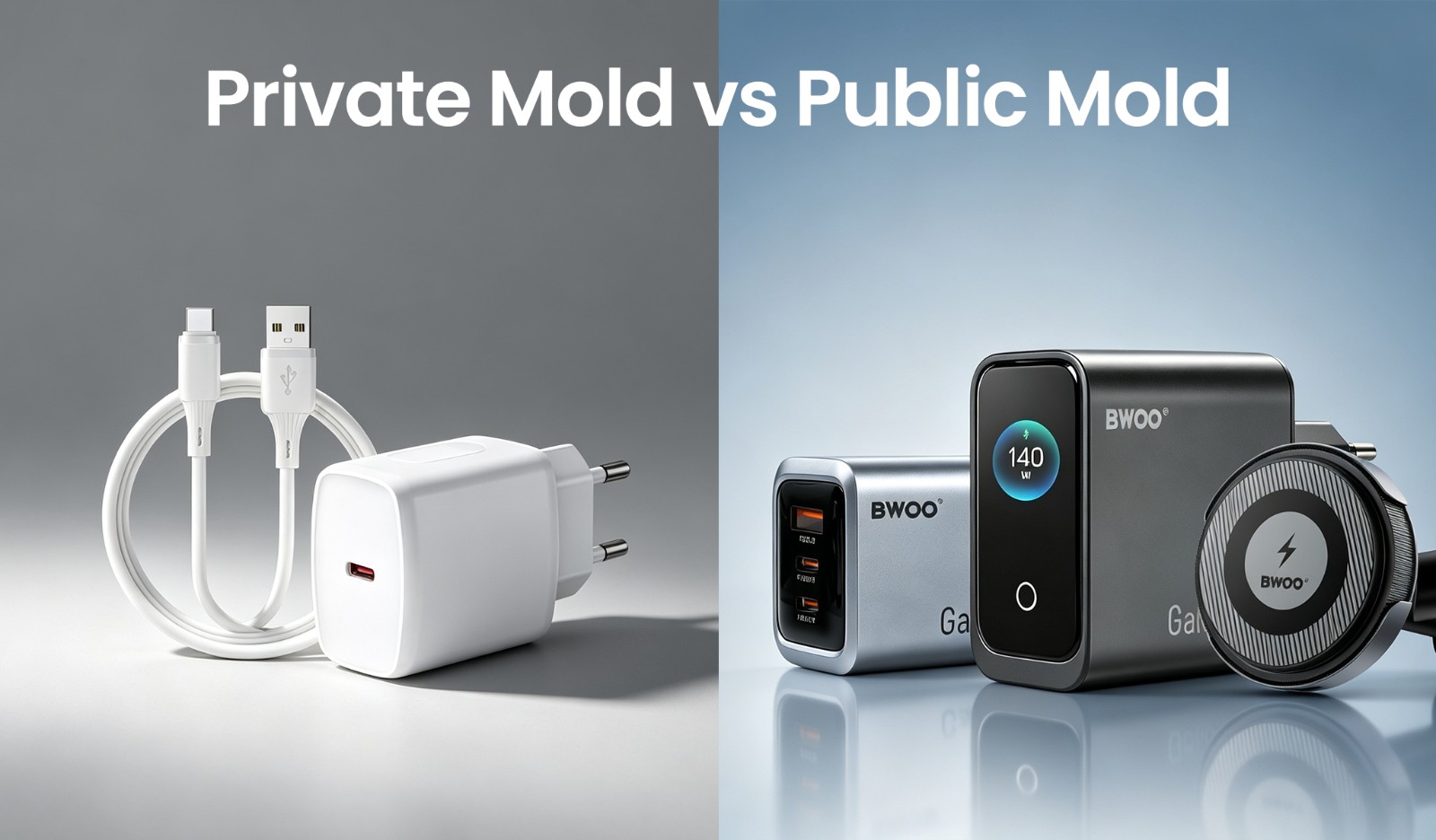
For B2B buyers building a mobile accessories brand, few decisions shape long-term competitiveness more than the choice between private mold (custom tooling) and public mold (open/shared tooling). A private mold is a mold developed exclusively for your product, owned by you; a public mold is an existing, open tool used by many brands, where your only customization is typically printing or color. Both have legitimate roles, but they serve fundamentally different strategies. This guide explains the trade-offs, the real costs of tooling, and how distributors and brand owners should decide — and how to talk to an OEM partner such as BWOO about private-mold development.
What “Mold” Means in Mobile Accessories Manufacturing
A mold is the tool that shapes a plastic (or silicone) part under injection molding. In accessories, molds determine the physical form of phone cases, charging housings, earbud casings, stands, and countless other parts. The decision is binary at the tooling stage:
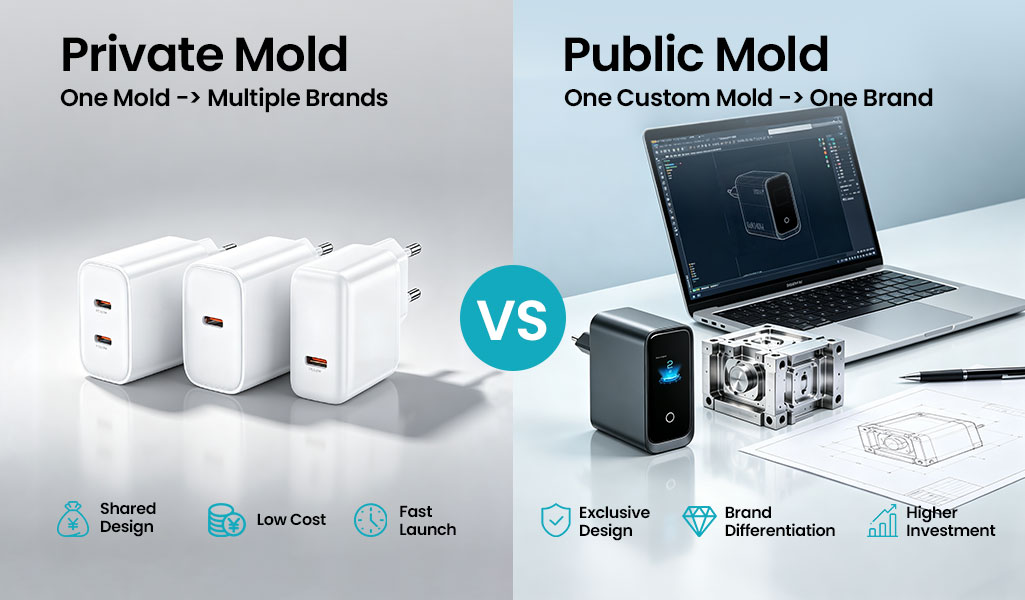
Public mold (公模): An existing mold already producing a standard design. Multiple brands order the same physical product, differentiating only through logo, color, and packaging.
Private mold (私模): A new mold designed and machined to your specification, giving you exclusive rights to that physical design.
The two paths lead to completely different market positions, cost structures, and timelines.
Public Mold: Speed and Low Risk
Public mold is the entry-level strategy and remains the backbone of low-cost accessories trade. Because the tool already exists, there is no tooling investment and no development wait — you can sample and order almost immediately.
Strengths of Public Mold
Near-zero upfront tooling cost: Capital stays in inventory, not in tool development.
Fast time-to-market: Order, brand, and sell in weeks.
Proven designs: The mold has already shipped at scale, so quality and assembly are de-risked.
Low MOQ: Shared tooling allows small first orders for market testing.
Weaknesses of Public Mold
Zero differentiation: Dozens of sellers offer the identical product; the only competition is price.
Margin compression: Identical products force a race to the bottom on wholesale price.
No exclusivity: Competitors can undercut you with the same design at any time.
Factor | Public mold | Private mold |
Upfront tooling cost | None (or minimal) | USD 5,000–50,000+ depending on complexity |
Time to market | Weeks | 3–6 months typical (design to mass production) |
Differentiation | None (shared design) | Exclusive to your brand |
MOQ | Low (500–1,000 typical) | Higher (typically 2,000–5,000 per colorway) |
Margin potential | Compressed by competition | Protected by design exclusivity |
Best for | Market testing, commodity lines, quick wins | Flagship products, brand building, high-margin lines |
Private Mold: The Competitive Moat
A private mold is a capital decision with a strategic payoff: design exclusivity that keeps competitors out. When your product’s physical form cannot be copied without a new tool, price competition shifts from identical-product bidding to feature and brand competition.
The Real Costs of Private Tooling
Tooling cost depends on part size, material, complexity, and number of cavities. In mobile accessories, realistic ranges are:
Simple single-part tools (e.g., a basic stand arm): USD 5,000–15,000.
Multi-part assemblies (e.g., a charging stand with 3–6 components): USD 15,000–40,000.
Complex, multi-cavity or highly cosmetic tools (e.g., premium cases with texture and inserts): USD 40,000+.
These figures vary by supplier, region, and part geometry — treat them as planning brackets, not quotes. Your OEM partner should provide a precise tooling quotation with a detailed DFM (Design for Manufacturing) review before you commit.
What Private Mold Buys You
Design exclusivity: Competitors cannot replicate your product without their own tooling investment.
Brand ownership: The physical product itself becomes part of your brand identity.
Margin protection: With no identical-comparison pricing, you set prices on value rather than commodity benchmarks.
Retail shelf differentiation: A unique form factor stands out where generic products blur together.
The Trade-Offs to Plan For
Higher MOQ: Private tooling economics usually demand larger first orders to amortize the tool investment. A typical starting range is 2,000–5,000 units per colorway, though this varies by category.
Longer lead time: From DFM review through tool trial and mass production, budget 3–6 months for a smooth project.
Risk of design error: The tool is built to your design, so validation and prototyping discipline matter. A professional OEM runs DFM review and tool trials before mass production to catch issues early.
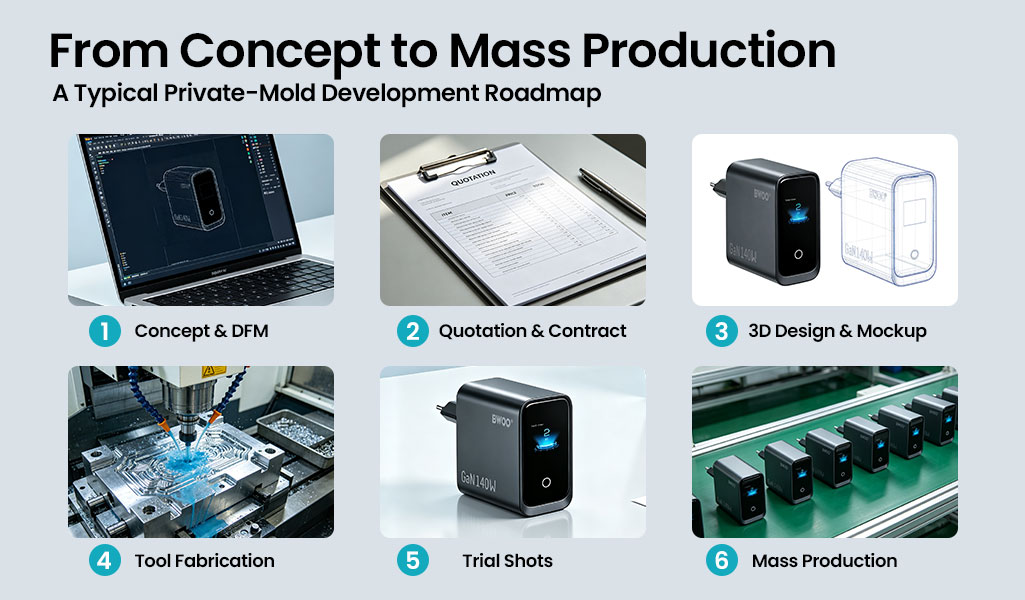
The 3-6 Month Private-Mold Roadmap
A well-run private-mold project follows a predictable sequence:
Concept & DFM review: Share your design or idea; the factory reviews manufacturability and cost. (Week 1–2)
Quotation & tooling contract: Agree on tool cost, MOQ, and unit price. (Week 2–3)
3D design & mockup: Finalize the 3D model; approve a prototype or hand sample. (Week 3–6)
Tool fabrication: Steel or aluminum tool machining. (Week 6–12)
Trial shots: First sample molding; refine texture, fit, and finish. (Week 12–14)
Pre-production & mass production: Approve pre-production samples, then scale. (Week 14–20)
A disciplined partner manages each gate with documentation, which is exactly what a B2B buyer needs for a capital decision.
How to Choose: A Decision Framework
Choose public mold when: you are testing a new market, need speed, have limited capital, or the product is a commodity line where design is not the differentiator.
Choose private mold when: you are launching a flagship product, building a brand identity, targeting premium margins, or protecting a proven best-seller from copycats.
Many successful brands run both in parallel: public mold for volume commodity lines, private mold for hero products. This hybrid protects cash flow while building the moat where it matters.
Partnering With an OEM on Custom Tooling
For a B2B supplier like BWOO, private-mold development is a core service rather than a specialty sideline. A capable partner provides DFM feedback, transparent tooling quotations, sample validation, and a clear handoff into mass production — and crucially, keeps the tooling ownership terms explicit in the contract so your exclusivity is legally protected.
If you are evaluating a private-mold project, the right first step is a DFM conversation with the factory — send your concept or reference design, and ask for a tooling feasibility review and quotation before committing any capital.
FAQ
Q1: How much does a private mold cost in mobile accessories?
Realistic ranges run from about USD 5,000 for a simple single-part tool to USD 40,000+ for complex multi-part or multi-cavity tools. The exact cost depends on part size, material, complexity, and cavity count — request a DFM-based quotation from your OEM partner.
Q2: What is the typical MOQ for a private-mold product?
MOQs are typically higher than public-mold lines, commonly starting around 2,000–5,000 units per colorway depending on category and tool design. Your supplier should state the MOQ clearly in the tooling quotation.
Q3: How long does custom tooling take?
A smooth private-mold project typically takes 3–6 months from DFM review to mass production. Tool fabrication itself is usually 6–12 weeks, followed by trial shots and pre-production validation.
Q4: Can I own the mold after production?
Yes — with a private mold, tooling ownership and exclusivity should be defined in the contract. Confirm ownership, storage, and transfer terms with your supplier before signing.
Send Inquiry: Considering private-mold development for your next product?
Contact BWOO for a DFM feasibility review and transparent tooling quotation — turn your design into an exclusive, high-margin line.


