



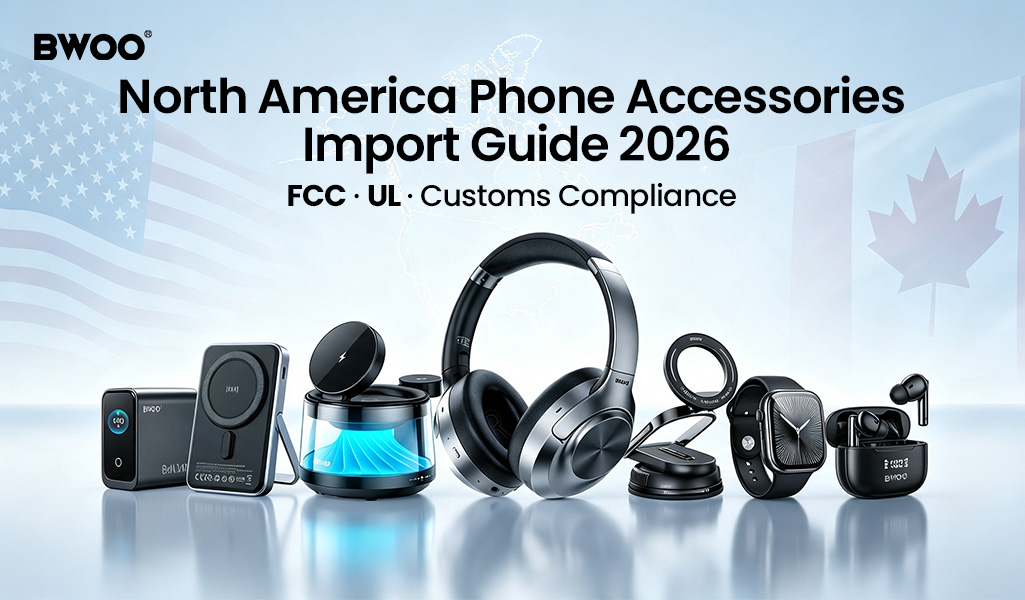
North America remains the world's largest market for mobile phone accessories, with annual imports exceeding $25 billion. For B2B importers and distributors, the United States and Canada together represent the highest-value opportunity—but also the most stringent regulatory environment. Unlike BWOO's blog overview of multi-country certification (CE, FCC, RoHS), this guide dives deep into the two certifications that matter most for North American market entry: FCC compliance and UL safety listing.
Whether you are importing USB-C chargers, wireless charging pads, BT audio devices, or smartwatch accessories, understanding FCC and UL requirements is not optional—it is a legal prerequisite for customs clearance and retail acceptance.
FCC Certification: The Non-Negotiable Entry Ticket
The Federal Communications Commission (FCC) regulates all electronic devices that emit radio frequency (RF) energy. For mobile accessories, this covers a broad range: any device with BT, Wi-Fi, or NFC wireless capability; any device that connects to a cellular network; and even wired chargers (which fall under FCC Part 15 for unintentional radiators—switching power supplies generate RF noise that must stay within regulated limits).
There are two FCC certification paths:
Path | Applies To | Process | Cost | Timeline |
FCC SDoC (Supplier's Declaration of Conformity) | Non-intentional radiators: wired chargers, cables, power banks (passive) | Self-declaration with accredited lab test report | $800-$2,000 per model | 2-4 weeks |
FCC Certification (FCC ID) | Intentional radiators: BT devices, Wi-Fi accessories, wireless chargers | FCC-recognized TCB (Telecommunication Certification Body) review required | $3,000-$8,000 per model | 4-8 weeks |
A critical point for importers: the importer of record—not the manufacturer—is legally responsible for FCC compliance. Even if your Chinese supplier provides an FCC test report, you as the US importer must ensure it is valid, current, and corresponds to the exact product you are importing. Customs and Border Protection (CBP) can detain shipments lacking proper FCC documentation, and the FCC can levy fines of up to $20,000 per violation per day. As noted by China-Electronics in their FCC/UL compliance overview, many first-time importers underestimate this liability.
UL Listing: Safety Certification That Retailers Demand
While FCC certification is a legal requirement, UL (Underwriters Laboratories) listing is a market requirement. Major US retailers—including Walmart, Target, Best Buy, and Amazon—require UL or equivalent NRTL (Nationally Recognized Testing Laboratory) certification for any plug-in electronic device. Without UL listing, your products will be rejected by these retail channels regardless of FCC compliance.
UL certification for chargers and power accessories follows UL 62368-1 (the US adoption of IEC 62368-1, with US national deviations). The testing process evaluates: electrical safety (dielectric withstand, leakage current, ground bonding), thermal safety (temperature rise under normal and fault conditions), mechanical safety (enclosure strength, drop test, strain relief), and fire safety (flammability of enclosure materials per UL94, as covered in our W31 post).
UL certification for a charger family typically costs $8,000-$15,000 and takes 8-12 weeks, with annual factory inspections thereafter. BWOO maintains active UL certifications for its entire charger product line, with certificates held under the BWOO brand—a significant advantage for private label partners who can leverage these existing certifications.
CE vs FCC: Understanding the Differences
B2B importers often assume CE and FCC are interchangeable—they are not. While both address product safety and electromagnetic compatibility, the regulatory frameworks differ significantly:
Aspect | CE Marking (EU) | FCC (USA) |
Legal Basis | EU Directives & Regulations | US Code of Federal Regulations Title 47 |
Responsibility | Manufacturer or authorized representative | Importer of record |
EMC Standards | EN 55032/55035 | FCC Part 15 |
Safety Standards | EN 62368-1 (EU adoption) | UL 62368-1 (US adoption with national deviations) |
Enforcement | National market surveillance authorities | FCC Enforcement Bureau + CBP |
Labeling | CE mark + notified body number (if applicable) | FCC ID or FCC logo + compliance statement |
The practical implication: a product with CE marking cannot be legally sold in the US without separate FCC compliance, and vice versa. BWOO products carry both certifications, enabling seamless distribution across both markets.
Customs Clearance: Avoiding Holds and Seizures
US Customs and Border Protection (CBP) actively targets non-compliant electronics. In 2025, CBP seized over $150 million worth of counterfeit and non-compliant electronic goods at US ports. For mobile accessory importers, customs clearance hinges on three things: correct HS code classification, complete FCC documentation, and accurate country-of-origin marking.
Common HS codes for mobile accessories include: 8504.40 (static converters, including USB chargers), 8507.60 (lithium-ion batteries/power banks), 8518.30 (headphones and earphones), and 8544.42 (USB cables with connectors). Misclassification can trigger additional duties or customs exams, delaying clearance by 2-4 weeks.
CBP also enforces Section 337 exclusion orders from the US International Trade Commission. Certain mobile accessory designs may be subject to patent-based import bans—importers should verify freedom-to-operate before placing large orders.
BWOO: FCC and UL Certified Across the Full Product Line
BWOO's complete mobile accessory catalog—chargers, power banks, cables, audio products, and smartwatch accessories—carries FCC compliance and UL certification where applicable. Our US-based client, David Miller (a repeat B2B importer since 2023), has successfully cleared over 50 BWOO shipments through US customs with zero compliance issues, citing our complete documentation packages as a key differentiator from other Chinese suppliers.
For private label customers, we offer certification support: your branded product can be listed as a model variant under our existing FCC and UL certifications (streamlining the process to 2-4 weeks), or we can facilitate new certification under your brand name for full independence.
Frequently Asked Questions
Q: Do I need FCC certification for USB cables without electronics?
A: Passive USB cables without active electronics generally do not require separate FCC certification, as they are considered passive components. However, cables with built-in chips (E-Marker, LED indicators, or active signal processing) do fall under FCC Part 15 and require SDoC.
Q: Can I sell on Amazon without UL certification?
A: Amazon's policy requires NRTL certification (UL, ETL, CSA, TÜV SÜD) for any product that plugs into a wall outlet. Power banks do not require UL but should have UN38.3 testing documentation. Amazon actively requests compliance documentation and can delist products that fail to provide it within 30 days.
Q: What is the difference between UL Listed and UL Recognized?
A: UL Listed applies to complete end products that are used by consumers (e.g., a wall charger). UL Recognized applies to components intended for incorporation into a larger product (e.g., a power supply module inside a docking station). For importers selling finished chargers, UL Listed is the correct certification.
Q: How do I verify if my supplier's FCC certification is legitimate?
A: Search the FCC ID on the FCC's OET (Office of Engineering and Technology) database at fcc.gov/oet/ea/fccid. A legitimate FCC ID will return the grantee code, product code, and test report details. If the ID does not appear or returns a different product, the certification is likely fraudulent.
Ensure your North American imports clear customs without delays. Contact BWOO to request our complete FCC and UL certification documentation, including test reports, certificate copies, and product compliance summaries. Our compliance team can review your target product list and confirm certification status within 24 hours.


