




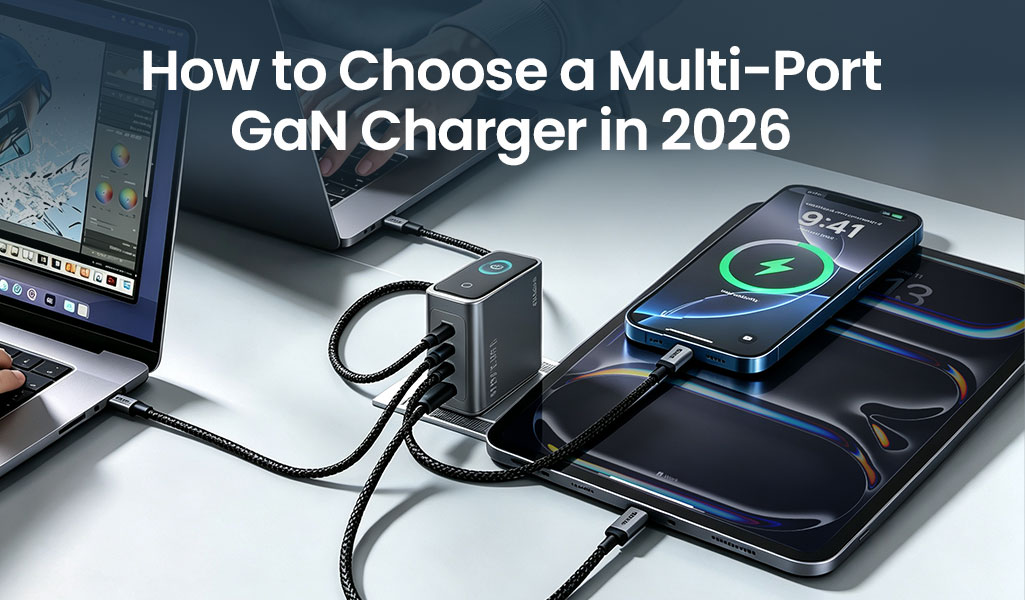
Why Multi-Port GaN Chargers Matter in 2026
The charging problem is no longer simply “How fast can one device charge?”
Many users now carry a smartphone, laptop, tablet, earbuds, smartwatch or other USB-powered products at the same time.
That creates a new requirement: How can one charger efficiently power multiple devices at once?
This is where multi-port GaN chargers have become increasingly important.
A July 2026 market estimate from LP Information projects the global multi-port GaN charger market to grow from approximately USD 771 million in 2025 to USD 2.346 billion by 2032, equivalent to a projected 17.3% CAGR from 2026 to 2032. The report describes multi-port GaN chargers as products combining multiple USB outputs with higher power density and power-management capabilities.
For B2B buyers, the category is moving from “premium fast charger” toward a broader multi-device charging solution.
What Makes a Multi-Port GaN Charger Different?
GaN stands for Gallium Nitride, a semiconductor material used in power electronics.
In practical terms, GaN technology can help chargers achieve higher power density and efficient thermal performance in relatively compact designs.
But GaN itself should not be the only purchasing criterion.
A charger advertised as “65W GaN” can behave very differently from another 65W multi-port charger depending on: - Number of ports - Port type - Power allocation - Charging protocols - Thermal management - Cable compatibility - Protection systems - Plug design
The power architecture is often more important than the GaN label itself.
Total Wattage vs. Individual Port Output
This is one of the most common misunderstandings when comparing chargers.
Suppose a charger is rated at 65W.
That does not necessarily mean every port can deliver 65W simultaneously.
The 65W figure typically represents the maximum available power under a particular operating condition. When multiple devices are connected, the charger may distribute that power between ports.
Charger Specification | What It Means |
65W total | Maximum combined charging capability under specified conditions |
65W USB-C1 | One port may reach up to 65W when used alone |
45W + 20W | Power may be shared when two devices are connected |
30W + 20W + 15W | Three-device distribution |
Dynamic allocation | Charger adjusts power according to connected devices |
This is why B2B buyers should request the full power allocation table, not just the largest wattage number.
How Much Power Does a User Actually Need?
The answer depends on the target device combination.
Main Device Combination | Charger Range | Typical Reason |
Smartphone + earbuds | 30W–45W | Lightweight daily charging |
Smartphone + tablet | 45W–65W | Balanced two-device use |
Smartphone + laptop | 65W–100W | More demanding laptop charging |
Laptop + tablet + phone | 100W–140W | Multi-device productivity |
Laptop + gaming / high-power devices | 140W+ | High sustained power demand |
These are product-planning ranges rather than universal charging requirements. Actual requirements depend on the device, protocol and charging conditions.
USB Power Delivery Is Becoming More Important
USB Power Delivery is one of the major technologies behind modern multi-device charging.
The USB Implementers Forum states that USB PD 3.1 expanded USB Power Delivery to support up to 240W over a full-featured USB Type-C cable and connector. The specification also supports flexible power negotiation, allowing devices to request the power they need rather than receiving a fixed output.
That does not mean every consumer needs a 240W charger.
For most mobile-accessory applications, 65W, 100W and 140W remain more practical product positions because they balance output, size, price and target-device compatibility.
What Should B2B Buyers Check?
1. Port Configuration
Port configuration directly determines the product's target customer.
Common combinations include: - 2 × USB-C - 2 × USB-C + 1 × USB-A - 3 × USB-C - 3 × USB-C + 1 × USB-A
The right choice depends on the device ecosystem of the target market.
A USB-C-heavy configuration is suitable for newer smartphones, laptops and tablets, while USB-A can remain useful for legacy accessories.
2. Simultaneous Charging
The phrase “charge multiple devices” is not enough.
The buyer should know exactly what happens when all ports are occupied.
Scenario | What Buyers Should Check |
One device | Maximum single-port output |
Two devices | Power allocation between ports |
Three devices | Total distribution and port priority |
High-power laptop + phone | Whether laptop still receives enough power |
Low-power accessories | Whether small devices are properly supported |
This should be clearly documented in the technical specification.
3. PD and Other Charging Protocols
A multi-port charger should be evaluated according to the protocol requirements of the target market.
Depending on the model, buyers may need support for: USB PD, PPS and other regional/device-specific fast-charging protocols.
Protocol compatibility can have a direct effect on actual charging speed.
4. Thermal Performance
Higher power density creates greater thermal-management requirements.
A compact charger that delivers high output must manage heat effectively through: - Semiconductor efficiency - Internal layout - Thermal components - Power-control algorithms - Housing materials - Protection systems
Therefore, “smaller and more powerful” should not automatically be interpreted as “better.”
BWOO Multi-Port GaN Examples
BWOO already has several products that fit different multi-device use cases.
The BWOO 2-Port 65W GaN USB-C Charger combines 65W PD output, USB-C + USB-A connectivity and simultaneous charging in a compact form.
For travel and broader multi-device usage, the BWOO 65W 3-Port GaN Travel Charger provides three charging ports and a compact travel-oriented design.
BWOO also offers higher-port configurations such as a 65W 3-Port USB-C GaN Charger with 2C1A output, which can be useful for buyers targeting mixed USB-C and USB-A environments.
How to Match Charger Power to a B2B Market
A common procurement mistake is launching the same wattage and port architecture in every region.
Instead, start with customer behavior.
Office and Business Users — Focus on: 65W–100W + 2–3 ports + laptop compatibility. The charger should replace multiple low-power adapters.
Frequent Travelers — Focus on: compact dimensions + multiple ports + wide input voltage + travel-friendly design. Port spacing and plug design also become more important.
Consumer Electronics Retail — Focus on: clear specifications + recognizable wattage tiers + compact design + broad compatibility. The packaging must make the product proposition understandable in seconds.
Premium Accessory Channels — Focus on: 100W+ + advanced power allocation + USB-C-heavy configuration + display or smart charging features. The buyer is not simply purchasing wattage. They are purchasing convenience and product differentiation.
A Multi-Port GaN Charger Procurement Checklist
Evaluation Item | Buyer Question |
Total Power | What is the maximum total output? |
Single-Port Power | What is the highest output from each port? |
Multi-Port Allocation | How does power change with 2 or 3 devices connected? |
Input | Does it support the required regional voltage? |
Protocols | Which charging standards are supported? |
USB-C | Are ports full-featured for the intended application? |
Safety | What over-current, over-voltage and temperature protections are included? |
Housing | Is the enclosure flame-retardant and durable? |
Size | How large is the product compared with ordinary chargers? |
Travel | Is the plug/structure appropriate for the target market? |
Certification | Does the model have the required market certifications? |
Samples | Can the buyer validate actual multi-device output? |
The Bigger Trend: From Charger to Charging Hub
A multi-port charger increasingly functions as a compact power hub.
Instead of carrying: one phone charger, one laptop charger, one tablet charger, one accessory charger — users can consolidate charging into one device.
This is exactly why multi-port GaN products are relevant to B2B buyers.
The product proposition is no longer simply: “Fast charging.” It is: “Power more devices with fewer chargers.”
That is a much stronger consumer-facing and B2B-facing value proposition.
BWOO's BLOG: <12 Must-Have Phone Accessories in 2026>
This article can also connect to BWOO's existing broader accessory content.
This creates a useful content path: Mobile Accessories Trends → GaN Charger → Multi-Port Charger → Product Detail Page
That structure is more valuable than linking repeatedly to the homepage.
Conclusion
Choosing a multi-port GaN charger in 2026 requires more than comparing the largest wattage printed on the box.
B2B buyers should evaluate total output, port-level power, simultaneous charging, USB PD support, thermal performance, safety and target-device compatibility as one system.
The broader market direction also supports the importance of the category, with one 2026 market estimate projecting the global multi-port GaN charger market to grow at 17.3% CAGR from 2026 to 2032.
For distributors and brands, the strongest product strategy is usually not “the highest wattage possible,” but the right combination of power, port configuration, size, compatibility and target-market positioning.
FAQ
What wattage is best for a multi-port GaN charger?
For mainstream mobile-accessory applications, 65W–100W is a practical range for many smartphone, tablet and laptop combinations. Higher-power products are useful for more demanding setups.
Does a 65W charger provide 65W to every port?
Not necessarily. The 65W figure generally represents total or maximum output under specified conditions. Buyers should check the detailed power-allocation table.
Is GaN better than a traditional silicon charger?
GaN can enable high power density and efficient power conversion in compact designs, but the overall charger architecture matters more than the semiconductor material alone.
Should B2B buyers choose USB-C-only chargers?
Not always. USB-C is increasingly important, but USB-A can still be useful in markets with legacy devices and accessories.
Why is power allocation important?
Because actual output can change when several devices are connected. A charger should be evaluated based on real multi-device operating scenarios, not only single-port performance.


