



USB-C is no longer a premium differentiator — it is the universal connector that every new device ships with. For B2B buyers, that shift has turned the humble data cable from a commodity afterthought into a high-volume, high-margin category that deserves a deliberate sourcing strategy. This guide breaks down the 2026 USB-C cable market, the four dimensions that actually determine product quality, and how to build a wholesale cable portfolio that matches your channel and margin targets.
The 2026 USB-C Market: Three Forces Driving Wholesale Demand
1. The EU USB-C Mandate
The European Union's USB-C mandate took full effect in 2024, requiring all new smartphones, tablets, and cameras to use a USB-C port. By 2026, the downstream effect is visible in wholesale: retailers and distributors across the EU are standardizing their accessory shelves on USB-C, and the legacy micro-USB and Lightning inventory is being cleared out. For importers, this means a predictable, regulation-backed demand curve rather than a fashion-driven one.
2. Apple's Full Switch to USB-C
Apple completed its transition to USB-C across the iPhone, iPad, and AirPods lines. With the world's largest single-brand accessory ecosystem now on USB-C, the replacement and upsell cable market has expanded dramatically. A distributor who previously stocked Lightning cables must now rebuild that SKU set around USB-C — and the buyers searching for "iPhone 15 charger cable" are now a permanent USB-C audience.
3. 100W+ PD 3.1 Fast Charging Goes Mainstream
As laptops, tablets, and power banks adopt USB Power Delivery 3.1 at 100W-240W, the cable is no longer just a data link — it is a power conduit that must handle high current safely. A cable that cannot sustain 5A at 20V is a liability, not a product. This raises the technical floor for what B2B buyers should source, and separates serious manufacturers from trading-company resellers.
Market context: the global USB-C cable market is projected to reach approximately $18.6 billion by 2028, growing at a double-digit CAGR. For wholesalers, the category combines the volume of a commodity with the margin of a specification-driven product — exactly the profile that rewards disciplined sourcing.
Four Dimensions That Determine USB-C Cable Quality
Dimension 1: AWG Wire Gauge — The Core Charging Parameter
AWG (American Wire Gauge) is the single most important specification for a charging cable. Lower AWG number means thicker copper conductor and higher current capacity:
28AWG / 28AWG: Standard data + charge cable, supports up to 60W (3A). Suitable for phones and earbuds.
24AWG / 28AWG (power/data mixed): Supports 100W (5A) on the power pair while keeping data lines at 28AWG. The sweet spot for most PD chargers.
22AWG / 24AWG: Heavy-duty 240W (5A EPR) cables for laptops and high-capacity power banks. Thicker, less flexible, higher cost.
For B2B buyers, the rule is simple: match AWG to your target device wattage. Stocking only 28AWG cables in a 2026 market where 100W laptops are common means lost sales and returns from buyers who cannot fast-charge their laptop.
Dimension 2: Certification — CE, FCC, and USB-IF
A USB-C cable that is not properly certified is a compliance and safety risk. The three marks that matter for wholesale:
CE / FCC: Mandatory for the EU and US markets respectively. Confirms electromagnetic compatibility and basic safety.
USB-IF Certified: The USB Implementers Forum logo confirms the cable meets the USB specification, including the 5A E-Marker chip requirement for 100W+ cables. This is the mark that separates spec-compliant cables from look-alikes.
RoHS / REACH: Confirms restricted substances compliance for the EU market.
For distributors selling into regulated markets, sourcing only USB-IF certified cables removes a class of warranty and liability risk that cheap uncertified cables create.
Dimension 3: Material — TPE vs PVC vs Braided Nylon
The jacket material drives both durability and price positioning:
PVC: Lowest cost, rigid, prone to cracking in cold climates. Entry-price SKU only.
TPE (Thermoplastic Elastomer): Softer, more flexible, eco-friendlier. The mainstream choice for mid-tier cables.
Braided Nylon: Highest durability and premium feel, resists tangling and pet-chewing. Commands the highest retail margin. The dominant material for the "premium tier" SKU in a dual-track portfolio.
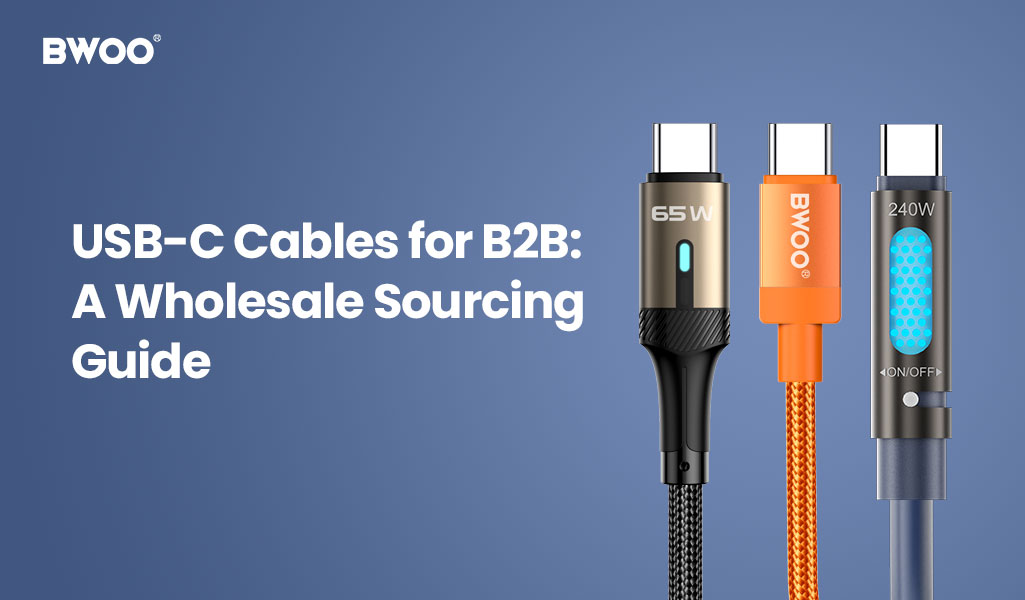
BWOO's cable line spans all three materials, letting distributors tier their offering from value to premium without switching suppliers.
Dimension 4: Length-to-Price Sweet Spot
Cable length affects both material cost and use-case fit. The wholesale sweet spots in 2026:
0.5m–1m: Desk and car use, lowest cost, highest volume. The default SKU.
1.5m–2m: Bedroom and couch use, the highest consumer demand band.
3m+: Niche, higher freight cost per unit, lower velocity. Stock selectively.
For most distributors, a 1m + 2m two-SKU base covers 80% of demand. Adding a 0.5m retractable variant captures the travel and car segment without bloating inventory.
The Fastest-Growing Sub-Category: Retractable USB-C Cables
Among all USB-C cable formats, retractable (spring-loaded) cables are the 2026 growth leader. The value proposition is compact: a 1m cable that coils into a 8cm puck, eliminating the tangling and pocket-bulk that drives negative reviews on standard cables. For B2B buyers, retractable cables offer three advantages:
Higher perceived value: justifies a 30-50% price premium over a fixed cable of the same spec.
Gift and promo channel fit: the compact form factor makes it ideal for corporate gifts, trade-show swag, and bundle-with-device promotions.
Lower return rate: the coiled design protects the internal wires from the sharp-bend fatigue that kills fixed cables.
BWOO's retractable USB-C line supports 100W PD and is available in TPE and braided variants, making it a turnkey premium SKU for distributors entering the category.
B2B Wholesale MOQ and Pricing Benchmarks
Understanding the wholesale economics helps buyers negotiate and plan inventory. Typical 2026 benchmarks for USB-C cables ex-China (FOB):
Standard 1m 60W TPE cable: MOQ 500-1,000 pcs, FOB $0.45-$0.75/pc.
100W 1m braided cable with E-Marker: MOQ 500-1,000 pcs, FOB $0.90-$1.40/pc.
Retractable 100W cable: MOQ 500-2,000 pcs, FOB $1.20-$1.80/pc.
Private-label / OEM: MOQ typically 1,000-3,000 pcs per SKU with custom color, length, and packaging.
The margin logic: a distributor buying at $1.20 FOB and retailing at $9.99 holds a 60-70% gross margin after freight and duties — far above the 25-35% typical on a branded phone case. This is why cable is a quiet margin engine in any accessory catalog.
How BWOO's USB-C Cable Line Covers Different Channels
BWOO manufactures a full USB-C cable portfolio that maps directly to distributor channel needs:
Value channel (dollar stores, mass retail): 1m 60W PVC/TPE cables in multi-packs.
Mid-tier (electronics retail, e-commerce): 1m/2m 100W braided cables with E-Marker, USB-IF certified.
Premium (gift, travel, automotive): retractable 100W cables and coiled car-mounted variants.
OEM / private label: custom AWG, length, jacket, and packaging with low-MOQ mixed orders.
All BWOO cables ship with regional plug adapters and full certification packs (CE, FCC, USB-IF, RoHS). Visit BWOO official website for distributor pricing, MOQ details, and sample requests.
Conclusion: Build the Cable SKU Set Before the Competition Does
The 2026 USB-C cable market is defined by regulatory tailwinds (EU mandate), ecosystem lock-in (Apple's full switch), and spec escalation (100W+ PD). For B2B buyers, the winning move is a deliberate four-dimension sourcing strategy — AWG matched to device wattage, USB-IF certification for compliance, material tiered to channel, and length optimized to demand. The retractable sub-category is the clearest 2026 upside. Distributors who build a structured cable portfolio now will capture margin that commodity resellers leave on the table. Start with a 1m + 2m + retractable three-SKU base, validate velocity, then expand into OEM private-label runs.


