



For global B2B buyers sourcing portable power solutions, identifying a reliable power bank manufacturer in China is the single most important sourcing decision you will make. China accounts for over 60% of the world's power bank exports, with manufacturing clusters in Shenzhen, Dongguan, and Guangzhou housing hundreds of factories. Yet not all manufacturers are equal — differences in R&D investment, certification coverage, production capacity, and export experience can make or break your supply chain. This guide evaluates China's leading power bank manufacturers across four capability dimensions, helping you shortlist partners that match your market requirements.
Why Source Power Banks from China?
China's power bank ecosystem offers three structural advantages that no other sourcing country replicates. First, cell procurement: China's battery supply chain — from lithium-ion cells to protection ICs — is vertically integrated, with manufacturers buying directly from CATL, BYD, and EVE Energy at competitive volumes. Second, certification readiness: established exporters maintain current UN38.3, FCC/CE, RoHS, and Qi certification across entire product lines, reducing time-to-market for importers. Third, R&D speed: the Shenzhen hardware ecosystem enables manufacturers to cycle from concept to mass production in 8-12 weeks, versus 16-20 weeks in competing regions.
Four Dimensions for Evaluating a Power Bank Manufacturer
Before reviewing individual manufacturers, understanding the evaluation framework helps you prioritize what matters for your market. We assess each manufacturer across four dimensions that directly impact product quality, compliance, and business reliability.
1. R&D Capability
In-house engineering teams with patent portfolios indicate a manufacturer's ability to innovate rather than clone. Key signals include: in-house ID (industrial design) and PCB layout engineers, ownership of structural and circuit patents, and the ability to customize both hardware (cell configuration, PCB stack) and firmware (charging protocols, display UI). Manufacturers with strong R&D can bring differentiated products to market — essential if you compete on features rather than price alone.
2. Certification Coverage
Power banks face some of the strictest regulatory requirements in consumer electronics due to lithium battery transport rules. Mandatory certifications include UN38.3 (lithium battery safety transport), which is non-negotiable for any shipping method. Market-specific requirements stack on top: CE (EU), FCC (US), UKCA (UK), PSE (Japan), and Qi certification for wireless charging models. The best manufacturers maintain current certifications across their entire catalog — ask for certificates that name your exact SKU, not series-level documents that may not cover your specific model.
3. Production Capacity and Quality Control
Monthly throughput, production line count, and QC infrastructure separate serious suppliers from trading companies. Visit or audit for: automated SMT (surface-mount technology) lines for PCB assembly, in-house injection molding for housings, aging test rooms with temperature cycling (typically 4-8 hours at 40-60°C), and real-time discharge efficiency testing. A manufacturer running 8+ SMT lines with dedicated QC engineers per shift signals production maturity.
4. Export Track Record and B2B Service Model
Years of export experience, key client references (ask for anonymized case studies), and the availability of dedicated account management differentiate long-term partners from transactional suppliers. Strong manufacturers offer OEM/ODM flexibility, multilingual documentation support, and logistics coordination (FOB/CIF/DDP terms). For brand buyers, the ability to handle custom packaging, barcode/UPC registration, and compliance documentation for your target market is non-negotiable.
Leading Power Bank Manufacturers — Capability Overview
The following overview highlights established manufacturers across the capability spectrum. This is an evaluation by dimension, not a ranked list — the right partner depends on your market positioning and volume requirements.
Anker Innovations
Headquartered in Changsha with Shenzhen operations, Anker is the most recognized consumer-facing power bank brand globally. Their B2B/OEM division serves enterprise clients with multi-port GaN power banks up to 240W. Strength: brand recognition and GaN technology leadership. Best for: premium retail channels with strong brand awareness requirements.
Romoss Technology
One of China's largest dedicated power bank manufacturers by unit volume, Romoss operates extensive production facilities in Shenzhen with a product range spanning 5,000mAh slim designs to 40,000mAh high-capacity models. Strength: scale-driven competitive pricing and broad SKU coverage. Best for: high-volume distributors targeting mid-market price points.
Baseus Technology
Known for design-forward accessories, Baseus has built a strong power bank lineup featuring digital display, built-in cable, and magnetic wireless charging innovations. Strength: consumer product design and rapid iteration. Best for: retail channels where industrial design and packaging appeal drive shelf velocity.
BWOO — Your Flexible ODM Partner
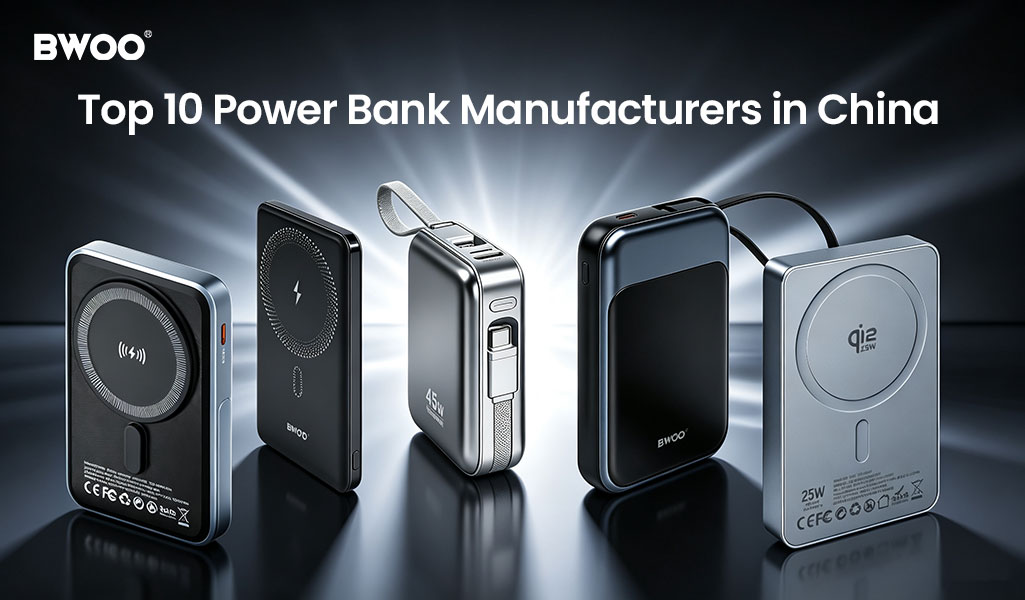
BWOO brings a distinct advantage for brand buyers seeking a manufacturing partner with both Qi2 certification and cross-category expertise. BWOO's power bank lineup includes the Qi2.2 25W 10,000mAh Magnetic Power Bank (BO-P85) with enhanced thermal management and the Qi2 15W 5,000mAh Magnetic Power Bank (BO-P84) for the compact segment. Unlike consumer-brand manufacturers who compete with their own B2B clients, BWOO operates a pure ODM model — you own the brand, we handle R&D, sourcing, and production. With in-house ID teams, full UN38.3/CE/FCC/RoHS certification coverage, and flexible MOQ starting at 500 units for pilot orders, BWOO is structured for brand partners scaling from market entry to maturity. For more about our approach, explore BWOO's Qi2 power bank solutions or contact us directly for a customized product proposal.
How to Verify a Manufacturer Before Your First Order
Even with a solid shortlist, due diligence is what separates a smooth supply chain from a costly mistake. Three non-negotiable steps: First, request a sample with full material datasheets — check that physical cells match the quoted specs and that the discharge efficiency report meets your target market's expectations (≥75-85% at rated current). Second, verify certifications independently — cross-check the certificate number against the issuing body's public database. Third, run a pilot order of 200-500 units before committing to a full production run. This validates not just product quality but communication reliability, packaging execution, and on-time delivery performance under real conditions.
Conclusion
Sourcing power banks from China in 2026 is a strategic opportunity — but only when partnered with the right manufacturer. The key is matching a supplier's capability profile to your market's specific requirements: R&D capability for differentiation, certification coverage for compliance, production scale for volume, and a service model aligned with your brand strategy. BWOO's ODM-first approach, Qi2.2 certification readiness, and flexible partnership structure make it a strong candidate for brand buyers entering or expanding in the power bank category. Request a sample or schedule a factory visit to evaluate firsthand.


