




The Car Is the Next Charging Battleground
For years, the in-car accessories market was an afterthought — a 12V cigarette-lighter adapter and a basic phone mount. In 2026, that landscape has been completely redrawn. The modern vehicle cockpit demands a full charging ecosystem: high-wattage multi-port car chargers, magnetic wireless charging mounts, and active cooling systems that keep devices running during extended navigation and streaming sessions.
For B2B wholesalers, the in-car charging category represents a particularly attractive opportunity: it is one of the least blog-covered categories on most accessory brand websites (BWOO included, with zero in-car blog content to date), meaning first-mover content can capture search traffic with relatively low competition.
The 20W to 160W Upgrade Cycle
The most significant trend in car charging is the dramatic wattage escalation. Where 20W car chargers were standard just three years ago, the 2026 market is defined by devices delivering 65W, 100W, and even 140W through USB-C Power Delivery.
This upgrade cycle is being driven by a simple consumer reality: more devices, higher power demands. A family road trip now involves:
Driver's phone running GPS navigation (15-25W continuous draw)
Passenger's phone streaming video or gaming (10-20W)
Tablet for rear-seat entertainment (20-30W)
Possibly a laptop for remote work during stops (45-65W)
A single 20W car charger cannot meet these demands. Multi-port 100W+ car chargers can.
Magnetic Wireless Charging Mounts: The Form Factor Winner
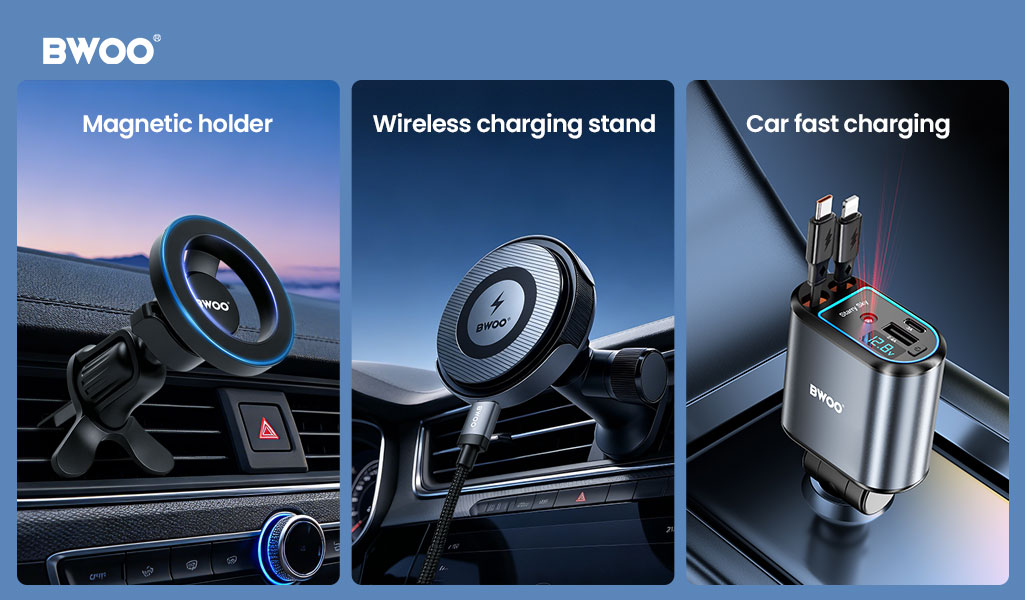
The convergence of magnetic mounting (Qi2/MagSafe compatible) and wireless charging has produced the defining car accessory form factor of 2026. These devices serve dual functions: they hold the phone securely for navigation visibility while simultaneously charging it wirelessly.
Brands like Baseus have validated this form factor with products like the PrimeTrip VP2 160W magnetic car charger, accompanied by dedicated product blog content. The form factor resonates because it solves two problems with one device — and consumers consistently prefer integrated solutions over separate mount + charger combinations.
BWOO's in-car lineup includes:
BO-ZJ163 15W Wireless Charging Magnetic Car Phone Holder. Combines Qi-compatible wireless charging with a secure magnetic mounting system.
BO-ZJ162 Magnetic Air Vent Phone Holder for Car. A streamlined magnetic mount optimized for air vent installation, providing secure phone positioning without the wireless charging layer for buyers who prioritize mounting over charging.
Both models are compatible with the broader BWOO magnetic ecosystem, including Qi2 power banks and desktop charging accessories.
Active Cooling: The 2026 Differentiator
One of the most overlooked features in premium car chargers is active cooling. High-wattage charging generates heat, and in a car environment — often parked in direct sunlight with ambient temperatures exceeding 40°C — passive cooling may be insufficient.
Active cooling via micro-fans in the charger head is becoming standard in the 100W+ segment. For B2B buyers, specifying active cooling protects against the most common car charger return reason: thermal throttling that causes charging to slow dramatically during summer use.
The Bundle Opportunity
The in-car charging ecosystem naturally lends itself to bundling, which increases average order value:
Commuter Bundle: Magnetic wireless charging mount + 65W dual-port car charger
Family Bundle: 100W 3-port car charger + 3× braided USB-C cables (1m, 1.5m, 2m lengths)
Premium Bundle: 160W car charger with active cooling + magnetic mount + USB-C to Lightning + USB-C to USB-C cable kit
Each bundle solves a complete customer scenario and reduces the likelihood of the buyer sourcing individual components from competitors.
Market Sizing and Competitive Landscape
The in-car accessories market benefits from two structural tailwinds:
The average vehicle age in developed markets is increasing, meaning older vehicles without built-in USB-C ports remain the majority of the installed base
Ride-share and delivery drivers represent a growing professional user segment with heavy in-car charging demands
Competitor activity in this space — from Baseus's product blogs to generic listings on Alibaba and Amazon — confirms that in-car charging is transitioning from a convenience accessory to a necessary part of the mobile device ecosystem. Wholesalers who build inventory now will be positioned ahead of this curve.
Conclusion
The 2026 in-car charging ecosystem is defined by three trends: wattage escalation to 100W+, the magnetic wireless mount as the dominant form factor, and active cooling as a premium-tier differentiator. For B2B distributors, this category offers a rare combination of high growth, low content competition, and natural bundling opportunities. BWOO's ZJ163, ZJ162, and car charger lineup provide a complete product foundation ready for wholesale deployment.


