



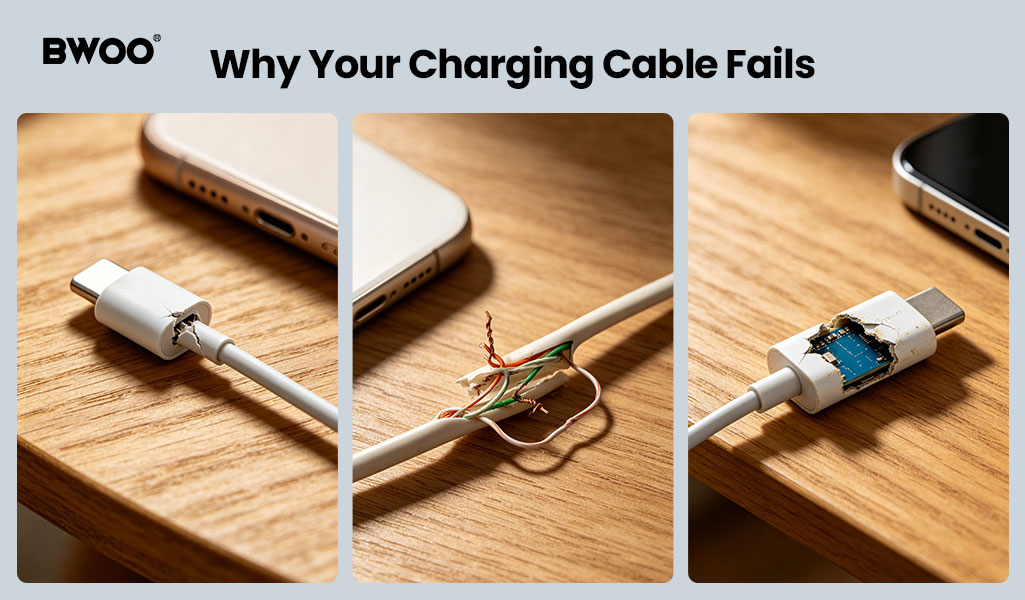
Charging cables are the most frequently purchased mobile accessory—and the most frequently returned. Industry data suggests that cable failure rates range from 8% to 25% within the first year, depending on quality tier. For B2B buyers, cable quality directly impacts return rates, warranty costs, and brand reputation. This article examines the three primary failure mechanisms through a laboratory testing lens, defines the quality metrics that separate commercial-grade cables from commodity alternatives, and provides a practical framework for evaluating cable suppliers.
1. The Three Root Causes of Cable Failure
Connector Fracture: The Stress Concentration Zone
The junction between the connector housing and the cable body is the most common failure point, accounting for approximately 60% of cable returns. This occurs because repeated bending concentrates mechanical stress at a single point—the strain relief boot. Poorly designed cables use rigid PVC molding that creates a sharp transition angle, concentrating all bending force on a 2–3mm zone. Quality cables employ TPE (Thermoplastic Elastomer) injection molding with a graduated strain relief design that distributes bending force across a 20–25mm zone, reducing per-millimeter stress by approximately 8–10×. BWOO's USB cables undergo a 10,000-cycle bend test at ±90 degrees with a 200g suspended weight as specified by USB-IF testing guidelines (usb.org), far exceeding the industry standard of 5,000 cycles.
Conductor Degradation: Material Quality Determines Longevity
Internal conductor degradation is invisible to the end user but produces the most frustrating failure mode: a cable that looks intact but charges slowly or intermittently. The root cause is copper core quality and construction. Low-cost cables use copper-clad aluminum (CCA) or copper-clad steel (CCS) conductors—materials with 40–60% higher resistivity than pure copper. Under repeated flexing, these bonded materials delaminate at the atomic level, creating micro-fractures that increase resistance over time. BWOO specifies oxygen-free copper (OFC) conductors with tin-plated strands, achieving resistivity below 0.0172 Ω·mm²/m. Tin plating prevents copper oxidation, which can increase contact resistance by 300–500% over 12 months in humid environments.
Protocol Negotiation Failure: When the Cable Can't Keep Up
Modern fast-charging protocols (PD 3.1, QC 4.0+, PPS) require the cable to include an eMarker chip that communicates its current-carrying capacity to the charger. Cables without eMarkers or with counterfeit chips default to 5V/1.5A (7.5W)—even when connected to a 140W charger. For B2B buyers, this creates a subtle but critical quality gap: a cable may “work” but never deliver fast-charging speeds, frustrating end users who blame the charger rather than the cable. BWOO cables rated for 100W+ include USB-IF certified eMarker chips that correctly negotiate PD 3.1 Extended Power Range (EPR) profiles, verified through protocol analyzer testing.
2. Key Quality Metrics: A B2B Evaluation Framework
Quality Metric | Industry Minimum | BWOO Standard | Why It Matters |
Bend Cycle Endurance | 3,000–5,000 cycles | 10,000+ cycles (USB-IF compliant) | Every bend cycle at the connector joint weakens conductors. 10,000 cycles simulates 2+ years of daily use. |
Copper Core Purity | CCA/CCS (40–60% IACS conductivity) | OFC tin-plated (>98% IACS) | Higher conductivity reduces voltage drop over cable length, maintaining fast-charging wattage at the device. |
Braided Jacket Density | 48–64 strand nylon | 96–128 strand nylon | Denser braiding prevents kinking, resists pet chewing damage, and extends jacket lifespan by 2–3×. |
Connector TPE Injection | Single-shot rigid PVC | Dual-shot graduated TPE | Graduated strain relief distributes bending stress, preventing the sharp-angle fracture zone. |
eMarker Chip | None or uncertified | USB-IF certified EPR eMarker | Without a certified eMarker, PD 3.1 devices default to 7.5W regardless of charger capability. |
Insertion Cycles | 5,000 cycles | 15,000+ cycles | Each plug/unplug cycle causes micro-wear on connector pins. 15,000 cycles covers 5+ years of daily use. |
3. How B2B Buyers Can Verify Cable Quality
Quality verification doesn't require an in-house lab. The following practical steps allow B2B buyers to assess cable suppliers before placing bulk orders:
Request SGS or TUV Test Reports: Independent third-party testing documentation (SGS, TUV Rheinland, Intertek) provides objective verification of bend-cycle endurance, conductor material composition, and connector insertion life. Suppliers should provide these reports voluntarily—hesitation is a red flag.
Perform a Simple Bend Test: Manually bend the cable at the connector joint to 90 degrees in both directions 50 times. Quality cables show no visible deformation; poor cables develop stress whitening or cracking at the strain relief within 20 cycles.
Check the eMarker with a USB-C Tester: A USD 30–50 USB-C power meter can read the eMarker chip data, displaying the cable's rated current capacity. Any cable claiming 100W+ that shows a 3A (60W) eMarker rating should be rejected.
Verify Braid Density Under Magnification: A 10× loupe reveals braid coverage. Quality cables show tight, uniform weaving without visible gaps in the braid pattern. Sparse braiding exposes the inner jacket to abrasion.
Request Material Composition Certificates: Copper purity and jacket material certifications (RoHS, REACH) should be standard documentation. CCA/CCS cables cannot pass material composition audits if the buyer specifies pure copper.
4. BWOO Data Cable Quality Commitment
BWOO's USB cable product line is engineered to the commercial-grade standards detailed above. All cables rated 60W and above include USB-IF certified eMarker chips. OFC tin-plated copper conductors are standard across the range—with no CCA or CCS downgrades at any price tier. Dual-shot TPE strain relief with graduated geometry is applied to every connector. Every production batch undergoes AQL 2.5 sampling with mandatory bend-cycle, insertion-cycle, and protocol-negotiation spot checks before shipment clearance.
5. Corporate Gifting and Bulk Procurement
Charging cables are among the most popular corporate gift items, but low-quality cables damage brand perception more than they enhance it. For promotional product distributors and corporate procurement managers, BWOO offers custom cable printing (logo on connector housing or cable jacket), branded packaging, and retail-ready blister packs. MOQ starts at 1,000 units for custom-printed cables and 500 units for standard models with custom packaging. All BWOO cables carry CE, FCC, and RoHS certification, with SGS test reports available upon request for qualified buyers.


