



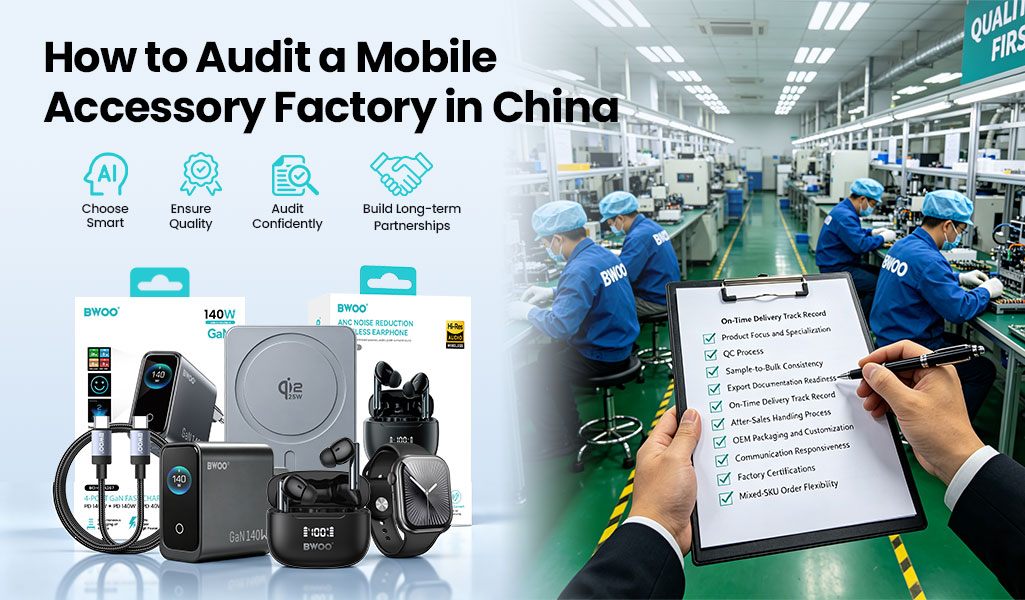
Walking into a factory for the first time without a structured audit framework is the fastest way to miss the quality signals that determine whether your order arrives on spec — or becomes a costly lesson. This 10-point factory audit checklist is built for first-time buyers and private-label brands sourcing mobile accessories in China. Each checkpoint maps to an outcome you can verify with your own eyes, not a certificate you take on faith.
1. Product Focus and Specialization
A factory that claims to produce chargers, earbuds, power banks, smartwatches, and cables under one roof is rarely excellent at all of them. Specialization matters.
Walk the production floor and count how many distinct product categories occupy active assembly lines.
Ask: "What product line accounts for over 60% of your revenue?" If the answer is vague, the factory is likely a trading company with subcontractor relationships rather than a dedicated manufacturer.
Red flag: Showroom shelves packed with unrelated categories — speakers, LED lights, massage guns — alongside mobile accessories. This indicates a general trading company, not a specialized factory.
BWOO operates product-specific production cells: the GaN charger line, the TWS earbuds line, and the power bank assembly floor are physically separated with dedicated QC stations and component inventory.
2. In-House QC Process (Not Just Final Inspection)
Ask to see the QC checkpoint layout, not just the final "passed" sticker.
Incoming material inspection: Are raw PCBs, battery cells, and injection-molded housings tested before reaching the assembly line?
In-process checkpoints: How many stations between SMT (surface-mount technology) and packaging have active testing — not just visual inspection?
Aging and burn-in: Do finished chargers and power banks undergo burn-in testing under load for a minimum of 4 to 8 hours before packaging?
Batch sampling standard: Ask which AQL (Acceptable Quality Limit) standard the factory follows. AQL 2.5 is the minimum for consumer electronics; AQL 1.0 or 1.5 indicates a more rigorous approach.
3. Sample-to-Bulk Consistency
A factory's first concern is delivering the exact product you approved. Request the golden sample — the physical reference unit signed off during development — and compare it side-by-side with a random pull from the current production line. Check for: material feel (housing texture, cable jacket flexibility), weight (within 5% tolerance), print quality on logos and regulatory markings, LED color temperature and brightness, and tactile feedback on buttons and hinges.
If the factory cannot produce the golden sample for comparison, treat that as a procedural gap. BWOO maintains a locked golden-sample archive for every active SKU — accessible to QC inspectors on every batch.
4. Export Documentation Readiness
Before a single unit ships, your cargo needs paperwork. A quality factory maintains pre-audited documentation packs for each product: CE, FCC, RoHS, and REACH declarations with valid certificate numbers and expiry dates; UN 38.3 test summaries for products containing lithium batteries; and MSDS sheets for battery-containing SKUs.
Ask for a documentation pack for one of your target products. If the factory takes more than 24 hours to produce it, the compliance chain is not integrated into their standard workflow.
5. On-Time Delivery Track Record
Request O.T.D. (on-time delivery) data for the past six months — not a percentage claimed in conversation, but actual shipment records with order dates, promised dates, actual dates, and variance in days. A factory running at consistent O.T.D. above 92% has production planning under control. A factory that hesitates to share this data or offers only verbal reassurance should raise your attention.
6. After-Sales Handling Process
Products fail — what matters is how the failure gets resolved:
Defect rate tracking: Ask for the factory's internal defect rate (DPPM — defects per million) for your target product category. A DPPM below 5,000 is competitive; below 2,000 is excellent.
RMA (Return Merchandise Authorization) process: How does the factory handle a defective batch discovered after arrival at your warehouse — credit note, replacement shipment, or partial refund? Confirm the policy in writing before placing the first order.
Root cause reporting: Does the factory produce an 8D report or equivalent corrective action document for any defect rate spike above a defined threshold?
7. OEM Packaging and Customization Capability
If you are building a private brand, the factory must handle more than printing a logo on a white box:
Packaging design support: Can the factory accept your dieline files and produce samples within one week?
Custom color matching: Pantone-matched housings, custom cable jacket colors, and silk-screen or laser-engraved logos.
Minimum order for custom SKUs: Some factories require 3,000-5,000 units per custom SKU. BWOO supports custom starter runs at 500-1,000 units, significantly lowering the barrier for new private-label brands.
8. Communication Responsiveness and Language Capability
Test communication during the audit itself: send a follow-up email requesting the specification sheet for a product you discussed. Measure response time in business hours. A factory with dedicated English-speaking account managers responding within one business day is structured for export business. A factory where questions bounce between three WeChat contacts without resolution will create ongoing friction.
9. Factory Certifications and Social Compliance
Beyond product certifications, ask for factory-level credentials: ISO 9001 (quality management baseline) and ISO 14001 (environmental management). For brands selling into European retail chains, BSCI or SMETA social compliance audit reports are increasingly mandatory. Request the most recent audit report and check the date — reports older than two years are expired for most retailers.
10. Mixed-SKU Order Flexibility
A factory that only accepts single-SKU container orders limits your ability to build a diversified catalog. Confirm: can you place a mixed-SKU order — 500 chargers, 300 power banks, 200 earbuds — on a single purchase order with one shipment? BWOO supports mixed-SKU consolidation from multiple production lines, reducing shipping cost and simplifying inventory management.
Conclusion
A factory audit is not about finding a perfect facility — none exist. It is about identifying the gaps that will directly affect your customer experience and your margin. Use this 10-point checklist as your floor, not your ceiling. The factories that pass most of these checks with transparent data are the ones worth building a long-term supply relationship with. For any factory visit, B2B buyer preparation is everything: bring this checklist, request the documentation packs in advance, and allocate a full day on the production floor rather than a 90-minute walkthrough.


