



The Cable Is Not a Commodity — It's a Materials Decision
Data cables are the most deceptively complex accessory in mobile electronics. To the consumer, a USB-C cable is a USB-C cable. To the B2B buyer, the choice between braided nylon, silicone, and Kevlar-reinforced cables determines return rates, retail positioning, and margin structure.
In 2026, European consumer preferences have shifted decisively from "cheapest available" to "longest lasting," driven by sustainability awareness and frustration with cables that fray after months of use. This shift creates an opportunity for B2B buyers who understand cable material science and can stock accordingly.
The Three Core Cable Materials
Braided Nylon
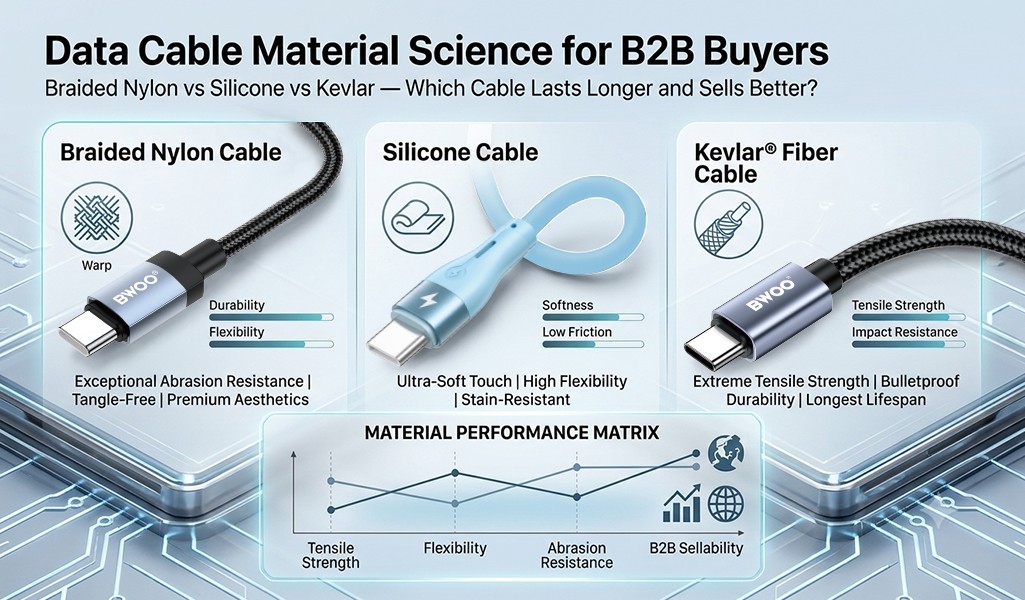
Braided nylon is the 2026 mainstream standard for mid-tier and premium cables. The nylon outer sheath provides superior tensile strength compared to bare TPE or PVC jackets, resisting the daily stresses of bending, pulling, and coiling.
Durability: Typically rated for 10,000+ bend cycles at stress points (connector joints)
Tangle resistance: Moderate — better than PVC, not as good as flat silicone
Consumer perception: "Premium feel" at mid-range price
Best for: Everyday use, charging + data sync, mid-tier and premium retail positioning
Silicone
Silicone-jacketed cables have surged in popularity in 2025-2026, driven by their distinctive soft-touch feel and near-zero tangle properties. They appeal strongly to younger demographics and are particularly popular in the mobile gaming and social media creator segments.
Durability: Comparable to braided nylon for the cable body, but connector joints can be weaker if not reinforced
Tangle resistance: Excellent — the standout feature
Consumer perception: "Trendy, soft, lifestyle" positioning
Best for: Mobile gaming, content creators, fashion-forward accessory lines, younger demographics
Kevlar/Aramid Fiber Reinforced
Kevlar (aramid fiber) reinforcement is the premium durability tier. Unlike braided nylon, where the weave itself provides strength, Kevlar cables embed aramid fiber strands within the cable core. This provides extreme tensile strength — often rated for 50,000+ bend cycles — without adding bulk.
Durability: Industry-leading, 50,000+ bend cycles common
Tangle resistance: Similar to braided nylon
Consumer perception: "Indestructible, professional, worth the premium"
Best for: Premium retail, heavy-use professional segments, construction/trades, outdoor enthusiasts
Biodegradable and Bio-Based Materials: The 2026 Emerging Trend
A new materials category is emerging in 2026: bio-based and biodegradable cable jackets. Driven by EU sustainability regulations and consumer demand for eco-friendly products, manufacturers are experimenting with plant-based polymers and biodegradable TPE alternatives.
While this category is still nascent — durability often trails conventional materials, and per-unit cost is 15-30% higher — B2B buyers targeting environmentally conscious markets (particularly Northern Europe) should monitor development closely. Early adopters who can offer a credible "eco-cable" will capture a niche with disproportionate brand loyalty.
Which Material for Which Market?
| Material | Target Market | Price Tier | Margin Profile | Key Selling Point |
| Braided Nylon | Mainstream e-commerce, mid-tier retail | Mid | Volume-driven | Best all-rounder for price/performance |
| Silicone | Youth, gaming, lifestyle | Mid-to-premium | Balanced | Tangle-free soft-touch experience |
| Kelar-Reinforced | Premium, professional, heavy-use | Premium | High margin, lower volume | "Lasts years, not months" |
Certification and Compliance
Regardless of material choice, all cables intended for regulated markets must carry appropriate certifications. For USB-C cables, USB-IF certification is the gold standard. For Lightning cables, MFi certification is mandatory for Apple compatibility. CE, RoHS, and FCC marks apply as baseline requirements.
BWOO cable range carries the necessary certifications for global distribution. For B2B buyers, verifying certification paperwork at the sourcing stage — not at the customs clearance stage — prevents costly delays.
Conclusion
The data cable is not a commodity. Material choice determines durability, consumer perception, retail price point, and return rate. Braided nylon remains the volume leader. Silicone captures trend-driven demographics. Kevlar commands premium margins. And bio-based materials represent the next frontier. For B2B buyers, the question is not "which cable is best?" but "which cable material matches my target market?"


