



A power bank is a compact consumer accessory, but it contains a rechargeable lithium battery. For importers, distributors and retailers, product selection therefore involves more than capacity, charging speed and appearance. Buyers also need confidence that the exact model can be identified, documented, tested and traced throughout the supply chain.
That responsibility has become more visible after several safety-related news items in 2026. On September 3, the U.S. Consumer Product Safety Commission (CPSC) announced a recall of approximately 32,400 XO Poppy Power Trip magnetic wireless power banks. The lithium-ion battery in the specific recalled product could overheat and ignite. The notice identifies model PYPBK5M and related color codes; it is a product-specific recall, not evidence that all magnetic power banks share the same issue.
The UK Civil Aviation Authority also published a passenger-facing lithium battery safety checklist on October 22, 2026. Its survey found that 54% of air passengers now carry a power bank when flying. While the checklist is about safe air travel rather than commercial sourcing, it shows why clear product identification and battery safety information matter to consumers and regulators.
For B2B buyers, the practical question is: what evidence should a supplier be able to provide for the exact power bank model being purchased?
1. Start with the Exact Model and Battery Identity
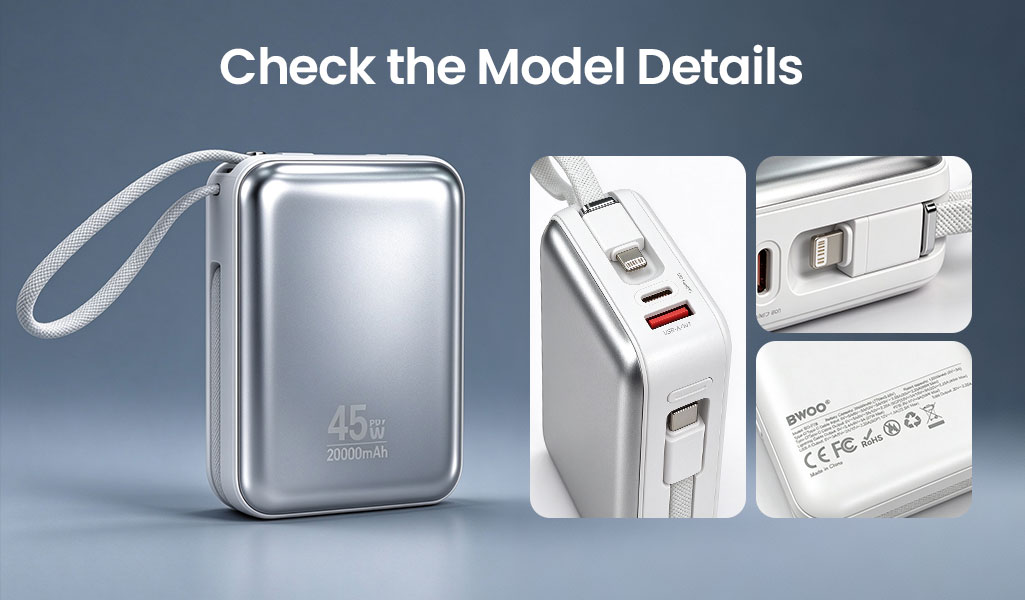
Do not assess a power bank only by the brand name or by a general factory capability statement. Ask for information that connects the finished product to its battery cells and production configuration. Useful details include:
Finished product model and revision: confirm the exact model number, hardware revision and package version being quoted.
Cell or battery identification: ask for the cell type, rated capacity, nominal voltage and manufacturer information that can be disclosed for the project.
Batch traceability: confirm how production lots, date codes and component changes are recorded.
Change control: ask whether a change of cell supplier, battery pack, protection board or enclosure triggers renewed review or testing.
A supplier should be able to explain how the battery listed in its documents maps to the finished product. A report for a similar-looking model is not automatically evidence for the model in your purchase order.
2. Review Model-Level Safety and Test Evidence
A safety claim should be connected to a defined product, test method and test result. Depending on the design and target market, buyers may need to review relevant reports for the battery, charging circuit, electrical protection, enclosure materials and finished product. The applicable documents vary by market and product configuration, so avoid relying on a generic checklist of logos.
Ask the supplier to clarify which protections are built into the model and which have been verified. Examples may include overcharge, over-discharge, overcurrent, short-circuit and temperature-related protection. These should be described only when they are present in the specific design and supported by technical evidence. Do not assume every power bank uses the same protection architecture.
For air transport, the IATA 2026 guidance explains the UN Manual of Tests and Criteria subsection 38.3 test-summary framework. Manufacturers and subsequent distributors must make an applicable test summary available. The guidance also explains that a paper copy does not need to accompany every consignment as a routine matter; the information can be made available through a website, QR code or URL. Buyers should confirm that the summary identifies the battery or product type relevant to the goods being shipped.
The distinction matters: UN 38.3 is a set of transport tests, and the document is a test summary—not a universal quality certificate for every aspect of the finished power bank. Other destination-market requirements, transport rules and product tests may also apply.
3. Check Labels, Packaging and Product Information
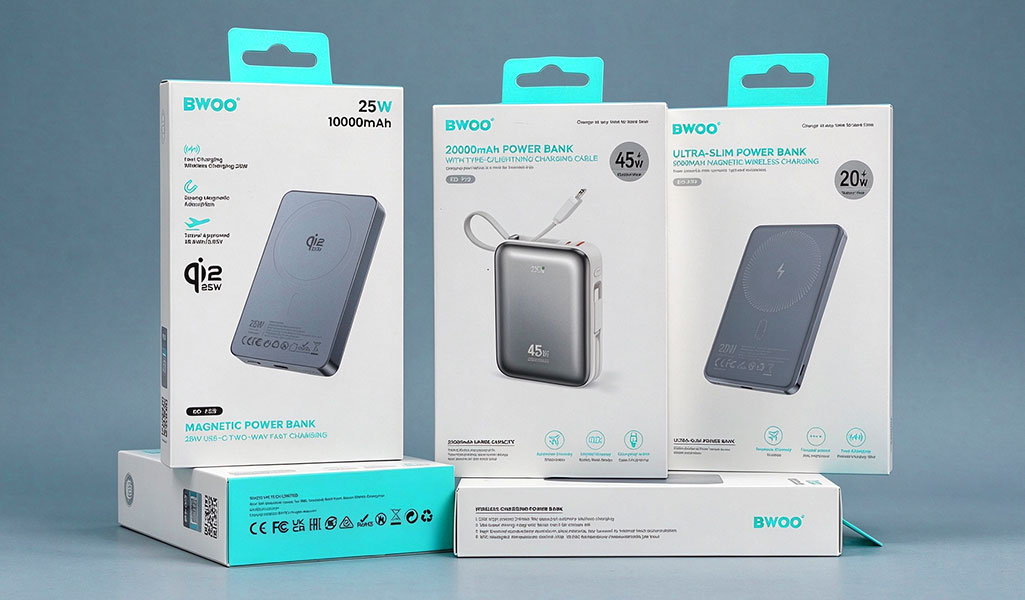
The label and retail package should communicate the product’s identity and electrical ratings consistently. Compare the product label, user manual, carton markings, online listing and test documents. Depending on the product and target market, buyers should check:
Model number and manufacturer or responsible-party identification.
Battery capacity and energy information, including Wh where required or relevant to transport.
Input and output ratings, supported charging ports and operating instructions.
Warnings, handling instructions and language requirements for the destination market.
The correct document references and traceability information for the battery and finished product.
Capacity also needs to be communicated accurately. A 10,000mAh or 20,000mAh label describes the cell capacity at its rated voltage; it does not mean that the same number of milliamp-hours will be delivered at a 5V USB output. For a plain-language explanation, buyers can refer to BWOO's guide to mAh, Wh and rated capacity. Buyers considering integrated-cable formats can also read the 2026 built-in cable power bank sourcing guide for a closer look at that product design.
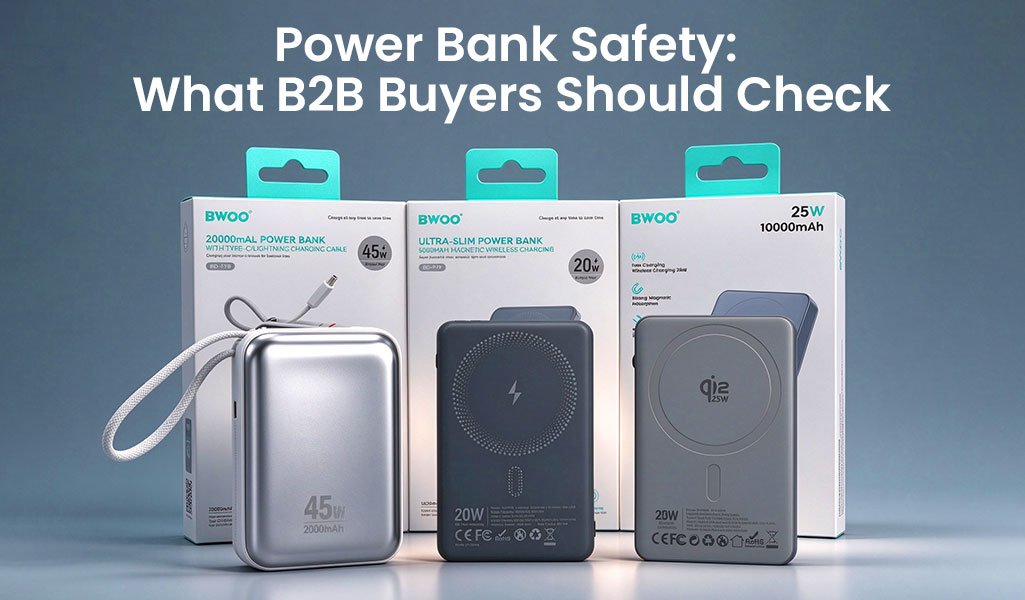
For model-level examples, BWOO's current range includes the BO-P79 5000mAh ultra-slim magnetic power bank, the BO-P85 Qi2.2 25W 10000mAh magnetic power bank, and the BO-P78 20000mAh PD45W power bank with built-in cables. These pages illustrate different capacities and form factors; they do not replace model-specific battery records, transport test summaries or destination-market safety evidence.
4. Evaluate the Supplier's Traceability and Response Process
Documentation is only useful when it can be connected to the production batch supplied. Before placing a bulk order, discuss how the supplier handles incoming battery inspection, in-process checks, final inspection, retained samples, complaint investigation and corrective action. Ask how the supplier would identify affected batches if a product issue were reported after shipment.
A supplier's answer should be specific enough to verify. “We have strict quality control” is less useful than an agreed inspection plan, the records that will be retained, and a clear process for investigating a non-conformity. Buyers should also agree which approved sample and specification revision will be used as the production reference.
5. A Practical Power Bank Checklist Before Ordering
Check | Question to ask |
Model identity | Do the model number, revision, battery and documents match the product being quoted? |
Battery data | Are capacity, voltage, cell type and battery supplier information documented? |
Safety evidence | Which model-specific tests and protection features can be supported with records? |
Transport | Can the supplier make the applicable UN 38.3 test summary and shipping information available? |
Label and package | Are ratings, warnings, identifiers and destination-market language consistent? |
Traceability | Can the supplier trace the production lot and manage component changes or complaints? |
Conclusion
The 2026 recall news is a reminder that a power bank should be evaluated as a battery-powered product, not just as a capacity and charging-speed specification. B2B buyers can reduce sourcing risk by checking model identity, battery records, applicable test evidence, labels, transport information and supplier traceability before a purchase order is confirmed.
To review product options, visit the BWOO Power Bank collection and compare the model-specific specifications with your destination-market requirements. Ask BWOO for the latest technical information and the documents applicable to the exact model under consideration.
FAQ
Does a power bank recall mean all power banks are unsafe?
No. A recall applies to the identified product and models named in the official notice. Buyers should use the incident as a reason to strengthen model-level due diligence, not as evidence that every power bank has the same defect.
What is a UN 38.3 test summary?
It is a summary of the applicable lithium battery transport tests under subsection 38.3 of the UN Manual of Tests and Criteria. It should identify the relevant cell, battery or product type. It is not a general certificate covering every aspect of product quality.
Should the UN 38.3 test summary be included in every shipment?
IATA's 2026 guidance says the summary must be made available by manufacturers and subsequent distributors, but it does not support requiring a paper copy with every shipment as a routine practice. Check the rules and requests that apply to the particular route and operator.
Which battery protection features should buyers verify?
The relevant features depend on the design. Ask which protections are built into the exact model—such as overcharge, over-discharge, overcurrent, short-circuit or temperature protection—and request supporting technical evidence.
What should importers check on a power bank label?
Check the model identity, electrical ratings, battery capacity or energy information where required, manufacturer details, warnings and consistency with the manual, package and technical documents.


