



The question how many charges is 10000mAh trips up most power bank buyers, because the answer depends on the difference between rated capacity vs battery capacity. Understanding mAh, watt-hours, and conversion losses is the key to choosing a power bank that actually delivers. This guide explains power bank capacity in plain language and shows exactly how many charges you can expect.
mAh, Wh, and Rated Capacity Explained
What mAh Actually Measures
mAh (milliamp-hours) measures electric charge. A 10000mAh power bank can theoretically deliver 10000 milliamps for one hour, or 1000 milliamps for ten hours. But mAh alone is misleading because it ignores voltage — that is where Wh (watt-hours) comes in.
Why Wh Matters More
Wh measures actual energy. A 10000mAh power bank at 3.7V (the battery's internal voltage) holds 37Wh of energy. When the power bank boosts that 3.7V up to 5V for USB output, the mAh drops proportionally — the same 37Wh becomes roughly 7400mAh at 5V. This is why the label says 10000mAh but your phone receives less.
Rated Capacity vs Battery Capacity
The battery capacity (10000mAh) is what the internal cell stores. The rated capacity (usually 6000-7400mAh) is what actually reaches your phone after voltage conversion, heat loss, and circuit overhead. A quality power bank converts 85-90% of stored energy to usable output — cheaper units waste far more.
How Many Charges Will You Get?
The real-world formula is: (Power bank Wh × conversion efficiency) ÷ phone battery Wh = number of charges. The table below shows results for a 10000mAh (37Wh) power bank at 85% efficiency.
Phone Model (Example) | Battery Capacity | Battery Wh | 10000mAh Rechargeable Times |
iPhone 15 (3300mAh) | 3300mAh | 12.2Wh | Approx. 2.6 times |
iPhone 15 Pro Max (4440mAh) | 4440mAh | 16.4Wh | Approx. 1.9 times |
Samsung S24 (4000mAh) | 4000mAh | 14.8Wh | Approx. 2.1 times |
iPad(8000mAh) | 8000mAh | 29.6Wh | Approx. 1.1 times |
Choosing the Right Power Bank
Match Capacity to Your Device
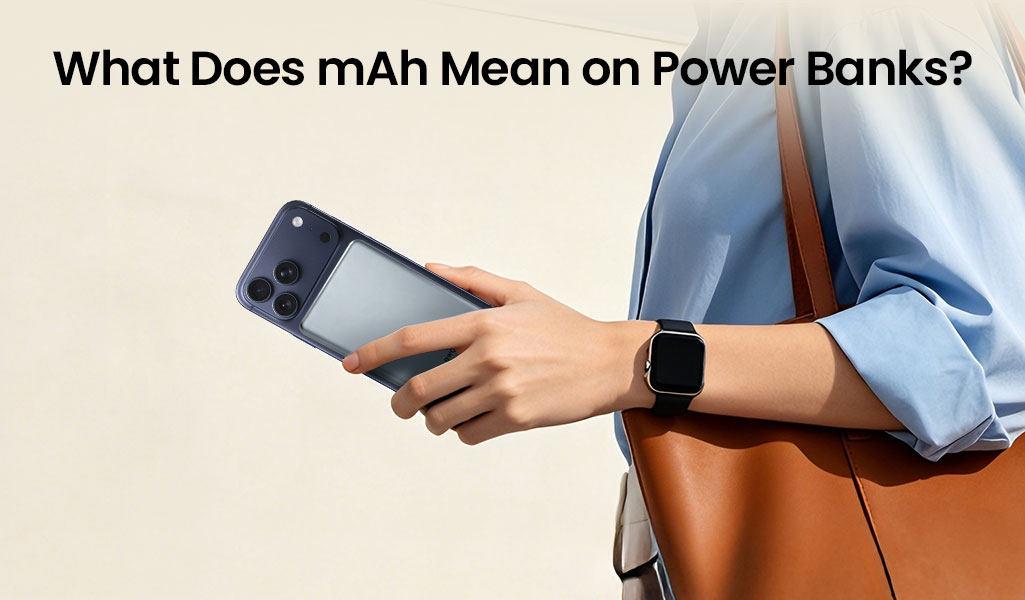
For daily carry, 5000mAh (like BWOO BO-P84) offers one full phone charge in a pocket-friendly magnetic form factor. For travel or heavy use, 10000mAh (like BWOO BO-P85) delivers about two full charges. For tablets and laptops, step up to 20000mAh+.
Qi2 Magnetic Charging Changes the Game
Qi2 magnetic power banks snap onto the back of your phone with perfect coil alignment, eliminating the efficiency loss of misaligned wireless charging. BWOO's BO-P84 delivers 15W Qi2 from 5000mAh, while BO-P85 pushes 25W Qi2.2 from 10000mAh — fast, aligned, and cable-free.
Understanding Conversion Efficiency
No power bank delivers 100% of its stored energy. Voltage boost from 3.7V to 5V (or 9V/12V for fast charging) consumes energy, as does heat dissipation in the conversion circuitry. A quality power bank achieves 85-90% efficiency, meaning a 37Wh (10000mAh) cell delivers 31-33Wh to your device. Cheap power banks may only reach 70-75%, silently delivering a fraction of their label.
Wireless charging adds another conversion loss layer — typically 70-80% efficiency — because energy is transferred through induction rather than a direct wire. This is why wireless power banks deliver noticeably fewer charges than wired output from the same cell. Qi2 magnetic alignment mitigates this by eliminating misalignment losses, but wireless remains inherently less efficient than wired.
Power Bank Safety and Certification
A power bank is a lithium-ion battery in your pocket, so safety matters. Look for CE/FCC certification, overcharge/overdischarge protection, short-circuit protection, and temperature cutoff. UN38.3 certification is essential for air transport — uncertified power banks cannot legally ship by air, a critical consideration for wholesalers importing stock. Quality cells (typically LG, Samsung, or Panasonic sourced) and BMS protection circuits are non-negotiable.
Power Bank Buying Checklist
Distill everything above into a five-point checklist before you buy. First, check the rated capacity, not just the mAh on the box — a 10000mAh bank should show a rated output of roughly 7400mAh at 5V. Second, confirm the protocols — PD and QC support determine whether your phone actually fast charges. Third, look for Qi2 magnetic alignment if you plan to charge wirelessly; it eliminates the misalignment penalty.
Fourth, verify safety certifications — CE/FCC and UN38.3 (for air shipping) are non-negotiable, and BMS protection is the difference between a safe cell and a fire hazard. Fifth, match the capacity to your use case — 5000mAh for daily pocket carry, 10000mAh for full-day travel, 20000mAh+ for laptops and multi-device trips. A power bank that passes all five checks will rarely disappoint. (内部链接:BO-P84/BO-P85 磁吸充电宝产品页)
A final tip: beware of misleading 'fast charge' labels that advertise 100W output but only deliver it briefly before throttling. Ask for the sustained output spec — a quality bank should hold its rated wattage until thermal limits are reached. This is the difference between a spec-sheet claim and real-world performance.
For heavy users, also consider pass-through charging — the ability to charge the power bank itself while it charges your phone. This is valuable for hotel stays with limited outlets, though it generates extra heat and slightly reduces efficiency. BWOO's Qi2 lineup is engineered to keep both the phone and the bank cool during extended use.
FAQ
Q1: How many charges is 10000mAh really?
About 2 full charges for a modern smartphone (3300-4000mAh battery), after voltage conversion and efficiency losses.
Q2: Why does my 10000mAh power bank only deliver 7400mAh?
Because the label measures the internal 3.7V cell, while USB output runs at 5V. Energy stays the same; mAh drops as voltage rises.
Q3: What is the difference between rated capacity and battery capacity?
Battery capacity is what the cell stores; rated capacity is what actually reaches your device after conversion losses.
Q4: Is Qi2 worth it for a power bank?
Yes, magnetic alignment removes wireless charging's biggest weakness — misalignment — making 15-25W wireless charging actually fast.
Choose a power bank that delivers what it promises. Browse BWOO magnetic power banks — BO-P84 for daily carry, BO-P85 for travel — and charge with confidence.


