



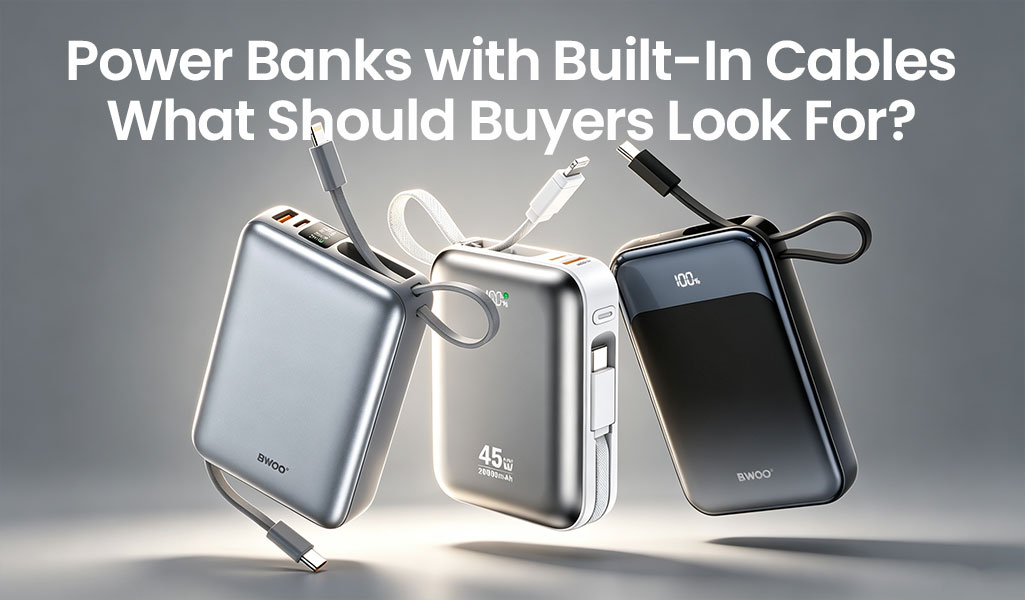
Why Built-In Cable Power Banks Are Getting More Attention
Carrying a power bank but forgetting the charging cable defeats the purpose of portable power.
That simple problem explains why power banks with built-in cables continue to attract product development and buying-guide attention in 2026.
Current products from brands including Anker, Baseus and Belkin show several recurring configurations: 10,000mAh and 20,000mAh capacities, integrated USB-C cables, multiple outputs, fast charging, digital displays and travel-oriented designs.
This is also an established topic on the BWOO website. BWOO published a broader Best Power Bank with Built-in Cable guide in 2025, covering portability, cable type, capacity, charging power and safety.
The purpose of this 2026 article is therefore different.
Instead of asking simply “Which power bank is best?”, this guide focuses on what B2B buyers should evaluate when sourcing the product category in 2026.
What Has Changed in the 2026 Product Design?
The basic idea remains the same: integrate a charging cable into the power bank.
But product design has become more sophisticated.
The current market includes: - Integrated USB-C cables - Dual built-in cables - Retractable cables - Digital power displays - Magnetic wireless charging - Higher wired output - Simultaneous multi-device charging - Compact travel designs
For example, Anker currently sells 10,000mAh and 20,000mAh power banks with built-in cables, while Belkin offers 10,000mAh and 20,000mAh integrated-cable models. Baseus also has a 20,000mAh model with a built-in USB-C cable and 45W output.
That means buyers should look beyond the basic “built-in cable” feature.
10,000mAh or 20,000mAh?
Capacity is still the first product decision.
Capacity | Main Advantage | Typical Positioning |
5,000mAh | Very compact | Emergency / ultra-portable |
10,000mAh | Balance of size and capacity | Daily carry |
20,000mAh | Extended power | Travel / work / multi-device |
25,000mAh+ | Higher capacity | Laptop and extended-use products |
10,000mAh
This capacity is highly suitable for consumers who prioritize portability.
A compact 10,000mAh power bank can fit easily into a handbag, backpack or jacket pocket and can be positioned as an everyday charging companion.
20,000mAh
A 20,000mAh model makes more sense for: - Business travel - Long working days - Multiple devices - Tablet users - Higher-output products - Longer periods away from an outlet
A larger capacity also means greater weight and volume, so the product should not be marketed as simply “better.”
The Built-In Cable Is Not Just a Convenience Feature
A built-in cable becomes part of the product's mechanical structure.
That creates new procurement questions.
Cable Length — A very short cable keeps the product compact but may be awkward to use. A longer cable improves flexibility but can affect portability.
Cable Position — The storage position matters. A cable attached to the side may be easy to access but more exposed. A recessed or wrapped structure may offer better protection.
Bending Area — The cable's connection point needs special attention because it experiences repeated bending.
Connector Durability — The connector is inserted and removed repeatedly. It should be checked for mechanical strength, fit and long-term stability.
This is particularly important because a damaged built-in cable may reduce the usefulness of the entire power bank.
Fixed Cable vs. Retractable Cable
These are different product architectures.
Design | Strength | Trade-Off |
Fixed short cable | Simple, reliable and compact | Limited cable length |
Fixed long cable | More flexible | More difficult to store |
Retractable cable | Excellent cable management | More mechanical components |
Detachable cable | Easy replacement | Loses some convenience |
A B2B buyer should select the structure according to target usage rather than treating retractability as automatically superior.
Charging Output Matters More in 2026
Capacity tells users how much energy is stored.
Output tells users how quickly that energy can be delivered.
This distinction is becoming increasingly important.
For everyday smartphone products, 20W–30W is a practical segment. Higher-output models can target tablets and selected laptop use cases.
For B2B product planning, the following architecture can be useful:
Product Tier | Suggested Positioning |
Entry | 10,000mAh + basic fast charging |
Mainstream | 10,000mAh + 20W–30W + built-in USB-C |
Premium | 20,000mAh + 30W–45W+ + multi-device |
Professional | 20,000mAh+ + higher PD output + advanced cable architecture |
Actual output capability must always be matched to the product's battery, controller, cable and thermal design.
Built-In Cable + Multiple Ports
One of the strongest developments in this category is the combination of integrated cable + external ports.
Why? Because one device may need to charge: Smartphone, TWS earbuds, Tablet, Smartwatch, Secondary phone, Other USB-powered devices.
A built-in cable handles the primary device while additional ports support other equipment.
This can make a power bank much more useful for business travelers and people carrying several devices.
A Strong Example from BWOO
BWOO's BO-P48 10,000mAh Power Bank uses three built-in cables, combining two USB-C cables and one Lightning cable with USB-C and USB-A outputs. The design is intended to support multiple devices without requiring users to carry multiple separate cables.
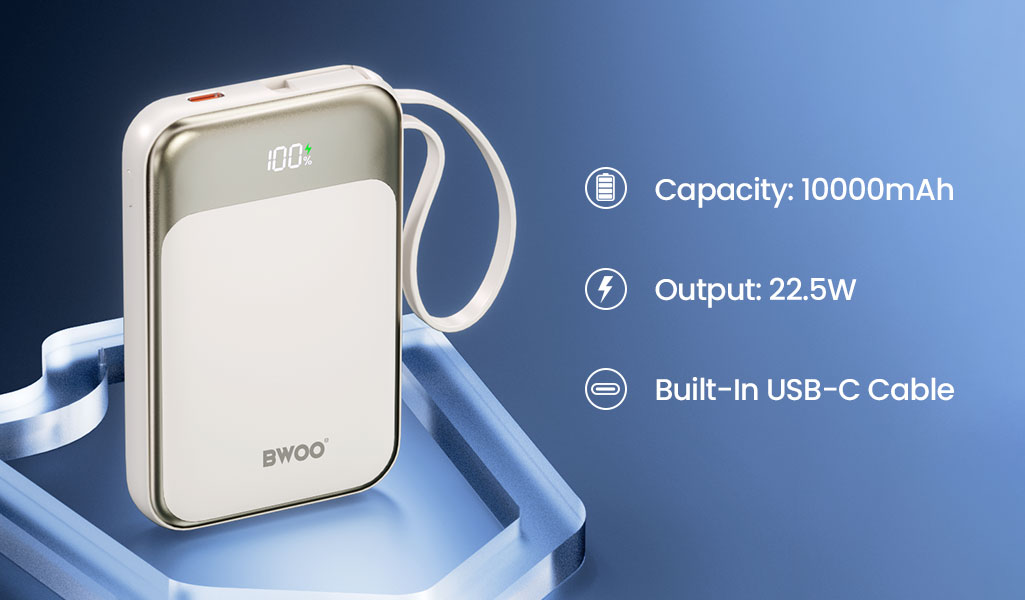
BWOO also offers the BO-P80, a 10,000mAh magnetic power bank with a built-in USB-C cable, combining magnetic wireless charging, wired charging, digital battery display and multiple safety protections
These products illustrate how the category is evolving from a simple “battery + cable” concept into a broader portable charging platform.
What About Digital Displays?
Digital displays are not essential, but they can improve user understanding.
A conventional four-light battery indicator tells users only that the battery is roughly: full / medium / low.
A digital display can communicate a more specific battery percentage.
For premium positioning, this can increase perceived product value without changing the fundamental charging architecture.
However, the display should support the product's actual use case rather than exist only as a visual upgrade.
Magnetic Charging and Built-In Cables
Another direction is combining wired and wireless charging.
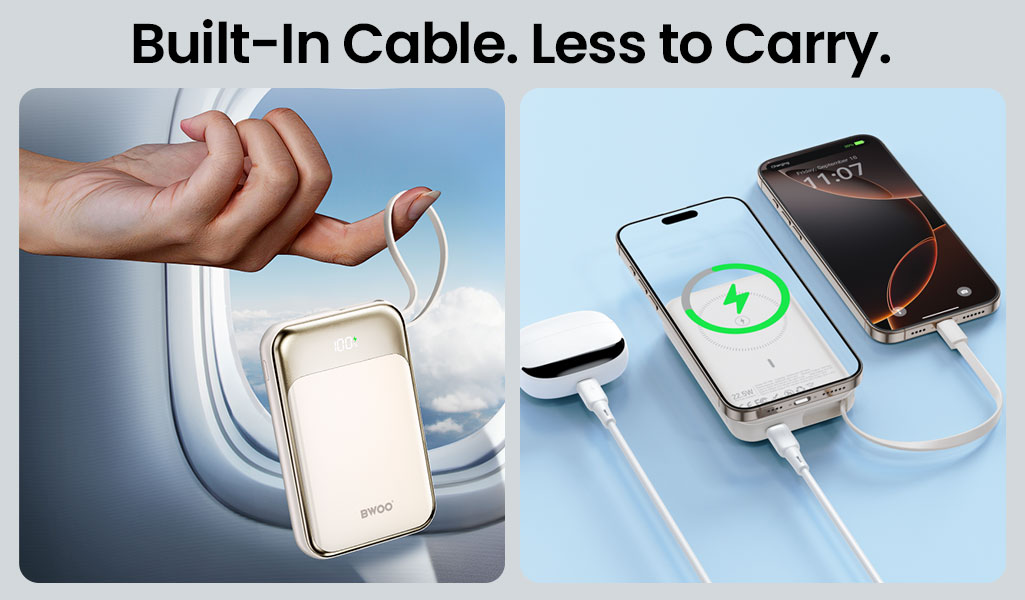
A user can attach the power bank magnetically to a compatible smartphone while the built-in USB-C cable provides wired charging to another device.
This creates more flexibility, but it also introduces another important purchasing criterion: thermal management.
Wireless charging and wired fast charging generate heat differently. When both are used together, the buyer should understand whether total output is reduced and how the product manages temperature.
Travel Considerations
Travel is one of the most natural use cases for a built-in cable power bank.
The main value is simple: fewer accessories to carry.
However, B2B buyers should also consider: - Battery capacity - Watt-hour labeling - Weight - Product dimensions - Safety certifications - Regional transport requirements - Airline restrictions - Packaging information
Airline rules can vary and may change, so the product should not simply be marketed with a universal “airline approved” statement without confirming the relevant requirements for the target market.
A 2026 Procurement Checklist
Evaluation Area | Questions for Buyers |
Capacity | Is 10,000mAh or 20,000mAh more suitable for the channel? |
Output | What is the actual maximum PD output? |
Cable | USB-C, Lightning or multiple cables? |
Cable Structure | Fixed or retractable? |
Cable Durability | What bending and mechanical tests are performed? |
Ports | Can multiple devices be charged simultaneously? |
Display | Is a digital power display included? |
Wireless | Is magnetic/Qi2 charging supported? |
Safety | What protection systems are included? |
Thermal | How is heat controlled during fast charging? |
Travel | What are the relevant Wh and transportation requirements? |
Packaging | Are capacity and electrical specifications clearly labeled? |
What Should Distributors Avoid?
Avoid Choosing by Capacity Alone — A 20,000mAh product is not automatically better than a 10,000mAh product.
Avoid Ignoring Cable Durability — The integrated cable is one of the most frequently handled components.
Avoid Looking Only at Peak Wattage — Check actual output under multi-device use.
Avoid Treating Travel Claims as Universal — Transportation rules differ by destination, carrier and battery specification.
Avoid Overloading the Product with Features — A digital display, wireless charging, built-in cables and multiple ports can add value, but only when the complete architecture remains reliable and intuitive.
From “Power Bank” to “Portable Charging System”
The direction of the category is clear.
A modern built-in cable power bank is increasingly becoming a portable charging system combining: battery + cable + fast charging + multiple ports + wireless charging + information display.
That gives distributors more ways to segment the same category by customer profile.
A daily commuter may need: 10,000mAh + built-in USB-C + compact design
A business traveler may prefer: 20,000mAh + 30W–45W + multiple charging paths
A premium consumer may look for: magnetic charging + digital display + integrated cable + multi-device support
The product architecture should follow the customer problem.
Conclusion
In 2026, a power bank with built-in cable should no longer be evaluated simply as a battery with one extra feature.
For B2B buyers, the most important factors are the relationship between capacity, power output, cable architecture, multi-device charging, safety, thermal management and portability.
Current market products from Anker, Baseus and Belkin demonstrate that integrated-cable models are now being offered across multiple capacity and power tiers.
For distributors and brands, the opportunity is to choose the product architecture that best matches a specific customer segment instead of competing only on milliamp-hours.
FAQ
Are built-in cable power banks better than traditional power banks?
They offer a clear convenience advantage because the user does not need to carry a separate charging cable. Traditional power banks may still offer greater cable flexibility.
Is 10,000mAh enough for daily use?
For many everyday users, 10,000mAh offers a good balance between portability and energy capacity. Actual usable energy depends on conversion losses and charging conditions.
Are 20,000mAh power banks better for travel?
They provide more stored energy, which can be useful for longer trips and multiple devices, but they are also larger and heavier.
What should buyers check on a built-in cable?
Check connector type, cable length, bending durability, mechanical structure, charging power and storage design.
Is a retractable cable better?
It can improve cable management and portability, but the added mechanism introduces additional components that should be tested for long-term durability.
What is the biggest sourcing risk?
One common risk is focusing on headline capacity or wattage while overlooking the actual cable durability, multi-device power allocation and thermal performance.


