



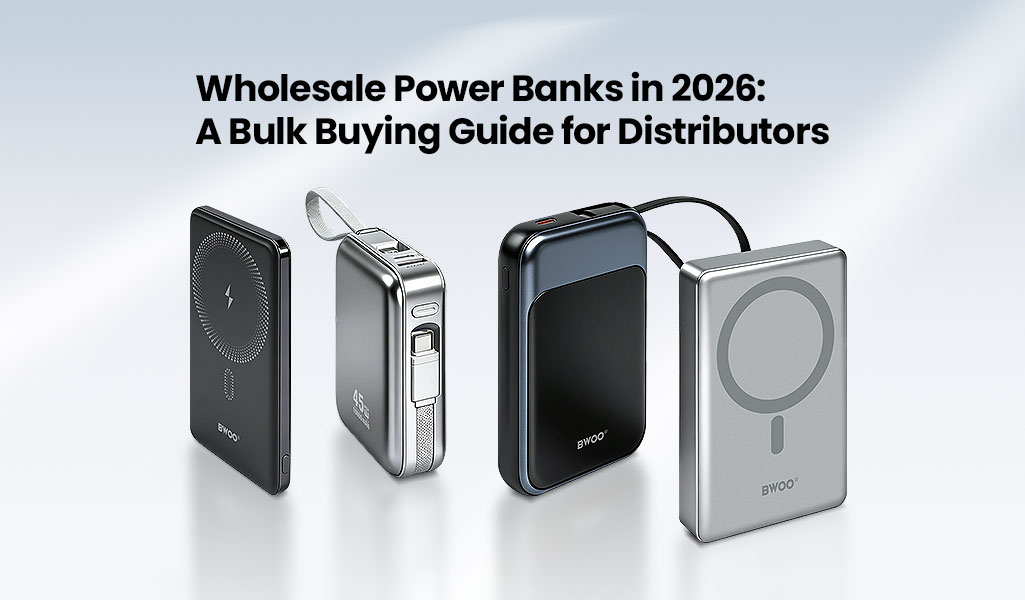
In 2026, power banks are no longer simple backup batteries. They have evolved into portable energy hubs that charge phones, tablets, and even laptops.
At the same time, the wholesale market is flooded with low-end products. For distributors, this often results in high return rates, rising after-sales costs, and damaged customer trust.
This guide is designed to help distributors move beyond trial-and-error sourcing. By understanding where the market is heading—and what technical traps to avoid—you can identify power banks that generate real, sustainable profit, not hidden losses.
Three Key Wholesale Trends in 2026
Understanding what end users demand is the foundation of smart sourcing.
1. From "Fast" to "Broader Power"
PD 20W is no longer enough.
Support for PD 3.1 and PPS, enabling 65W+ laptop charging, is rapidly becoming a baseline requirement in many markets.
2. Magnetic Wireless Charging Goes Mainstream
Magnetic alignment–based wireless power banks (Qi2-compatible) are becoming best-sellers in 2026.
Stable alignment improves efficiency, reduces heat, and significantly enhances user experience.
3. Lightweight Design with Higher Energy Density
Consumers are increasingly rejecting bulky "brick-style" power banks.
The winners are those that deliver 20,000mAh capacity in slimmer, lighter designs—without compromising safety.
The Distributor's Technical Checklist: Avoid Costly Mistakes
Professional buyers ask technical questions—not just for information, but to filter suppliers.
1. Rated Capacity vs. Advertised Capacity
Low-end manufacturers often exaggerate capacity.
Focus on conversion efficiency, not just mAh numbers.
BWOO's internal benchmark requires 85% or higher efficiency under standard test conditions.
2. The Critical Role of the BMS
A power bank is not just stacked battery cells.
A well-designed Battery Management System (BMS) prevents overcharge, overheating, and short circuits.
Expert tip: Ask suppliers whether the BMS includes independent NTC temperature monitoring.
3. Fire-Resistant Housing Standards
Check whether the enclosure has passed V0 flame-retardant testing.
This is essential for importer liability protection and local safety inspections.
4. Certification Completeness
CE alone is not enough.
Distributors should verify current battery safety certifications such as IEC 62133 or UL 2056, depending on the target market.
Why "Low Price" Is Quietly Damaging Distribution Businesses
1. The Hidden Cost Equation
Saving $0.50 per unit at purchase often correlates with 5% or higher early defect rates.
Returns, replacements, and customer churn quickly erase any upfront savings.
2. Compliance and Customs Risk
Customs inspections for power banks are becoming stricter worldwide.
Products without reliable brand backing or documentation are far more likely to be delayed or seized—freezing cash flow.
3. Long-Term Market Position
Branded, compliant products offer stable margins and help distributors build a reputation as reliable local suppliers, not short-term traders.
Partner Value: Why Distributors Choose BWOO
From a B2B perspective, sourcing is about systems—not just products.
1. Laboratory-Level Quality Control
Every production batch undergoes aging tests and functional validation before shipment, reducing early failure rates.
2. Inventory & Cash-Flow Support
BWOO offers flexible MOQs and ready-stock options, helping distributors maintain healthy turnover without excessive inventory pressure.
3. Deep Customization Capability
From housing design and packaging to firmware-level protocol tuning, BWOO provides complete brand-ready solutions, not generic products.
Conclusion:
In 2026, the power bank business is no longer about who sells cheapest.
It is about who delivers safe performance, fast charging, and long-term reliability.
Distributors who source with technical discipline—and partner with manufacturers who meet global standards—are the ones who win.


