



The USB-C wall charger market has matured significantly in 2026. With the EU's Common Charger Directive now in full effect and USB-C becoming the universal standard across laptops, phones, and accessories, B2B demand for quality USB-C wall chargers has never been stronger. For wholesalers, distributors, and private label brands, identifying the right manufacturer is the single most important sourcing decision you will make.
This guide provides an objective overview of the USB-C wall charger manufacturing landscape in China, with a focus on real, verifiable capabilities—not marketing rankings. We evaluate manufacturers across key dimensions: production capacity, certification portfolio, ODM capability, minimum order quantities, and technology leadership in GaN and multi-port designs. BWOO is included as one of the evaluated manufacturers, with full transparency on our capabilities and how they compare to industry peers.
USB-C Wall Charger Categories: Know What You Are Sourcing
Before evaluating manufacturers, it is essential to understand the product categories. USB-C wall chargers fall into three main segments:
Category | Power Range | Typical Ports | Target Market | Key Technology |
Single-Port Compact | 20W - 45W | 1×USB-C | Phone-only users, entry-level retail | GaN miniaturization, low BOM cost |
Multi-Port Mid-Range | 45W - 100W | 2-3 Ports (C+C+A) | Mainstream retail, corporate gifts | Dynamic power allocation, PPS support |
High-Power Multi-Port | 100W - 240W | 3-4 Ports (Multi-C + A) | Pro users, laptop+multi-device, premium retail | PD 3.1 EPR, GaN+thermal management |
For B2B buyers, multi-port mid-range and high-power chargers offer the best margin profile, as they command higher retail prices while sharing many components across SKUs. Single-port chargers are volume-driven and highly price-competitive, with thinner margins but larger order quantities.
Key Evaluation Dimensions for USB-C Charger Manufacturers
When assessing a USB-C wall charger manufacturer, price per unit is only one factor. A comprehensive evaluation should cover these six dimensions:
1. Production Capacity & Scale
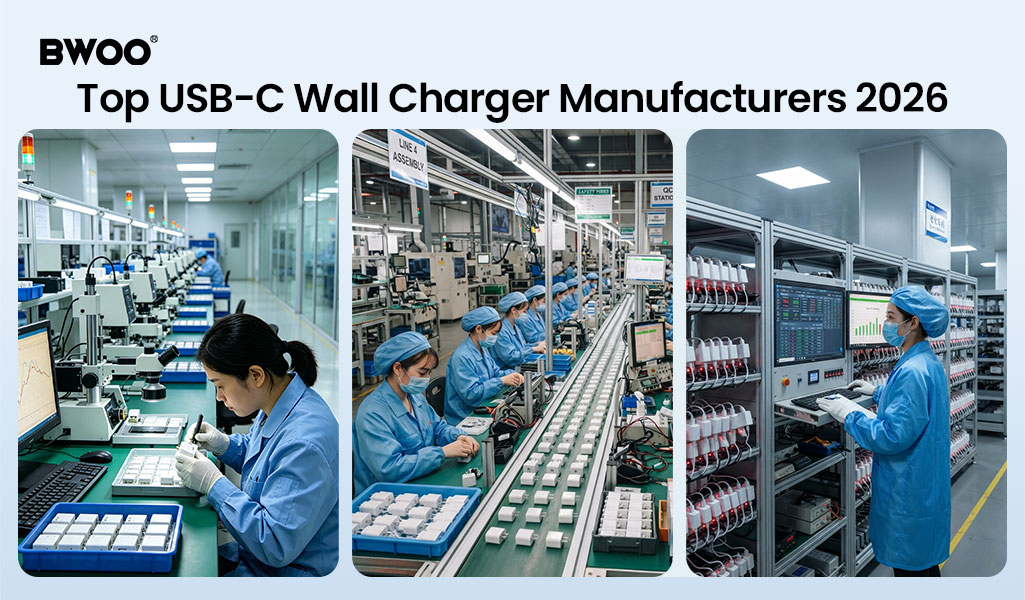
Annual output capacity determines whether a manufacturer can handle your order volumes without sub-contracting. Look for manufacturers with in-house SMT lines (surface-mount technology for PCB assembly), injection molding, and automated testing. A factory with 8-12 SMT lines and daily output of 20,000-50,000 units can comfortably handle mid-to-large B2B orders with consistent quality.
2. Certification Portfolio
As covered in detail in our IEC 62368-1 compliance guide, safety certifications are non-negotiable. The best manufacturers maintain active certifications across multiple regions: UL (USA), CE (EU), UKCA (UK), PSE (Japan), RCM (Australia), and KC (Korea). Having these certifications pre-existing—rather than needing to apply for them per order—saves 8-16 weeks of lead time and $5,000-$15,000 in testing fees per SKU.
3. ODM & Private Label Capability
Not all manufacturers offer ODM services. The difference between an OEM (builds your design) and an ODM (designs and builds a custom product for you) is significant. Top-tier ODM partners have in-house industrial design, firmware engineering, and packaging design teams. For private label, verify that the manufacturer can handle: custom housing colors and materials, logo printing/silk-screening, custom packaging design, and brand-specific certification (listing your company as the certificate holder).
4. GaN Technology Expertise
GaN (Gallium Nitride) is now table stakes for competitive USB-C chargers in 2026. However, not all "GaN chargers" are equal. Verify which GaN semiconductor your manufacturer uses: Navitas, Innoscience, and GaN Systems are tier-1 suppliers; unbranded or rebranded GaN FETs may have inconsistent performance. Also check whether the manufacturer has in-house GaN driver circuit design capability—some factories simply swap GaN FETs into existing silicon designs, which negates the efficiency and thermal advantages of GaN.
5. Minimum Order Quantity (MOQ) Flexibility
MOQ is a critical factor for brands entering the market or testing new SKUs. While large manufacturers may require 3,000-5,000 units per SKU, more flexible partners offer MOQs of 500-1,000 units for initial orders, with volume discounts scaling from 2,000+ units. BWOO, for example, offers 500-unit MOQ for private label wall chargers, allowing brands to validate market demand before committing to large production runs.
USB-C Wall Charger Manufacturer Landscape (China, 2026)
The following overview covers established Chinese USB-C charger manufacturers with verifiable capabilities. This is not a ranking—each manufacturer has different strengths suited to different buyer profiles:
Manufacturer | Location | Annual Capacity | Key Certifications | ODM/Private Label | MOQ (Typical) |
BWOO | Foshan | 5M+ units/year | UL, CE, FCC, UKCA, IEC 62368-1, RoHS, REACH | Full ODM + Private Label | 500 units |
Wecent | Dongguan | 10M+ units/year | UL, CE, FCC, PSE | OEM + Limited ODM | 2,000 units |
Baseus (Times Innovation) | Shenzhen | 20M+ units/year | UL, CE, FCC, PSE, KC, BSMI | OEM (own brand priority) | 5,000+ units |
Anker Innovations | Changsha/Shenzhen | 30M+ units/year | UL, CE, FCC, PSE, KC, BSMI, TÜV | OEM (own brand priority) | 10,000+ units |
Ugreen | Shenzhen | 15M+ units/year | UL, CE, FCC, PSE, KC | Limited ODM | 3,000 units |
AOHi (AoHai Technology) | Shenzhen | 8M+ units/year | UL, CE, FCC, PSE | ODM Available | 1,000 units |
CUKTECH | Nanjing | 5M+ units/year | CE, FCC, CCC | Limited ODM | 2,000 units |
INIU | Shenzhen | 3M+ units/year | CE, FCC, RoHS | OEM | 2,000 units |
Note: Large consumer brands like Anker and Baseus primarily serve their own retail channels and have high MOQs. For private label brands seeking a true manufacturing partner (not competing with their supplier's own brand), mid-sized ODMs like BWOO offer the best balance of capability, flexibility, and price.
BWOO USB-C Wall Charger Lineup for Wholesale & Private Label
BWOO's BO-CDA series covers the full USB-C wall charger spectrum with GaN technology across all models:
Model | Power | Ports | GaN Tech | Best For |
BO-CDA241 | 65W | 2C + 1A | GaNex Gen 2 | Compact everyday, phone+laptop |
BO-CDA265 | 67W | 2C + 1A | GaN | Business travel, 3-device simultaneous |
BO-CDA267 | 140W | 3C + 1A | GaN | Pro users, multi-laptop, family charging hub |
All BO-CDA models are IEC 62368-1 Fourth Edition certified, support USB PD 3.1 with PPS, and are available for private label with full customization—including housing color, logo placement, packaging design, and region-specific plug types (US/EU/UK/AU). Our GaNex technology in the BO-CDA241 delivers 65W in a 40% smaller package than equivalent silicon chargers, a key differentiator in the compact charger segment.
Sourcing Tips for USB-C Wall Charger Buyers
Request a factory audit report before committing to large orders. Even if you cannot visit in person, third-party audit services (SGS, Bureau Veritas, TÜV) can verify production capabilities and quality systems.
Test samples against your target market's electrical grid. A charger that performs well on China's 220V/50Hz grid may behave differently on North America's 120V/60Hz or Japan's 100V/50-60Hz systems. Always request samples and test under your target market conditions.
Clarify intellectual property ownership upfront. For ODM projects, establish who owns the PCB layout, firmware, and industrial design. BWOO's standard ODM agreement assigns full IP ownership to the client upon final payment, with no restrictions on future sourcing.
Negotiate warranty terms. Standard warranty is 12 months; premium manufacturers offer 18-24 months. Clarify whether warranty covers return shipping, unit replacement, or credit against future orders.
Frequently Asked Questions
Q: What is the difference between GaN and silicon chargers for B2B buyers?
A: GaN chargers are 30-50% smaller, run cooler, and achieve higher efficiency (90-95% vs 82-88% for silicon). For B2B, this means lower shipping costs (smaller/lighter packaging), fewer warranty returns (less heat = longer lifespan), and premium retail positioning. The per-unit cost difference is now under $2 at scale, making GaN the clear choice for 2026.
Q: How long does private label USB-C charger production take?
A: Typical timeline: 2-3 weeks for sample production and approval, 4-6 weeks for mass production after sample confirmation, plus 2-4 weeks for certification if your brand needs separate certification documents. BWOO's pre-existing CB certifications can reduce the certification phase to 1-2 weeks.
Q: What is the minimum investment for a private label wall charger line?
A: With BWOO's 500-unit MOQ at approximately $8-15/unit (depending on power and features), a first-order investment of $4,000-$7,500 can launch a branded USB-C charger line. This includes custom housing, logo, packaging, and certification documentation under your brand.
Q: Should I choose a single-port or multi-port charger for my first product?
A: Multi-port (2C+1A) 65-67W chargers offer the best market entry profile: they appeal to the broadest user base, command higher retail prices than single-port units, and have proven demand on Amazon and e-commerce platforms. Single-port chargers are more suitable as a second SKU for price-sensitive market segments.
Ready to launch your own branded USB-C wall charger line? Contact BWOO for a private label consultation, including sample evaluation, certification documentation, and customized pricing based on your target market and order volume. Our team responds within 24 hours.


