



When you plug your phone into a charger, you probably don't think about safety standards. You just expect it to work—and more importantly, you expect it not to catch fire or give you an electric shock. That expectation is not a coincidence. Behind every charger, power supply, and electronic device on the market lies a complex web of safety regulations designed to protect consumers. Among these, one standard has been making waves in the electronics industry: IEC 62368-1. If you've never heard of it, you're not alone—but if you use any modern electronic device, this standard is quietly keeping you safe.
Why Do Electronics Need Safety Standards?
Think of safety standards as the guardrails of the electronics world. Without them, manufacturers could release products with no independent verification that they are safe. A poorly designed charger could overheat and melt. A laptop power supply with inadequate insulation could deliver a dangerous shock. Safety standards exist to prevent these scenarios by setting minimum requirements that every product must meet before it reaches store shelves.
For decades, different types of devices followed different standards. Audio and video equipment like TVs and speakers followed IEC 60065. IT equipment like computers and printers followed IEC 60950. But as technology converged—your phone is now your camera, music player, and computer—these separate standards became increasingly awkward and outdated.
What Is IEC 62368-1? A Simple Explanation
IEC 62368-1 is a new generation of safety standard that takes a fundamentally different approach. Instead of classifying devices by product type (TV vs. computer), it classifies them by the types of energy they contain. This is called the Hazard-Based Safety Engineering (HBSE) model.
The HBSE Model: Energy Sources, Not Device Types
The HBSE approach looks at every electronic device and asks: what kinds of energy does this product contain, and could any of them harm a person? The energy sources are divided into categories:
Electrical energy — the risk of electric shock from exposed circuits or inadequate insulation
Thermal energy — the risk of burns from components that get too hot
Optical energy — the risk of eye damage from LEDs, lasers, or bright displays
Mechanical energy — the risk of injury from moving parts, sharp edges, or unstable enclosures
For each energy source, the standard defines safety thresholds (called ES1, ES2, and ES3 for electrical, TS1/TS2/TS3 for thermal, etc.). An ES1 exposure is considered safe under all conditions—no special protection needed. An ES3 exposure is dangerous and requires robust safeguarding. This universal language means a charger and a laptop are evaluated using the same framework, making safety assessments more consistent and thorough.
Why Were IEC 60065 and IEC 60950 Retired?
The old standards served their purpose for decades, but technology outgrew them. IEC 60065 (for audio/video) and IEC 60950 (for IT equipment) were product-category-based standards. If a new type of device didn't fit neatly into either category, regulators had to shoehorn it into a standard that wasn't designed for it. USB-C chargers that can power both a laptop and a phone are a perfect example—are they IT equipment or A/V equipment? Under the old system, the answer was unclear.
Furthermore, the old standards were prescriptive—they told you exactly how to build something. The new IEC 62368-1 is performance-based: it tells you what level of safety you need to achieve, and lets engineers figure out the best way to get there. This flexibility encourages innovation while maintaining rigorous protection for consumers.
What Does IEC 62368-1 Mean for You as a Consumer?
For the average person buying a charger, power bank, or any electronic accessory, IEC 62368-1 translates to real, tangible benefits:
Lower risk of overheating and fire — The thermal safeguards in IEC 62368-1 are stricter than legacy standards. A compliant charger must pass rigorous temperature tests under worst-case conditions.
Better protection against electric shock — Enhanced insulation requirements and creepage distance rules mean the high-voltage and low-voltage sides of a charger are more thoroughly separated.
Smarter fail-safe design — The standard requires manufacturers to consider single-fault conditions: if one component fails, the device must remain safe.
Future-proof testing — Because the standard is technology-neutral, it applies to USB-C PD chargers, GaN chargers, wireless charging pads, and products that haven't been invented yet.
How to Identify IEC 62368-1 Certified Products
When shopping for electronics, look for these signs that a product has passed IEC 62368-1 testing:
Check the product label or user manual — Look for "IEC 62368-1" printed on the charger body, packaging, or specification sheet.
Look for recognized certification marks — UL (US), CE (EU), CCC (China), and UKCA (UK) marks often indicate IEC 62368-1 compliance as the underlying standard.
Visit the manufacturer's website — Reputable brands publish compliance documents and test reports for their products. If a brand is transparent about certifications, that's a good sign.
Verify on certification databases — UL, TUV, and other testing labs maintain public databases where you can look up certified products by model number.
BWOO: Full IEC 62368-1 Compliance Across the Entire Charger Lineup
At BWOO, safety is not an afterthought—it's the foundation of every product we design. Our entire BO-CDA series of USB-C wall chargers has been tested and certified to IEC 62368-1, giving you peace of mind whether you're charging your phone on your nightstand or powering your laptop during a critical presentation.
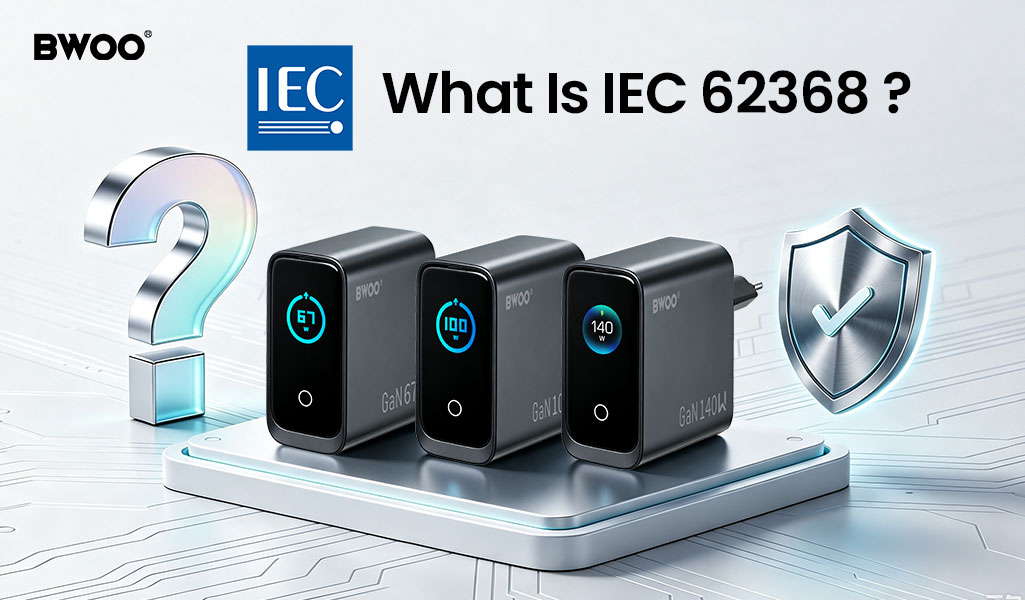
The BO-CDA241 (65W) delivers safe, efficient power in a compact body ideal for everyday carry. The BO-CDA265 (67W) adds dual-port capability so you can charge two devices simultaneously without compromising safety. For power users, the BO-CDA267 (140W) provides workstation-level charging for laptops, tablets, and phones—all under the same IEC 62368-1 umbrella of protection.
Every BO-CDA charger undergoes multi-point safety testing before leaving the factory: over-voltage protection, over-current protection, short-circuit protection, and temperature regulation are all built in. When you see the BWOO logo, you're seeing a commitment to your safety.
Frequently Asked Questions
Is IEC 62368-1 mandatory for all electronics?
Yes, in most major markets. The EU, North America, China, Japan, and Australia all recognize IEC 62368-1 as the primary safety standard for audio/video, IT, and communication equipment. Since December 2020, manufacturers have been required to transition from the old standards to IEC 62368-1.
Does IEC 62368-1 apply to wireless chargers too?
Yes. Any device that plugs into mains power or contains energy sources that could pose a hazard falls under IEC 62368-1. This includes wireless charging pads, power banks, and multi-device charging stations.
How can I tell if my current charger is safe?
If your charger was purchased from a reputable brand within the last 2-3 years and carries certification marks (UL, CE, CCC, etc.), it likely complies with IEC 62368-1. If you're using an old or unbranded charger, it's worth replacing it with a certified product—the cost is small compared to the safety risk.
What's the difference between IEC 62368-1 and USB-IF certification?
IEC 62368-1 covers electrical safety (shock, fire, injury). USB-IF certification covers protocol compliance and interoperability. A charger can be USB-IF certified but not safety-certified, or vice versa. For the safest experience, look for chargers that carry both certifications—like BWOO's BO-CDA series, which meets IEC 62368-1 safety standards and supports USB PD protocols.
Choose Safety. Choose BWOO.
When it comes to something you plug into your wall and connect to your expensive devices every single day, safety matters. Don't settle for chargers that cut corners on compliance. BWOO's BO-CDA series gives you GaN-powered efficiency, USB-C fast charging, and full IEC 62368-1 certification—all in one package.
Browse the full BO-CDA lineup on the BWOO official website or find us on major online retail platforms. Your devices deserve the safest power possible.


