




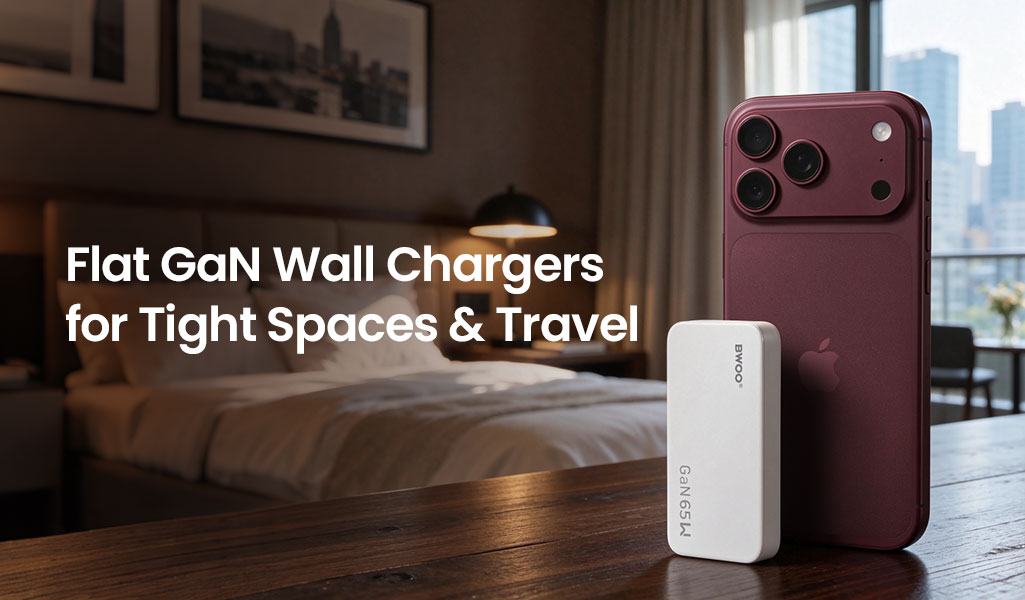
Charger design is usually discussed in terms of wattage, ports and charging protocols. But a charger also has to fit into a real place: behind a bedside table, beside another plug on a power strip, or inside a compact travel pouch. A flat GaN wall charger approaches the problem from a different angle. Its value is not only how much power it delivers, but also how it occupies space around the outlet.
The design direction appeared in a recent product launch. On November 4, 2026, Peak Design introduced a dual-USB-C GaN charger rated up to 65W with a slim body around half an inch thick. The announcement is a useful example of how manufacturers are exploring charger form factors alongside output and port count. It should be treated as a product-design signal, not proof that every buyer needs a flat charger. (The Verge coverage)
Why Does a Flat Profile Matter?
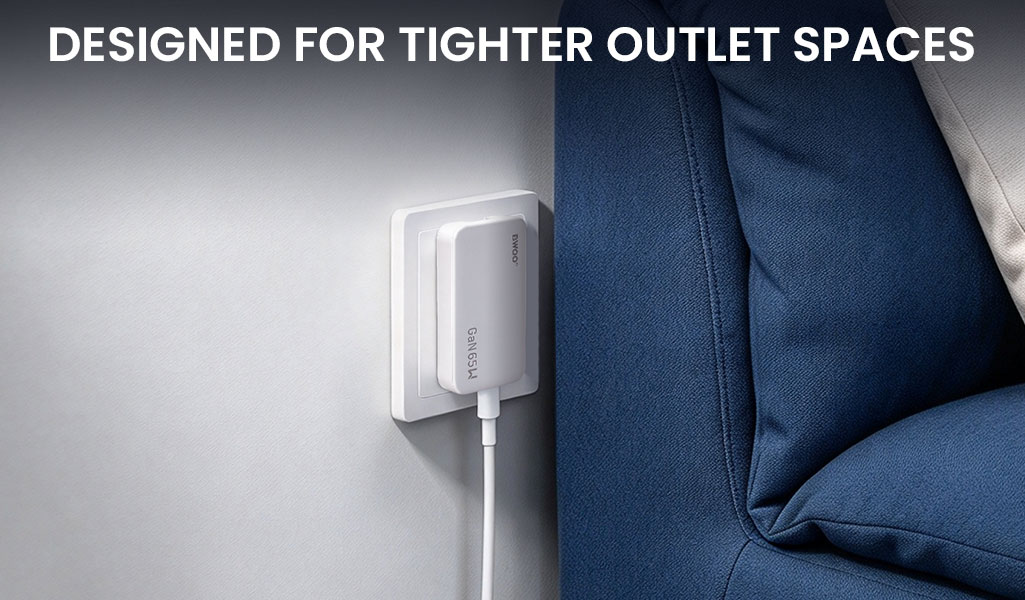
In a crowded outlet, a conventional cube charger can block an adjacent socket or interfere with a large plug. A flatter body may reduce that obstruction, depending on the direction of the wall socket and the charger's plug orientation. It can also sit closer to a wall or furniture surface when the outlet is positioned behind a desk or nightstand.
The benefit is practical rather than universal. A flat charger may be easier to slip into a laptop sleeve or travel organizer, but the cable still needs space to bend and route safely. A slim body also does not automatically mean a lighter product: dimensions, materials, plug design and internal components all affect weight.
What Does GaN Add to the Design?
GaN (gallium nitride) is a power semiconductor technology used in compact charging products. It can support high switching frequencies and efficient power conversion, helping designers build higher-power chargers in smaller packages than many traditional silicon-based designs. The final size and temperature behavior still depend on the circuit, cooling design, components and enclosure.
GaN is an enabling technology—not a guarantee that every GaN charger is smaller, cooler or faster than every silicon charger. Buyers should evaluate the finished product under realistic loads, especially when multiple ports are used.
For a deeper explanation of port count and power allocation, see BWOO's guide to choosing a multi-port GaN charger for multiple devices. The current article focuses on the physical form factor; the existing guide covers how buyers should think about total wattage, ports and charging distribution.
Where Can a Slim Charger Be Useful?
Behind furniture and beside other plugs
A flat body can be useful when an outlet is close to a wall, behind a cabinet or located in a tight space. It may also leave more room for an adjacent socket. However, the result depends on the outlet orientation and the shape of the charger's plug and cable. Buyers should test it on both vertical wall sockets and horizontal power strips where relevant.
On a travel day
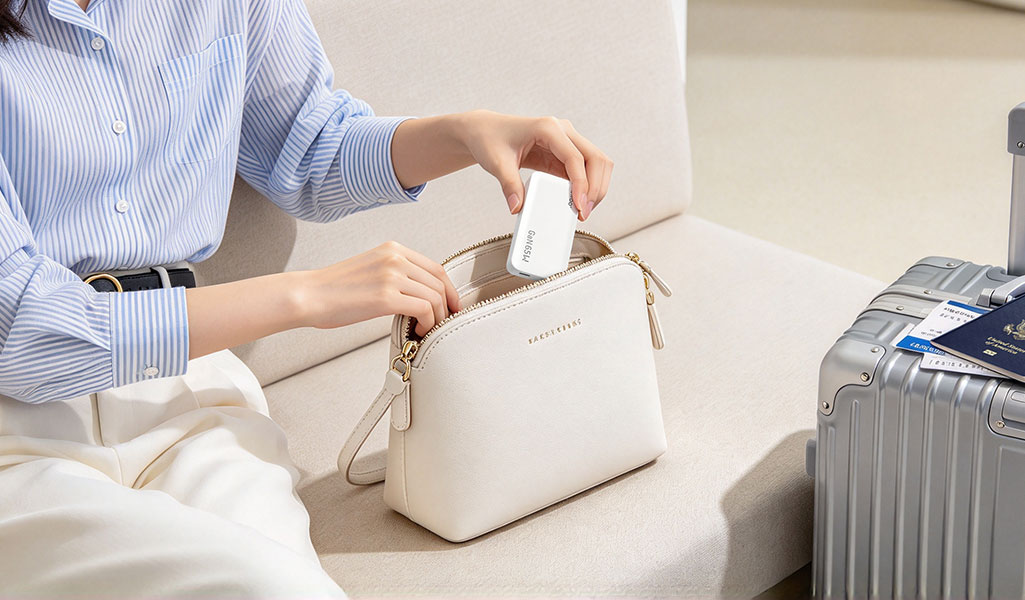
A slim charger can be easier to pack beside a laptop, phone and cable set. The value is especially clear for business travelers who want one wall charger for a laptop and a phone. Still, a slim wall charger is not the same as a universal travel adapter. Plug type, input voltage, regional compatibility and safety certification must be checked separately.
At a shared desk or bedside table
A dual-port charger can reduce the number of separate adapters needed, provided the total power and port allocation match the connected devices. Users should check whether the charger can maintain the required laptop output when a second device is connected, and whether plugging or unplugging a second device causes charging to renegotiate.
A BWOO Example: BO-CDA230
The BWOO BO-CDA230 is listed as a 65W flat dual-port GaN wall charger with a foldable plug. Its product page describes a slim profile for tight spaces and travel, dual-device charging, and a nine-layer protection system. These points make it a relevant product example for the flat-charger discussion.
However, the public page does not currently provide a detailed technical output table. Before publishing a port-by-port power claim, buyers and editors should request the latest specification sheet. Confirm the exact USB-C port configuration, the maximum output in single-port mode, the allocation when both ports are used, supported PD profiles, plug type and regional certifications. Do not assume that “65W dual-port” means 65W is available to each port simultaneously.
B2B Buying Checklist for Flat GaN Chargers
Dimensions and orientation: Request length, width and thickness, plus clear photos showing the charger connected to a wall socket and a power strip.
Plug options: Confirm fixed, foldable, interchangeable or regional plug versions. Do not infer universal travel compatibility from a foldable plug.
Power allocation: Ask for the complete single-port and dual-port output table. Test with a laptop and phone connected at the same time.
Thermal performance: Test sustained charging under realistic ambient temperature and load. A compact housing makes thermal design especially important.
Cable clearance: Check whether the USB-C cable can bend without pressing against furniture or another adapter.
Safety and compliance: Request the certificates and test reports required for the target market, and ensure the exact plug variant is covered.
Packaging and channel fit: Consider whether the slim form factor is visually obvious in packaging and whether a travel use case is clear to shoppers.
For a wider view of the BWOO charger range, buyers can compare flat, compact multi-port and higher-output charger types. A flat model can complement, rather than replace, a conventional cube or desktop charger in a range plan.
Conclusion
A flat GaN wall charger can solve a real but specific problem: fitting useful charging power into spaces where a bulky adapter is inconvenient. Its commercial value depends on the combination of profile, plug design, port allocation, thermal behavior and regional compatibility. For B2B buyers, the right question is not “How thin is it?” alone, but “Does this shape make charging easier in the situations my customers actually face?”
FAQ
Is a flat GaN charger automatically better for travel?
Not automatically. A slim body may pack more easily, but buyers should also check weight, plug type, voltage input, cable clearance and regional compatibility.
Does GaN make a charger run cool?
GaN can improve power-conversion efficiency and enable compact designs, but temperature depends on the full circuit and thermal design. Test the finished charger under sustained load.
Can a 65W dual-port charger deliver 65W to both ports?
Not unless the specification explicitly supports that combined output. The total power budget is shared or otherwise allocated according to the charger’s design. Check the port-by-port table.
Is a flat wall charger the same as a universal travel adapter?
No. A wall charger supplies power to devices; a universal travel adapter changes plug compatibility. A flat charger does not automatically support every regional socket or voltage condition.
What should buyers request before sourcing BO-CDA230?
Request its full output allocation table, supported charging protocols, plug variants, dimensions, thermal test results and target-market certificates.


