




The GaN charger wholesale market reached $1.2 billion in 2026, with a projected 25.7% CAGR carrying it toward $6 billion by 2033. For B2B buyers evaluating fast charging technology for business, the strategic question is no longer whether GaN vs silicon charger — it is when to switch, and how to time the transition for maximum margin.
The GaN Supply Chain Landscape
Power IC Cost Curve
The single most important cost driver in GaN chargers is the power IC. As GaN-on-silicon and GaN-on-SiC manufacturing scale, power IC costs are falling 8-12% annually. This steady decline compresses the premium over silicon-based chargers every quarter, and it is the main reason GaN is crossing from premium to mainstream price points.
In-House IC Sourcing Advantage
Suppliers with in-house IC sourcing or long-term wafer agreements gain a structural cost advantage. They can lock prices across quarters, reduce dependency on spot-market fluctuations, and shorten lead times. In contrast, suppliers buying third-party chips are exposed to allocation risk during demand spikes. For wholesalers, this supplier-side difference translates directly into price stability and delivery reliability.
Component Ecosystem Maturity
Beyond the IC, GaN chargers rely on high-frequency transformers, synchronous rectifiers, and advanced thermal management materials. The maturity of this component ecosystem now supports mass production at consistent quality, removing the yield problems that plagued early GaN adoption.
Regulatory Drivers: EU ESPR
The EU ESPR (Ecodesign for Sustainable Products Regulation) is the most consequential regulatory force in the charger market. ESPR sets energy-efficiency targets and durability requirements that legacy silicon chargers struggle to meet. GaN chargers, with >93% efficiency and lower heat output, comply more easily and often exceed the mandated thresholds. (来源:EU ESPR)
For any B2B buyer selling into the EU, GaN is no longer a premium option — it is becoming a compliance requirement. Delaying the transition risks inventory that cannot legally be sold in key markets.
GaN vs Silicon Charger Comparison
Dimensions | GaN charger | Traditional silicon charger |
Size | 40-60% smaller | Larger |
Conversion Efficiency | >93% | 85-90% |
Heat Generation | Low | High |
Maximum Power per Port | Up to 140W | Typically ≤65W |
Cost Trend | 8-12% annual decrease | Has bottomed out |
ESPR Compliance | Easy to meet | Difficult to meet |
When Should B2B Buyers Switch?
Switch Now: EU and Premium Segments
Switch now if your target market includes the EU (ESPR compliance), North America premium retail, or business/professional segments where compact multi-port chargers command higher margins. The GaN price premium has narrowed to 10-20% and continues shrinking, so early movers capture differentiation before GaN becomes table stakes.
Wait Only for Pure Budget Segments
The only defensible reason to wait is if you sell exclusively into ultra-budget markets where every cent matters and customers accept bulkier, hotter chargers. Even there, the gap is closing fast — within 12-24 months, GaN cost parity will erase the silicon advantage entirely.
The BWOO GaN Portfolio
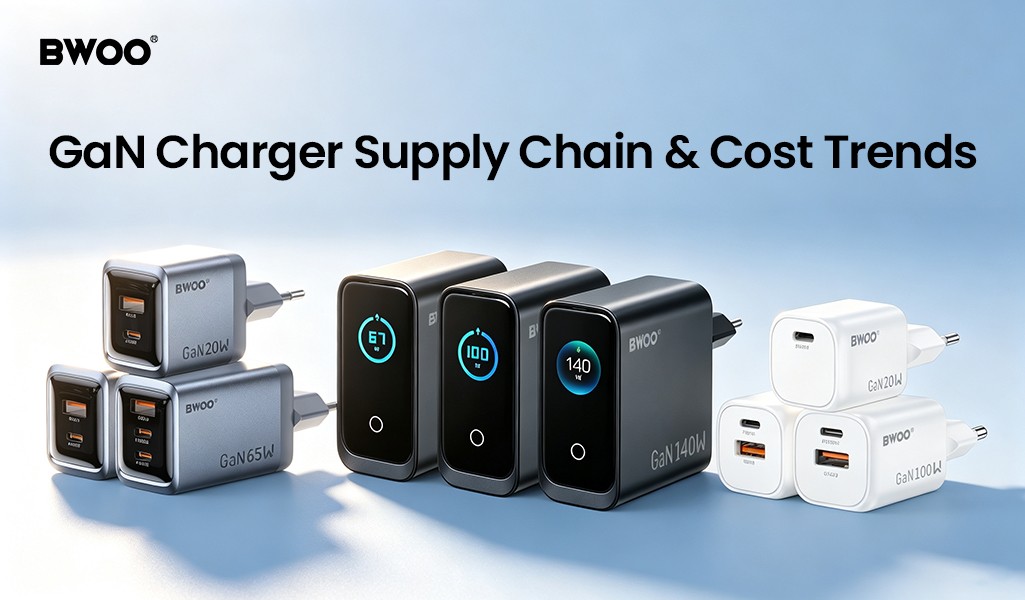
BWOO's GaN charger series spans the full power range: CDA241 (65W), CDA265 (67W), CDA267 (140W), CDA270, CDA271, and the CDA255-261 range. All models carry CE/FCC/UL certification and support multi-port output with smart power allocation, covering laptop, tablet, and phone charging in a single adapter.
The Technology Behind GaN: Why Efficiency Wins
Gallium nitride differs from silicon in its bandgap — the energy required to move electrons into a conducting state. GaN's wider bandgap lets it handle higher voltages and switching frequencies with less energy lost as heat. In practical terms, a GaN charger can run at 1MHz or higher switching frequency, versus 100-300kHz for silicon, which allows far smaller transformers and capacitors. This is why GaN chargers are dramatically smaller for the same power output.
The efficiency advantage compounds under load. At 65W, a quality GaN charger stays cool to the touch and delivers >93% efficiency, while a comparable silicon charger may waste 10-15% as heat. For business buyers, this translates to lower defect rates, longer product life, and fewer customer complaints about overheating — all of which reduce your total cost of ownership beyond the purchase price.
Multi-Port Design and Power Allocation
Modern GaN chargers increasingly feature multiple USB-C and USB-A ports with smart power allocation. A 140W charger might deliver 100W to a laptop or split 65W + 30W + 18W across three devices simultaneously. The quality of this power-allocation algorithm directly affects user experience — poor implementations cause devices to reconnect when another device plugs in. When evaluating samples, test multi-device charging stability under mixed loads.
For wholesale positioning, multi-port GaN chargers are the highest-value SKUs because they replace multiple single-port adapters and command premium pricing. BWOO's BO-CDA267 (140W) and the CDA255-261 range exemplify this approach with smart allocation and multi-protocol support.
Testing and Quality Control for GaN Chargers
Wholesale buyers should verify three things before signing off on GaN samples.
Thermal performance — run the charger at rated power for 30 minutes and confirm the surface stays below 55°C; excessive heat is the leading cause of GaN field failures.
Multi-port stability — plug and unplug devices repeatedly to check for re-negotiation glitches.
Ripple and noise — a quality unit keeps output ripple low, protecting sensitive devices.
Reading the Spec Sheet Correctly
A GaN charger's total power rating (e.g., 140W) is the sum across all ports, not per-port output. Confirm the per-port maximums and the allocation table before marketing a SKU to laptop buyers. Also verify the supported protocols — PD 3.1, QC 4.0+, PPS — because protocol coverage determines real-world compatibility across phone brands.
FAQ
Q1: Is GaN charger technology mature enough for bulk sourcing?
Yes. GaN chargers achieve >93% efficiency and are mass-produced by major Chinese manufacturers at consistent quality.
Q2: What is the current price premium of GaN vs silicon?
10-20%, declining 8-12% annually as IC costs fall. Parity is expected within 12-24 months.
Q3: Does EU ESPR require GaN specifically?
No, but ESPR's efficiency targets are far easier for GaN chargers to meet than legacy silicon designs.
Q4: What GaN power range should I stock first?
65W multi-port is the volume sweet spot for phones and laptops; add 100W-140W for premium and business buyers.
Evaluate GaN for your product line today. Request Catalog from BWOO to see the full CDA GaN charger series with wholesale pricing.


