



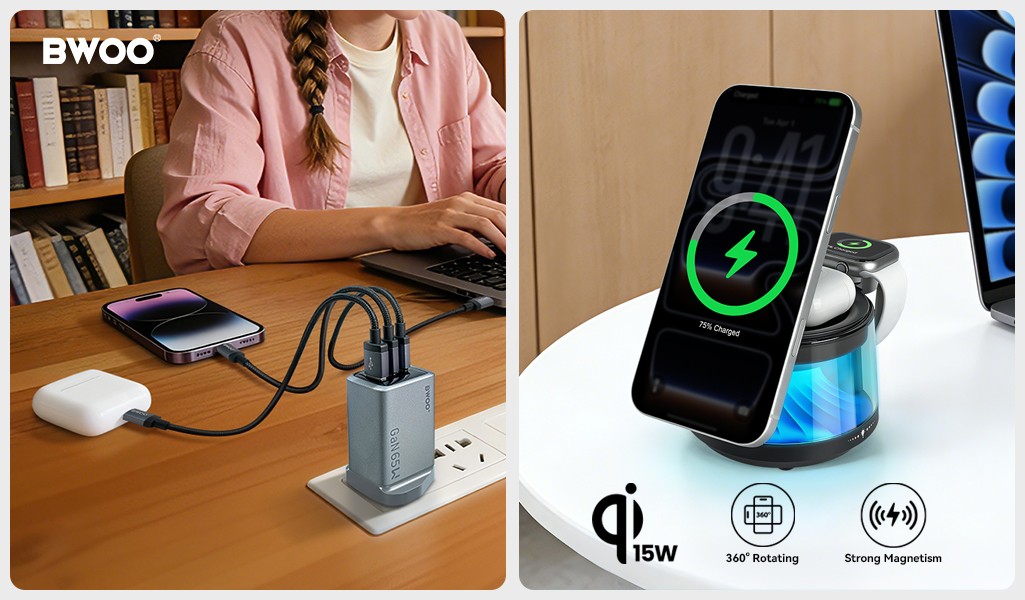
The wired vs wireless charging debate has evolved significantly. In 2026, wired charging has reached 240W via USB PD 3.1 EPR, while wireless charging with Qi2 delivers up to 25W with magnetic precision. But speed is only part of the equation. This article compares both methods across four dimensions — speed, battery health, efficiency, and convenience — using real-world data, so you can decide which is right for your lifestyle.
Speed: Head-to-Head Comparison
We compiled test data from charging an iPhone 16 Pro (3,577 mAh battery) using different methods. All tests started from 0% battery:
Charging Method | Max Power | 0→50% | Full Charge | Heat Level |
Standard Qi Wireless | 7.5W | ~68 min | ~3.5 hours | Moderate |
Qi2 / MagSafe Wireless | 15W | ~42 min | ~2.5 hours | Low–Moderate |
Qi2 25W Wireless | 25W | ~30 min | ~1.9 hours | Moderate |
Standard Wired USB-C | 20W | ~30 min | ~1.8 hours | Low |
Fast Wired PD 3.1 | 65W | ~18 min | ~1.1 hours | Low (actively managed) |
Super-Fast Wired (GaN) | 100W–140W | ~12 min | ~28 min | Low (actively managed) |
Verdict: Wired charging is 2–4x faster than wireless. Even Qi2 at 25W takes nearly twice as long as a basic 20W wired charger. For emergency top-ups, wired wins decisively.
Battery Health: Does Wireless Charging Degrade Your Battery Faster?
The Key Factor Is Heat, Not The Method
Lithium-ion batteries degrade primarily from two stressors: heat and high-voltage stress. A well-managed wireless charger causes negligible additional degradation compared to wired. The problem arises when:
The phone and charger coils are misaligned (non-magnetic), dropping efficiency from 85% to 60% and generating excess heat
A thick or non-compatible phone case traps heat
You use a cheap, uncertified charger without proper thermal management
Modern Qi2 chargers with magnetic alignment eliminate the misalignment problem entirely. Combined with active cooling fans now common in premium Qi2 chargers, the temperature difference between wired and wireless charging has narrowed to just 2–5°C in controlled tests.
The 80% Strategy
Regardless of charging method, keeping your battery between 20% and 80% charge is more impactful on long-term battery health than choosing wired over wireless. Many phones in 2026 offer "Optimized Battery Charging" that learns your routine and holds at 80% until you need the full charge.
Efficiency: Energy Loss and What It Costs You
Metric | Wired (GaN) | Wireless (Qi2) |
Charging Efficiency | 90–95% | 75–90% |
Energy Loss (per full charge) | ~5–10% | ~10–25% |
Annual Extra Electricity Cost (daily charge) | Negligible | ~$2–5/year |
Standby Power Draw | <0.1W | 0.3–1.5W (active standby) |
Wireless charging is inherently less efficient because energy must be transmitted through an electromagnetic field across a physical gap. The 2026 introduction of Qi2's Magnetic Power Profile (MPP) has improved efficiency to ~85–90% by eliminating alignment losses, closing the gap with wired charging.
Convenience: The Real Differentiator
Use Case | Best Method | Why |
Overnight charging | Wireless | Slow, gentle charge; no cable wear; StandBy mode |
Quick top-up before leaving | Wired | 50% in 12–18 minutes with GaN charger |
Desk / office | Wireless | Drop-and-go; cleaner desk setup |
Gaming while charging | Wired | No heat stacking; faster charge |
Car (short drive) | Wireless (Qi2 magnetic) | No cable fumbling; magnetic auto-attach |
Car (long road trip) | Wired | Faster charge; GPS+charging won't overheat phone |
Cost Comparison: What You Pay for Convenience
Product | Wired Setup | Wireless Setup |
Charger | $15–$35 (65W GaN) | $25–$60 (Qi2 25W) |
Cable | $8–$20 (USB-C, 1–2m) | N/A |
Replacement Cost | Cable every 12–18 months | None |
3-Year Total | ~$50–$95 | ~$25–$60 |
Wireless charging has lower total cost of ownership because there are no cables to fray or connectors to wear out. However, wired chargers offer more versatility — a single 100W GaN charger can power your phone, tablet, and laptop.
2026 Verdict: Use Both
The best charging strategy in 2026 is a hybrid approach:
Wireless for overnight, office desk, and car mounts — convenience wins
Wired for emergency top-ups, gaming sessions, and travel — speed and efficiency win
With Qi2 bringing magnetic alignment and 25W speeds, plus GaN making wired chargers smaller than ever, there has never been a better time to invest in a complete charging ecosystem.
BWOO's Complete Charging Ecosystem
BWOO offers both wired GaN fast chargers (20W–240W, PD 3.1 support) and Qi2-certified wireless chargers (desktop stands, car mounts, power banks), giving you the best of both worlds. Click here to explore our full range.


