



The Most Persistent Question in Consumer Electronics
"Will fast charging destroy my phone battery?" It is one of the most Googled questions in consumer electronics, with over 8,000 monthly searches globally. On social platforms like Reddit and Toutiao, fast-charging debate threads routinely attract tens of thousands of views and thousands of comments — often filled with conflicting advice and outdated information.
In 2026, the science is clear. Let's address the five most stubborn fast-charging myths, one by one, using current data from accredited laboratories and industry standards.
Myth 1: Fast Charging Destroys Battery Health
The truth: Modern fast charging is engineered to be battery-safe.
The China Electronics Standardization Institute and TEL Laboratory published a white paper in 2026 specifically addressing this question. Their finding: after 500 standard charge-discharge cycles, the battery health gap between fast charging and slow charging was only 0.3% to 0.5%. This is imperceptible in daily use.
How is this possible? Today's fast-charging systems use multi-stage charging profiles:
0% to 60%: High-power rapid charging, when the battery can safely accept maximum current
60% to 80%: Power gradually reduces as the battery approaches capacity
80% to 100%: Trickle charging, identical in speed to old-school 5W chargers
The battery is never subjected to sustained high current at high charge levels — the exact condition that accelerates degradation. For a deeper dive into the technology behind this, see our explainer on how multi-port chargers handle power negotiation.
Myth 2: You Must Use the Original Manufacturer's Charger
The truth: You need a charger that supports the right protocols, not necessarily the original brand.
USB Power Delivery (USB-PD) is an open standard used by Apple, Samsung, Google, and most laptop manufacturers. A third-party charger that supports USB-PD 3.1 and PPS (Programmable Power Supply) will charge your device exactly as effectively as the first-party charger — often at a lower price and with additional ports.
The key is protocol matching, not brand matching. BWOO GaN charger lineup supports USB-PD 3.1, PPS, and QC 5.0, covering virtually every smartphone, tablet, and laptop on the market.
The caveat: some manufacturers still use proprietary ultra-fast charging protocols (e.g., OPPO's SuperVOOC, HUAWEI's SuperCharge). For these devices, a standards-compliant charger will still fast-charge, but may not achieve the absolute maximum branded speed. In all cases, the charging is perfectly safe.
Myth 3: All USB-C Cables Are the Same
The truth: Cable quality is often the bottleneck, not the charger.
USB-C cables have wattage ratings. A cable rated for 60W will limit a 100W charger to 60W output. Worse, some unrated cables cannot handle sustained high current safely, leading to overheating at the connector.
When purchasing cables, look for:
Wattage rating clearly stated on packaging or connector
E-Marker chip (5A-rated cables): enables the cable to communicate its capacity to the charger
Certification marks: USB-IF certification or MFi (for Lightning accessories)
BWOO data cable collection includes braided nylon and silicone options rated for the full wattage range, from standard 60W to high-power 100W+ applications.
Myth 4: Charging Overnight Is Dangerous
The truth: Modern chargers and phones have multi-layer overcharge protection.
Lithium-ion battery management systems (BMS) in every modern smartphone monitor voltage, current, and temperature continuously. When the battery reaches 100%, charging stops completely — the phone runs directly off wall power, and the battery is not "overcharged."
The one legitimate concern is heat: if you charge your phone under a pillow or on a fabric surface with no airflow, the charger and phone can overheat, triggering thermal throttling or, in rare cases, safety shutdown. This is a ventilation issue, not a charging issue. Place your phone and charger on a hard, open surface while charging overnight.
Myth 5: Wireless Charging Is as Fast as Wired
The truth: Wired charging remains significantly faster on a watt-for-watt basis.
Wireless charging loses approximately 20-30% of input power to heat due to electromagnetic induction inefficiency. A 15W wireless charger delivers roughly 10-12W of actual charging power to the device, while a 15W wired charger delivers close to the full 15W with minimal loss.
This isn't to say wireless charging is bad — its convenience for desk and nightstand use is genuine. But for rapid top-ups when time matters, wired GaN fast charging is the superior choice.
BWOO's Role in Safe Fast Charging
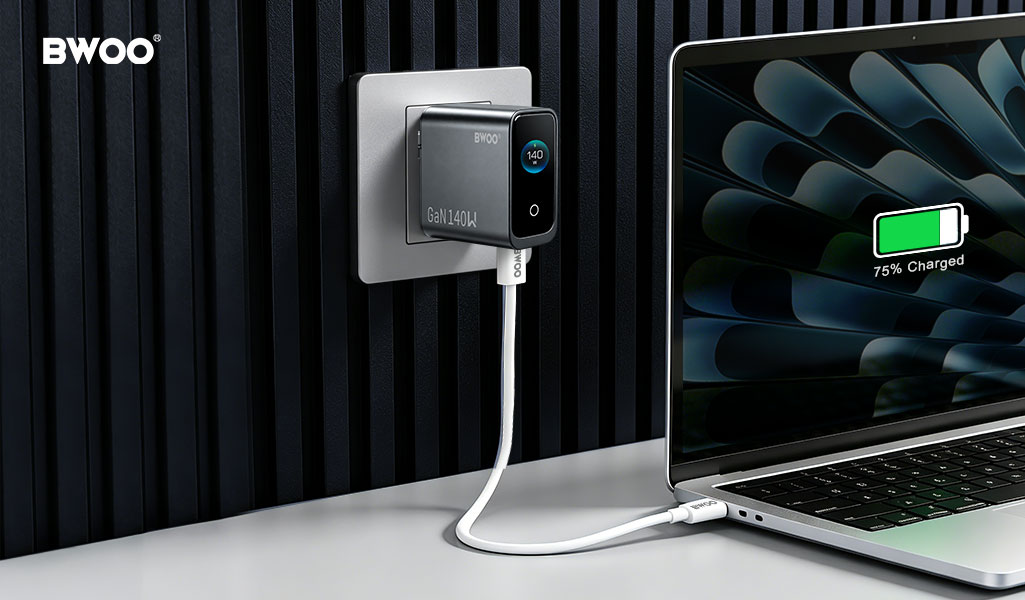
Every BWOO charger and cable is designed with multi-layer protection: over-current protection, over-voltage protection, short-circuit protection, and temperature control. Whether you're using the BO-CDA267 140W GaN Smart Display Charger for your laptop or a compact 20W PD charger for your phone, the safety systems operate identically.
Fast charging in 2026 is not a compromise between speed and safety. It's an engineering achievement that delivers both. The myths persist because the technology moved faster than consumer education — but the data from accredited laboratories is unambiguous.


