



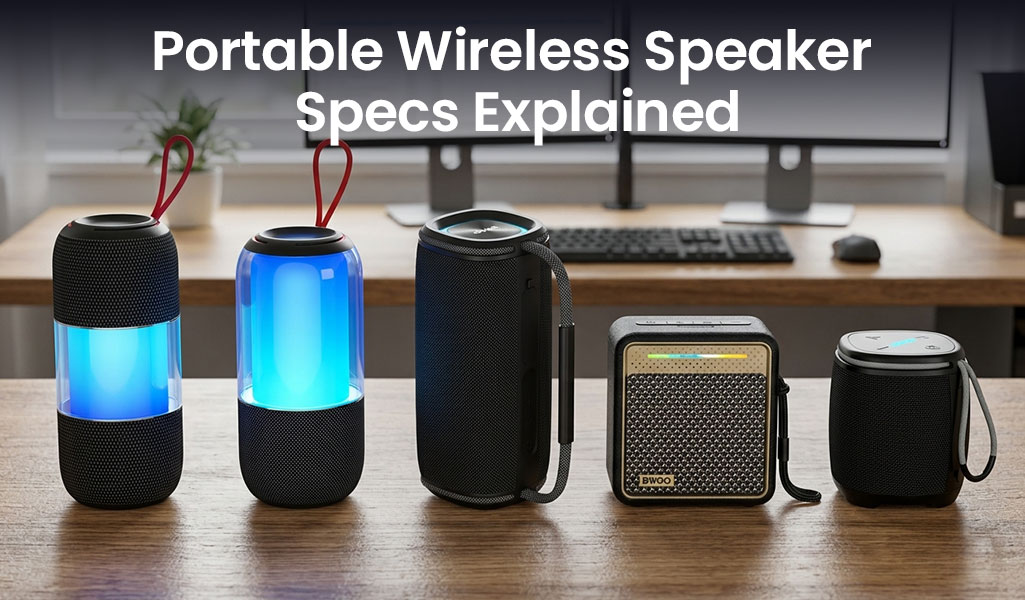
A portable wireless speaker can look simple on a product page, but its specification sheet contains several numbers that buyers often compare incorrectly. Output power, battery capacity and stated playtime describe different aspects of a product. None of them alone tells the full story of sound quality or real-world listening time.
There is also seasonal context for wireless audio. In its October 21, 2026 holiday technology survey, the Consumer Technology Association (CTA) reported that 87% of U.S. adults planned to shop for technology gifts. Wireless audio was a leading gift category: 67% were considering wireless headphones or earbuds. The survey did not report the same figure for portable speakers, so it should be treated as a broad wireless-audio signal—not a speaker-specific sales forecast.
1. What Does Speaker Wattage Tell You?
Wattage describes the rated electrical output of the speaker system or driver under the manufacturer’s stated conditions. A higher wattage rating may indicate greater power-handling capability, but it does not automatically mean the speaker will sound louder, clearer or better. Loudness also depends on driver sensitivity, enclosure design, tuning, distortion, frequency response and the listening environment.
When comparing models, check whether the published number refers to one driver, multiple drivers, nominal/RMS output or a peak figure. If a page lists “5W × 2,” that indicates two 5W-rated speaker units in the stated configuration; it should not be rewritten as a guaranteed real-world loudness level. Ask the supplier to clarify the rating basis if the product sheet does not define it.
2. Battery Capacity Is Not the Same as Playtime
Battery capacity is often shown in mAh, but runtime depends on stored energy and the speaker’s average power consumption. A larger battery can support longer playback, but the final result also depends on amplifier efficiency, volume, audio content, wireless connection, sound effects and other active features.
For example, turning the volume up can increase energy use. RGB lighting, bass enhancement or other effects may also change runtime. Battery age and temperature can influence results over time. A playtime claim should therefore be treated as a test-based estimate, not a fixed duration for every listening situation.
3. Real BWOO Speaker Examples: Read Each Model on Its Own Terms
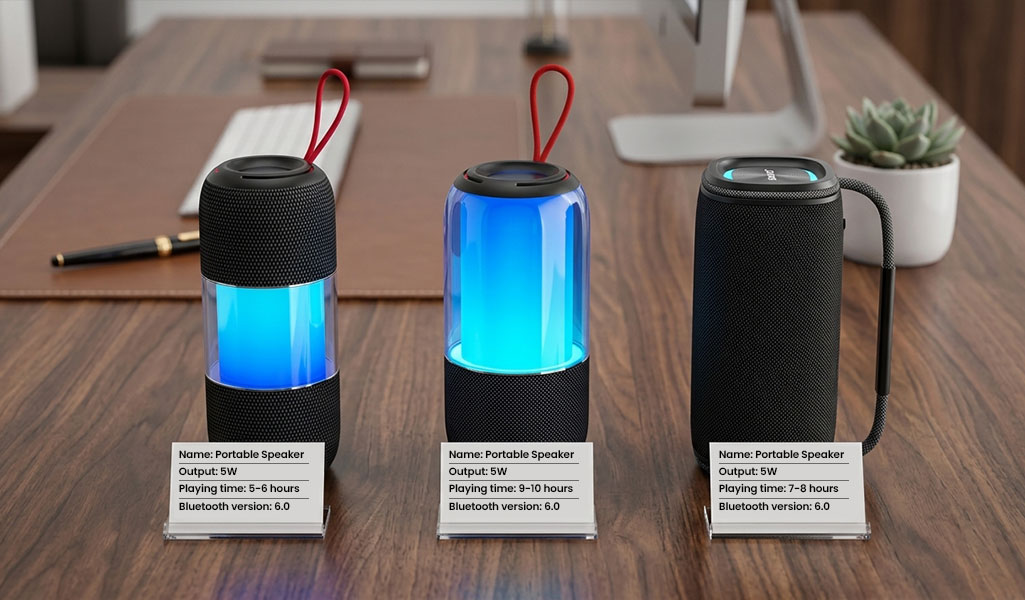
The current BWOO product pages provide two examples of how output, battery and published playtime appear together. They are useful for understanding a specification sheet, but the figures should not be treated as a controlled head-to-head performance test because the public pages do not state identical playback conditions.
Model | Published output | Battery | Published playtime | Other listed positioning |
BO-BS89 | 2.5W | 2000mAh | 10 hours | IPX7; RGB lighting; BT 5.4 |
BO-BS91 | 5W × 2 | 3.7V / 1800mAh | 8 hours | IPX6; dual-speaker design; RGB lighting; BT 5.3 |
These product-page specifications show that two speakers can have different driver configurations, battery ratings and playtime claims. They do not prove that one model is more efficient or better for every customer. The intended use case—such as a compact outdoor speaker, a larger party-oriented model or a speaker with multiple playback inputs—should guide the comparison.
A further model example is the BWOO BO-BS97 IPX6 wireless speaker, whose product page lists dual 66mm speaker units, a 2000mAh battery and up to 6 hours of playtime. The visible page does not provide a clear wattage figure, so buyers should request the current specification sheet rather than infer output power from driver size.
4. Do Not Overlook Water-Resistance and Playback Features
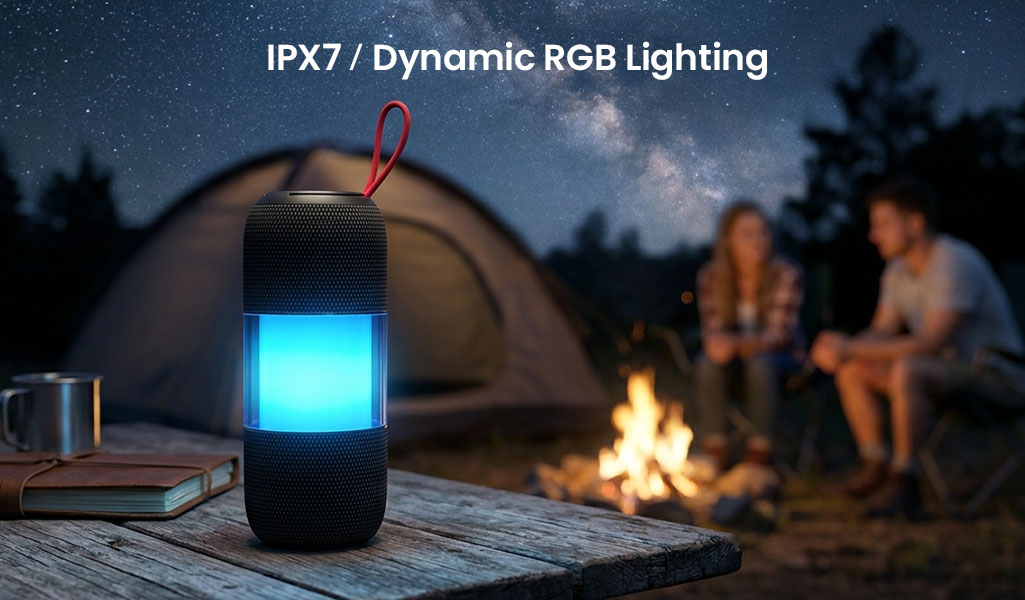
Portable speakers are often used outdoors, so buyers may compare IPX ratings alongside sound and battery specifications. Check the exact rating and its stated test conditions. An IPX water-resistance rating does not automatically indicate dust protection, and it should not be translated into an unrestricted claim such as “safe in every outdoor or underwater situation.”
Other practical details can influence the product's appeal:
Playback options: BT connection, TF card, USB or AUX support can make a speaker more flexible in different use environments. Check the exact model rather than assuming all models offer the same inputs.
Charging port: confirm the connector, charging time and included cable from the final product specification.
Microphone and calls: if hands-free calling is listed, test voice clarity in a realistic environment.
TWS pairing: if two speakers can be paired, confirm the exact pairing process, supported model combination and user instructions.
5. A Practical Checklist for Wireless Speaker Buyers
Specification | What to confirm before sourcing |
Output power | Is the rating per driver or total system output? Is the basis clearly stated? |
Battery | Confirm voltage and capacity, and ask whether the battery information matches the production version. |
Playtime | Ask for the test volume, lighting/effects settings, source and other conditions behind the published time. |
Water resistance | Verify the exact IP rating and the conditions covered by the test; do not generalize beyond the rating. |
Playback and calls | Check BT, TF, USB, AUX, microphone and TWS features on the exact model. |
Retail readiness | Confirm colors, packaging, accessories, user manual, labels and destination-market documents. |
Conclusion
A portable wireless speaker should be evaluated as a complete product rather than by one headline number. Wattage describes an output rating, mAh describes battery capacity, and playtime is an estimate under particular conditions. Buyers should review driver configuration, playback features, water-resistance claims and test conditions together before selecting models for a retail or wholesale range.
Explore the BWOO Wireless Speaker collection and review the published specifications for BO-BS89 and BO-BS91. Contact BWOO for the latest model specifications, available colors, sample arrangements and bulk quotation.
FAQ
Does a higher-wattage speaker always sound louder?
No. Wattage is only one part of the specification. Driver sensitivity, enclosure design, tuning, distortion and the listening environment also affect perceived loudness and sound quality.
Does a larger mAh battery always mean longer playback?
Not necessarily. Runtime depends on stored energy and average power consumption. Volume, lighting, audio processing, wireless connection and test conditions all influence playtime.
Why do speaker manufacturers publish different playtime figures?
The test conditions may differ, including volume level, audio source, lighting, effects and connection mode. Buyers should request the conditions behind each model's claim before making direct comparisons.
What does IPX7 or IPX6 mean for a portable speaker?
It refers to a defined water-ingress protection classification under the relevant test conditions. It does not mean unrestricted use in every water environment, and the “X” does not provide a dust rating.
What should a distributor request before placing an order?
Request a model-specific specification sheet, playtime test conditions, exact IP-rating evidence where applicable, playback and pairing details, packaging information and samples for evaluation.


