



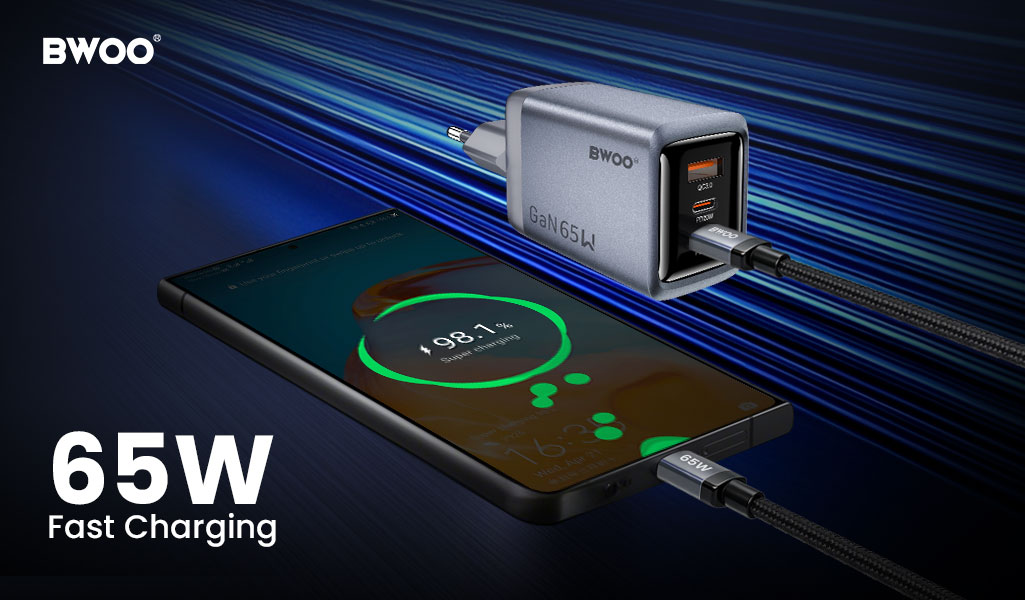
Many users face the same frustration: you bought a 100W fast charger, your phone supports fast charging, yet the real charging speed is only 10–15W.
The key misunderstanding is this: fast charging is a complete system, not just a charger. It depends on four elements working together:
charger + cable + device + environment
If any part of this chain underperforms, your charging speed will drop. Let's break down the three most common causes.
Culprit 1: Protocol Mismatch (The "Handshake" Failure)
This is the most technical—and most overlooked—reason.
Different charging protocols:
PD (Power Delivery)
QC (Quick Charge)
Brand-specific protocols (like VOOC or SuperCharge)
If your charger and device don't support the same protocol, they cannot communicate properly.
How the handshake works:
When you plug in your device, the charger and phone "talk" to each other:
Charger: "What voltage/current do you support?"
Device: "I can handle up to 9V/3A"
If they don't understand each other, the system defaults to safe mode (5V/2A)—which is slow charging.
Why PPS matters:
Some devices (like newer Android flagships) require PPS (Programmable Power Supply) to reach peak speed. Without it, charging will be limited.
Culprit 2: The Cable Bottleneck
Many people underestimate the importance of cables—but in 2026, a cable is a smart power carrier, not just a wire.
Current limitation:
Standard cables: up to 3A (≈60W max)
Fast charging (100W–240W): requires 5A cable with E-Marker chip
Voltage drop issue:
Low-quality or overly long cables increase resistance, causing power loss during transmission. Your phone then reduces input power for safety.
BWOO Tip:
Always check the cable rating. Your cable must support equal or higher wattage than your charger.
Culprit 3: Thermal & Battery Protection Logic
Sometimes, your phone is intentionally slowing down charging.
Thermal throttling:
If your phone gets too hot (gaming, navigation, or hot weather), the system reduces charging power to protect the battery.
Charging curve behavior:
Fast charging is not constant:
0–50%: very fast
50–80%: moderate
80–100%: slow (trickle charge)
This is designed to extend battery lifespan.
Screen usage impact:
Using your phone while charging can also reduce speed, as power is split between usage and charging.
Troubleshooting Checklist: How to Test Your Charging Speed
Check charger specs: Ensure single-port output meets your device requirement
Swap components: Try another cable or charger to identify the weak link
Use monitoring tools:
1. LED display cables
2. Chargers with power display
These tools help you see real-time wattage and identify issues instantly.
BWOO Solution: A Fully Compatible Fast Charging Ecosystem
BWOO provides an integrated solution to eliminate all bottlenecks:
Smart protocol support:
Built-in Smart-iC chip
Compatible with PD 3.1, QC 4+, PPS
High-performance cables:
5A / 240W E-Marker cables
Stable, low-loss power transmission
Advanced safety protection:
NTC temperature control
Stable high-speed charging without overheating
Conclusion: Full-Speed Charging Requires Perfect Matching
To achieve true fast charging, you need all three components working together:
compatible charger + high-quality cable + optimized device conditions
BWOO is a professional B2B mobile accessories manufacturer, providing complete fast-charging solutions for global partners.
We welcome wholesalers and distributors to contact us for inquiries and pricing.


