




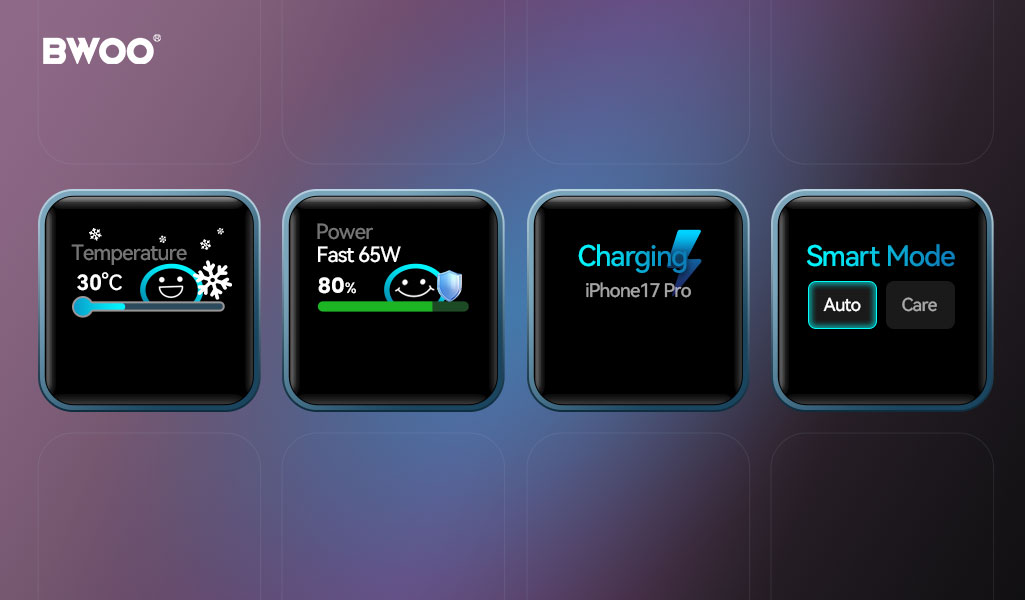
Over the past decade, charging power has increased dramatically—from 5W to over 240W. Yet for most users, the charging process still feels like a "black box."
Recently, leading brands like Anker (Nano Series) and UGREEN (Uno Series) have introduced smart display chargers, bringing "visual charging" into the mainstream. These products highlight a clear industry shift: charging is no longer just about speed—it's about visibility and control.
Users are no longer satisfied with simply "fast charging." They want to know:
Am I really getting the advertised wattage?
Is my device charging safely?
Is my cable limiting performance?
This is where visual charging becomes essential.
By integrating real-time data display, smart device recognition, and battery status feedback, smart chargers are evolving into interactive energy management tools—marking the beginning of the data-driven charging era.
1. Why Do Chargers Need a Display?
The rise of display-equipped chargers is driven by both technical needs and user psychology.
Real-Time Verification of Charging Performance
One of the most common user frustrations is not knowing whether a device is charging at its maximum speed.
Factors such as:
Low-quality cables
Incompatible charging protocols
Device limitations
can all reduce charging performance.
A built-in display allows users to see real-time wattage output, making it easy to:
Confirm if fast charging is active
Identify whether a laptop is receiving full power (e.g., 65W or higher)
Detect performance drops caused by cables or adapters
Smart Device Recognition
Advanced smart chargers now include enhanced microcontroller units (MCUs) capable of identifying connected devices.
This enables the charger to:
Detect whether the device is a smartphone, tablet, or laptop
Adjust voltage and current dynamically
Optimize charging curves for efficiency and safety
For users, this means a more intelligent and adaptive charging experience.
Battery Health Awareness
Another key benefit of visual charging is improved transparency around battery protection mechanisms.
Displays can show real-time charging states such as:
Trickle charging (final stage charging)
Temperature protection
Power regulation status
This helps users understand that slower charging at certain times is intentional, designed to protect battery health and extend lifespan.
2. Key Technologies Behind Smart Display Chargers (2026 Benchmark)
Smart display chargers are not just about adding a screen—they represent a combination of hardware innovation and software intelligence.
Customizable Display Interfaces
Modern chargers now support multiple display modes, including:
Real-time power data
Charging animations
Status dashboards
Some models offer more than 20 interface styles, adding both functionality and visual appeal.
This enhances the user experience and introduces a new level of product personalization.
Advanced Thermal Management with Visual Feedback
Premium chargers integrate intelligent temperature control systems.
Some advanced designs include:
Certified safety modes (such as thermal protection profiles)
Real-time temperature monitoring displayed on-screen
Optimized heat dissipation using GaN technology
By visualizing temperature control, users gain confidence that the device is operating safely under high power conditions.
Adaptive Design: Rotatable Plugs and Auto Screen Orientation
To improve usability, high-end chargers now feature:
180° rotatable plug designs for different wall socket orientations
Auto-rotating displays, similar to smartphone screen rotation
These design improvements ensure that information remains readable and accessible in any setup.
3. What "Visual Charging" Means for the B2B Market
Beyond user experience, smart display chargers offer significant advantages for distributors and brands.
Product Differentiation in a Competitive Market
The charging accessories market is highly competitive, with many products offering similar specifications.
Display-equipped chargers provide a clear visual differentiator, making them easier to position as premium products.
For distributors, this creates opportunities to:
Increase average selling prices
Stand out in crowded retail environments
Attract tech-savvy consumers
Reduced After-Sales Issues
A common issue in after-sales service is customers reporting that devices are "not charging properly."
In many cases, the real cause is:
Faulty or low-quality cables
lIncompatible devices
With a display showing real-time power data, users can quickly identify whether the issue comes from the charger or another component.
This reduces:
Unnecessary returns
Customer complaints
Technical support workload
Stronger Brand Value Through Transparency
Smart display chargers reflect a brand's confidence in its technology.
Features such as:
Real-time data display
Intelligent power management
Advanced chip integration (such as GaN-based systems)
demonstrate a higher level of engineering capability and product reliability.
For B2B buyers, this translates into stronger brand positioning and long-term market competitiveness.
Conclusion: From "Charging" to "Understanding Power"
The evolution from basic charging to visual charging represents a major shift in how users interact with power devices.
By combining GaN technology, intelligent power management, and real-time data visualization, smart display chargers are redefining expectations in the charging category.
BWOO is a professional consumer electronics manufacturer and B2B supplier, specializing in mobile accessories such as chargers, power banks, cables, and wireless audio products. With strong R&D capabilities and factory-direct supply, BWOO provides OEM/ODM solutions, wholesale support, and customized product development for global distributors.
If you are looking to expand your product line with next-generation charging solutions, welcome to contact BWOO for catalogs, pricing, and cooperation opportunities.


