



ANC Is No Longer a Yes/No Question
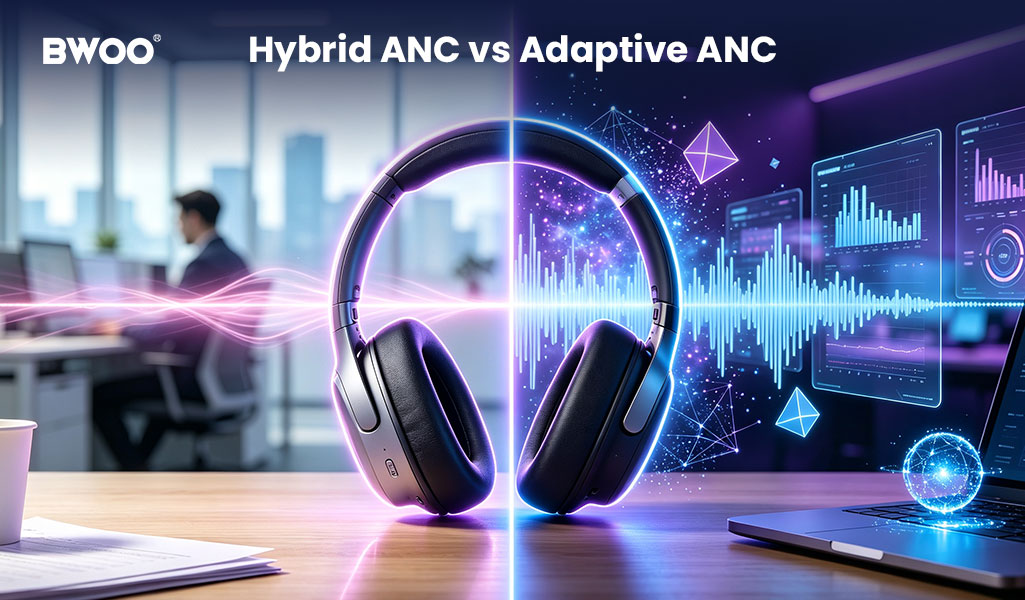
Three years ago, "ANC" on a headphone spec sheet was a binary checkbox: either the headphones had it, or they didn't. In 2026, that checkbox has splintered into a spectrum of technologies — Feedforward, Feedback, Hybrid, and Adaptive — each representing a fundamentally different approach to noise cancellation, and each commanding a different wholesale price tier.
For B2B buyers sourcing over-ear headphones, understanding the difference between Hybrid ANC and Adaptive ANC is not a technical curiosity. It directly determines which price segment you can serve, what margins are achievable, and whether your customers will return products due to subpar noise cancellation.
The ANC Technology Ladder in Over-Ear Headphones
Feedforward ANC (Entry Tier)
A single microphone on the outside of the earcup captures ambient noise before it reaches the ear. The chip generates an inverse sound wave to cancel it. Simple and affordable, but vulnerable to wind noise and incapable of correcting errors — when the seal shifts slightly as you move your head, feedforward ANC cannot compensate.
Typical price point at wholesale: 8–15 USD. Noise cancellation depth: 15–25 dB.
Feedback ANC (Mid Tier)
A microphone placed inside the ear cup monitors what the listener actually hears and generates corrective anti-noise. Better at handling seal variations than feedforward, but slower to respond because the noise has already entered the ear before correction begins.
Typical price point: 12–22 USD. Noise cancellation depth: 20–30 dB.
Hybrid ANC (Premium Tier — Current Standard for Over-Ear)
Combines both feedforward and feedback microphones for a more complete noise cancellation system. The two microphone systems work in tandem: the external mic cancels predictable ambient noise, while the internal mic corrects for seal variations and residual noise. This architecture has been the flagship standard for over-ear headphones since approximately 2022, and it remains the volume driver for B2B channels in 2026.
In the over-ear form factor, Hybrid ANC benefits from the natural passive noise isolation provided by the ear cups themselves — large over-ear cushions block mid-to-high frequency noise physically, allowing the ANC circuitry to focus on low-frequency cancellation (engine hum, HVAC drone, traffic rumble). The result is a total noise reduction that often exceeds the ANC chip's rated dB figure.
BWOO BO-BW591 Over Ear ANC Wireless Headphone exemplifies current-generation Hybrid ANC in over-ear format. Featuring BT 6.0, a multi-microphone Hybrid ANC array, and plush over-ear cushions with strong passive isolation, the BW591 delivers reliable noise cancellation across environments — from open-plan offices to commuter trains.
Typical price point: 18–40 USD. Noise cancellation depth: 30–45 dB (ANC) + 15–20 dB (passive).
Adaptive ANC (Flagship Tier — 2026 Growth Driver)
Adaptive ANC takes Hybrid ANC hardware and adds an AI-driven processing layer. The system continuously samples the acoustic environment — up to 50,000 times per second — and dynamically adjusts noise cancellation parameters in real-time. It differentiates between a jet engine's low-frequency drone (aggressively cancel) and a sudden car horn (pass through for safety), all without user intervention.
For over-ear headphones, Adaptive ANC represents a meaningful upgrade because over-ear users tend to wear headphones for longer continuous sessions (flights, workdays, gaming marathons). During a long session, the acoustic environment changes — you walk from a noisy street into a quiet café, then onto a bus — and Adaptive ANC transitions between noise profiles seamlessly without the user touching a button or app.
This technology has been championed by brands like HAVIT in their comprehensive Adaptive ANC guide for B2B dealers. According to Grand View Research, the global noise-cancelling headphone market will grow significantly through 2030, driven almost entirely by AI-powered Adaptive ANC in over-ear and TWS form factors.
Typical price point: 35–70 USD at wholesale. Noise cancellation depth: 40–52 dB.
Why Over-Ear Has an ANC Advantage Over TWS
One key insight for B2B buyers: over-ear headphones have an inherent ANC advantage over TWS earbuds. The physics are simple — larger ear cups allow for:
Bigger drivers and ANC chips: More physical space for higher-performance components
Better passive isolation: Over-ear cushions physically block 15–20 dB of mid-to-high frequency noise before ANC even activates
Longer battery life for ANC: Over-ear headphones with 500–800 mAh batteries can sustain ANC for 30–60 hours, versus 4–8 hours on TWS earbuds
More microphone placement options: Larger ear cups allow for optimized mic positioning, improving ANC accuracy
For B2B buyers, this means over-ear headphones with Hybrid ANC often deliver real-world noise cancellation comparable to TWS earbuds with Adaptive ANC — at a lower wholesale cost. The passive isolation advantage narrows the perceived gap between the two technologies.
What B2B Buyers Should Look for on an Over-Ear Spec Sheet
Noise Cancellation Depth (dB Rating)
A specification like "-35dB ANC" means the headphones can reduce ambient noise by up to 35 decibels. In practical terms: -35dB makes airplane cabin noise feel like a quiet office. -45dB approaches near-silence.
However, a single number is misleading. In over-ear headphones, the total noise reduction is ANC + passive isolation combined. A headphone advertising "-35dB Hybrid ANC" with excellent passive isolation may outperform a headphone claiming "-40dB ANC" with thin ear cushions. Ask suppliers for total noise attenuation figures, not just ANC chip dB ratings.
Number of Microphones
For Hybrid ANC over-ear headphones, 4 microphones (2 external + 2 internal per side) is the current mainstream standard. Premium implementations use 6–8 microphones for improved beamforming and environmental sampling.
Transparency Mode Quality
Transparency mode — which pipes external sound back into the ear — is technically demanding and increasingly valued by consumers. Premium over-ear implementations deliver transparency that is nearly indistinguishable from not wearing headphones at all. For B2B buyers, transparency quality is a strong proxy for overall ANC chipset quality.
B2B Market Positioning: Which Tier to Stock
| Tier | ANC Type | Wholesale Price | Target Market | Margin Profile |
| Budget | Feedforward | $8-15 | Emerging markets, promotional bundles | High volume, thin margin |
| Mainstream | Hybrid ANC | $18-40 | E-commerce, mid-tier retail, corporate procurement | Balanced volume and margin |
| Prenium | Adaptive ANC | $35-70 | Developed markets, flagship retail, travel retail | Lower volume, highest margin |
For most B2B distributors entering the over-ear ANC market, the Hybrid ANC tier offers the best risk-reward balance. Over-ear Hybrid ANC headphones like BWOO BO-BW591 deliver effective noise cancellation at a wholesale price point that leaves room for retail markup while remaining competitive. The passive isolation advantage of the over-ear form factor closes much of the perceived gap with Adaptive ANC, making Hybrid the practical choice for mainstream channels.
Adaptive ANC is the growth play for distributors targeting premium positioning — but in 2026, Hybrid ANC over-ear headphones remain where the volume and margin intersect most favorably.
Conclusion
In the over-ear headphone category, Hybrid ANC is not a compromise — it is the proven, volume-driving technology that anchors the mid-to-premium market. Adaptive ANC represents the future, with AI-driven real-time adjustment commanding flagship margins. But the physics of the over-ear form factor — large drivers, superior passive isolation, and extended battery life — mean that a well-implemented Hybrid ANC over-ear headphone like the BWOO BO-BW591 will satisfy the vast majority of B2B customer requirements, today and for the foreseeable future.


