




Active noise cancellation is now common across the wireless earbud market, but ANC and call noise reduction are not exactly the same thing.
When users take a phone call in a street, office, station, or café, the listener needs to hear the user's voice clearly while unwanted environmental sounds are reduced.
That is where microphone arrays become important.
Modern earbuds may use multiple microphones together with signal processing to improve voice pickup and noise suppression. Microphone placement can also affect call performance, while hybrid ANC uses both external and internal microphone feedback paths for listening-side noise cancellation.
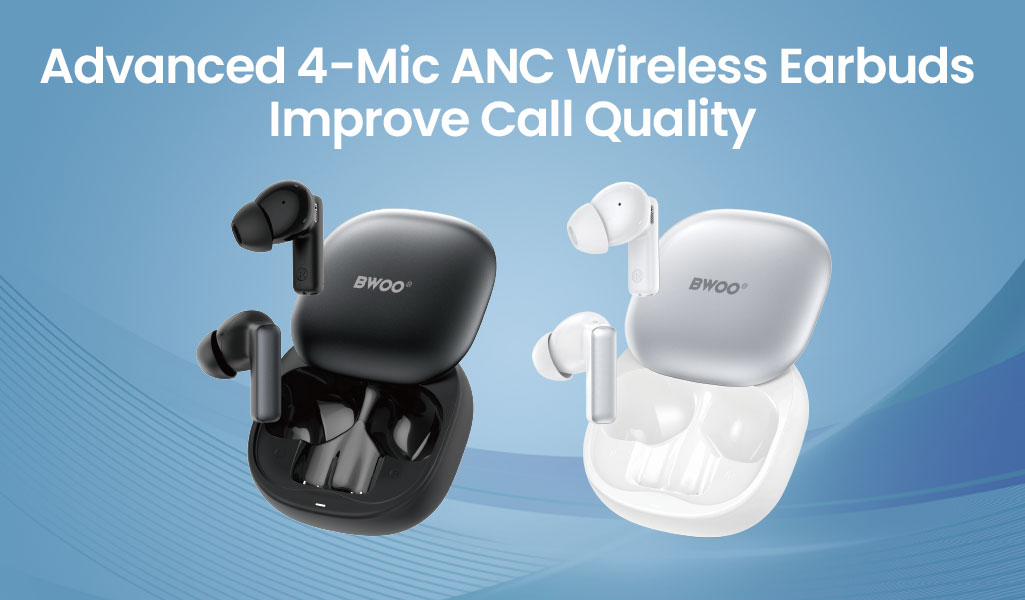
BWOO's BO-BW52 ANC 4-Mics Wireless Earbuds BT 6.0 combines Hybrid ANC with a 4-Mic AI Noise Cancelling Calls system, making it a practical example of how multiple microphones can be used in a TWS product.
1. Why Do Wireless Earbuds Need Multiple Microphones?
A single microphone can capture sound, but a multi-microphone system can provide more information for signal processing.
In a common wireless-earbud architecture, different microphones may be used to:
Capture the wearer's voice
Detect surrounding environmental sound
Help distinguish voice from background noise
Support directional or beamforming processing
Improve echo and noise suppression
The exact microphone assignment depends on the product's acoustic architecture and software.
That is why "4 microphones" should not automatically be interpreted as "four times better call quality."
The microphone count is only one part of the system.
2. How Microphone Arrays Can Improve Call Quality
2.1 Voice Pickup
A microphone closer to the user's mouth direction can capture the voice signal more effectively.
When several microphones are available, the processing system has more audio information to work with.
2.2 Background Noise Detection
Environmental microphones can capture information about surrounding noise.
The processing algorithm can then estimate which components are unwanted and reduce their influence on the outgoing voice signal.
2.3 Directional Voice Processing
Multi-microphone systems can support techniques such as beamforming, which use the relative signals between microphones to emphasize sound arriving from a desired direction.
Modern earbud designs commonly combine microphones with digital signal processing rather than relying on microphone hardware alone.
2.4 Wind and Complex Environments
Outdoor environments are particularly difficult because wind noise can affect microphones directly.
The best results therefore depend on:
Microphone design + physical placement + acoustic structure + DSP/AI processing
rather than microphone count alone.
3. Four Microphones Are Not the Same as Hybrid ANC
This distinction is important when comparing earbuds.
Hybrid ANC
Hybrid ANC generally combines feedforward and feedback microphone paths to reduce the sound reaching the listener's ears. Feedforward microphones detect external sound, while feedback microphones monitor sound closer to the ear.
4-Mic Call Noise Cancellation
The microphone array used for calls focuses on the outgoing voice signal.
Therefore, a product can have:
Listening-side noise cancellation → Hybrid ANC
and
Speaking-side noise reduction → 4-Mic AI call processing
These functions can complement each other, but they solve different problems.
Function | Main Purpose |
Hybrid ANC | Reduce unwanted sound heard by the user |
Multi-mic call processing | Improve the user's voice transmitted to the other person |
DSP / AI processing | Analyze microphone signals and apply noise/voice processing |
Earbud fit | Maintain acoustic consistency during use |
4. What Should Buyers Look for in 4-Mic ANC Earbuds?
For B2B buyers, the microphone number should not be the only specification used to compare products.
Evaluation Point | Why It Matters |
Microphone count | Indicates the available microphone array configuration |
Microphone placement | Can influence voice pickup and environmental-noise detection |
Noise-reduction processing | Determines how microphone signals are interpreted |
ANC architecture | Affects listening-side noise cancellation |
Fit and acoustic design | Influences consistency across different users |
Wind handling | Important for outdoor calls |
Real-world tests | Helps validate claims under office, street, and transport conditions |
Battery life | Important for frequent calls and mobile use |
For buyers sourcing private-label or wholesale earbuds, a useful testing procedure is to evaluate the same sample under several environments:
Quiet indoor room
Busy office
Outdoor traffic
Windy environment
Public transportation
A single quiet-room recording is not enough to understand real call performance.
5. BWOO BO-BW52 as a 4-Mic ANC Example
BWOO's BO-BW52 combines several technologies in one TWS platform:
Hybrid ANC up to -30dB
4-Mic AI Noise Cancelling Calls
BT 6.0
13mm dynamic drivers
Hi-Res Audio with AAC
Dual connection and modes
The important point for buyers is how these specifications work together.
A product with strong listening-side ANC but weak call performance may not meet the expectations of users who frequently make calls.
Conversely, strong microphone processing without good acoustic fit may also produce inconsistent results.
The more useful evaluation question is therefore:
How well does the complete voice-and-noise system perform in realistic environments?
6. Why Call Quality Is Becoming More Important
Omdia's latest Q2 2026 data shows that global TWS shipments fell 0.7% year over year to 82.1 million units, while open wireless stereo grew 12% to 11.1 million units. Omdia also identifies AI-enabled functions as an increasingly important area of differentiation in premium audio, while consumers continue to value comfort, audio quality, call quality, and ANC.
This suggests that audio products are increasingly competing on specific user outcomes, not simply basic wireless playback.
Call quality is one of those outcomes.
For B2B buyers, features such as multi-microphone call processing can therefore become useful product differentiation when supported by genuine testing and clear positioning.
Conclusion
Four microphones do not automatically guarantee better calls. Their value comes from how the microphones are positioned, how their signals are processed, and how the complete acoustic system performs in real environments.
For wireless-earbud buyers, the right evaluation model is:
Microphone Array + Processing + Acoustic Design + ANC + Fit + Real-World Testing
BWOO's BO-BW52 provides a practical product example by combining 4-Mic AI Noise Cancelling Calls with Hybrid ANC, BT 6.0, and high-resolution audio features.
FAQ
Does having four microphones guarantee better call quality?
No. Microphone count is only one part of the complete call-quality system. Placement, processing, acoustic design, and environmental testing also matter.
What is the difference between ANC and call noise cancellation?
ANC mainly reduces noise heard by the earbud user, while call noise cancellation focuses on reducing unwanted sound in the microphone signal sent to the other person.
What is Hybrid ANC?
Hybrid ANC combines feedforward and feedback microphone paths to improve listening-side noise cancellation.
Why is microphone placement important?
Different microphone positions capture voice and environmental sounds differently, which affects how effectively signal processing can distinguish wanted and unwanted sound.
How should buyers test ANC earbuds for call quality?
Test samples in quiet rooms, offices, streets, transport environments, and windy conditions. Real-world testing is more informative than relying on microphone-count specifications alone.
What does the BWOO BO-BW52 offer?
The BO-BW52 combines Hybrid ANC up to -30dB, 4-Mic AI Noise Cancelling Calls, BT 6.0, 13mm dynamic drivers, and AAC audio support.


