



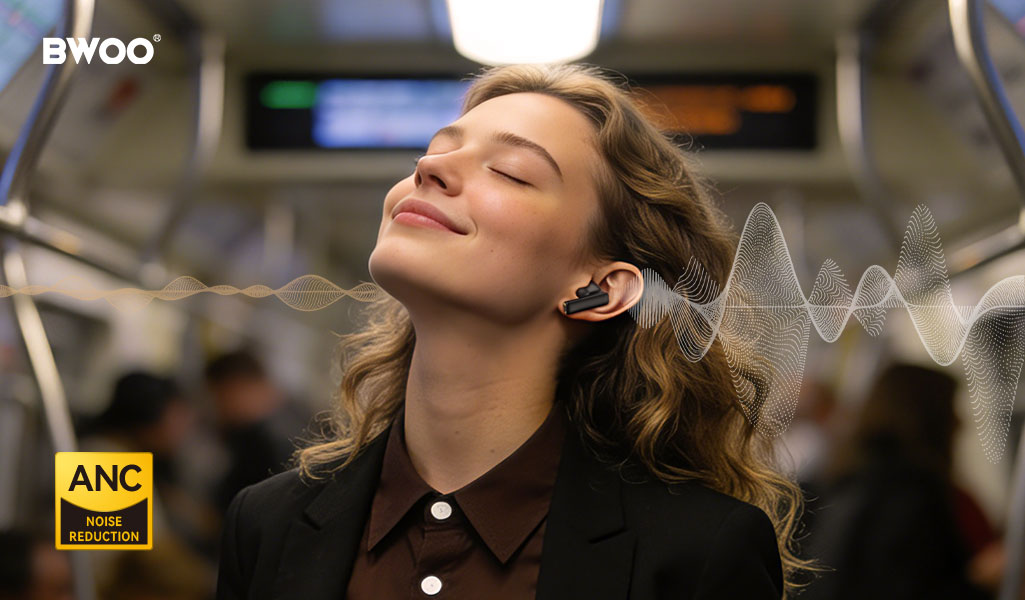
You are sitting on a packed commuter train. The engine hum is a constant, low-frequency drone that seems to vibrate through your bones. Someone two rows back is watching a video without headphones. The person next to you is taking a loud phone call. You jam your earbuds in deeper, turn up the volume, and try to focus on your podcast — but the noise cuts through anyway.
If this sounds familiar, you have already experienced the limits of passive noise isolation. And you have probably wondered: would ANC (Active Noise Cancellation) actually help here? Or is it just marketing fluff that charges you an extra 10–50 to the product price depending on ANC chip quality and microphone configuration.
The key takeaway: passive and ANC are complementary, not competing. Passive isolation handles high frequencies; ANC handles low frequencies. The best noise-canceling earbuds use both together.
What Is Hybrid ANC?
Hybrid ANC combines feedforward microphones (on the outside of the earbud) and feedback microphones (inside the ear canal) to create a more complete noise cancellation system.
Here is why that matters in real-world use:
Feedforward-only ANC is good at blocking external, predictable noise (like airplane engines), but if you move your jaw, adjust your glasses, or shift the earbud, the seal changes and the ANC can momentarily become less effective. Wind noise can also confuse the external microphones.
Feedback-only ANC adapts to the actual sound reaching your eardrum, so it handles seal changes better. But it is less effective at capturing low-frequency noise before it enters the ear.
Hybrid ANC uses both microphone systems simultaneously, cross-referencing their inputs to produce a more accurate anti-noise signal. The result is more consistent noise cancellation that adapts to both environmental changes and fit changes.
If you are shopping for ANC earbuds and see "Hybrid ANC" or "Adaptive ANC" in the specifications, that is generally a positive signal — it indicates a more capable noise cancellation system than single-microphone implementations.
ANC Technology Trends: Adaptive ANC and ENC
ANC technology continues to evolve. Two important developments are worth understanding before you buy.
Adaptive ANC
Traditional ANC applies a fixed level of noise cancellation regardless of your environment. Adaptive ANC uses additional environmental sensing to automatically adjust the level of noise cancellation based on the ambient noise level.
In a quiet office, adaptive ANC might reduce the ANC depth to save battery and reduce any perception of "pressure." On a noisy train, it increases ANC depth to maximum. The transition is usually automatic and seamless.
The benefit is primarily battery life — by not running maximum ANC when it is not needed, adaptive ANC extends listening time. Some implementations also automatically switch to Transparency Mode when they detect that you are speaking, so you can hear yourself and hold a conversation without removing your earbuds.
ENC (Environmental Noise Cancellation): Not the Same as ANC
This is a common point of confusion. ANC and ENC are two different technologies that solve two different problems.
ANC (Active Noise Cancellation) improves your listening experience. It reduces ambient noise so you can hear your music or podcast better.
ENC (Environmental Noise Cancellation), sometimes called cVc (Clear Voice Capture), improves the person on the other end of your call's listening experience. It uses microphones and DSP to isolate your voice and filter out background noise, so the caller hears you clearly even if you are in a noisy environment.
If you make frequent voice calls in noisy places (commuting, walking on a busy street), ENC is an important specification to look for. But it is not the same as ANC, and having ANC does not guarantee good ENC performance — the two features use different algorithms and sometimes different microphones.
Scenario Selection Guide: Which One Do You Actually Need?
The "best" noise cancellation technology depends entirely on where and how you listen. Here is a practical guide:
Commuting / Flights: ANC Is Essential
If your primary use case is commuting by train, bus, or flying, ANC is not optional — it is essential. The dominant noise source in all of these scenarios is low-frequency engine drone (50–300 Hz), which passive isolation cannot effectively block. ANC reduces this drone by 25–45 dB, transforming a fatiguing journey into a tolerable or even pleasant one.
Look for earbuds with Transparency Mode as well — this lets you hear announcements and conversations without removing your earbuds, by using the microphones to pass external sound through the drivers.
Office / Café: ANC with Transparency Mode
In an open-plan office or a café, the noise environment is mixed: there is low-frequency HVAC hum (which ANC handles well) and irregular human speech (which ANC handles poorly, but passive isolation helps with).
The ideal setup is ANC earbuds with good Transparency Mode, so you can block the AC hum while still hearing colleagues when they tap you on the shoulder or call your name. Some ANC earbuds also offer an "ambient aware" mode that amplifies speech frequencies while still suppressing low-frequency noise.
Sports / Outdoor Running: Passive + Environmental Awareness
For running or cycling outdoors, ANC is generally not recommended. The microphones can pick up wind noise and produce unnatural artifacts. More importantly, you need to hear traffic, cyclists, and other environmental cues for safety.
Passive isolation with a moderate seal (that lets some external sound in) is the safer choice. Some sports earbuds offer a "pass-through" mode that uses microphones to amplify important sounds (like a car horn) while still blocking constant wind noise.
At Home / Quiet Room: Passive Is Sufficient
If you primarily listen in a quiet bedroom or study, the ambient noise level is already low. Passive isolation is sufficient to block occasional household sounds (a closing door, a ringing phone). ANC adds cost and battery drain without delivering a noticeable benefit in this scenario.
Scenario Comparison at a Glance
Scenario | Recommended Approach | Key Reason |
Commuting / Flights | ANC + Transparency Mode | Low-frequency engine drone cannot be blocked by passive alone |
Office / Café | ANC with Transparency Mode | Suppress HVAC hum, stay aware of colleagues |
Sports / Outdoor Running | Passive + Environmental Awareness | Safety first — need to hear traffic and surroundings |
Home / Quiet Room | Passive is sufficient | Ambient noise is already low; ANC adds unnecessary cost |
What to Look for When Buying ANC Earbuds
If you have decided that ANC earbuds are right for your use case, here are the specifications and features that actually matter:
ANC Depth (dB Rating)
Manufacturers sometimes advertise "up to -45dB" ANC depth. This number is measured under ideal laboratory conditions. Real-world performance is always lower but should still be meaningful. A rating of -35dB to -42dB from a reputable source is a strong indicator of effective ANC. Also check whether it uses Adaptive ANC — this means the system adjusts cancellation depth based on your actual environment rather than applying a one-size-fits-all filter.
Hybrid vs. Single-Microphone ANC
Hybrid ANC (feedforward + feedback microphones) consistently outperforms single-microphone implementations in real-world use, especially when the earbud fit is less than perfect. If the product page mentions "Hybrid ANC" or "Adaptive ANC," that is a positive signal.
Transparency Mode / Ambient Aware
This feature uses the ANC microphones to let external sound through, so you can hear your surroundings without removing the earbuds. It is essential for commuters who need to hear station announcements and for office workers who need to stay aware of colleagues.
Battery Life (ANC On vs. Off)
Check the stated battery life with ANC enabled and with ANC disabled. A large gap indicates that the ANC implementation draws significant power. For travel use, total battery life (including the charging case) should be at least 20 hours with ANC on. A charging case with a digital power display is a practical bonus — it lets you see remaining battery at a glance, eliminating "battery anxiety" before a long trip.
ENC for Call Quality
If you take calls with your earbuds, check whether the product has ENC. The specification may say "ENC," "cVc 8.0," or "AI call noise reduction."
Sound Quality and Hi-Res Certification
ANC is important, but so is what you actually hear once the noise is gone. Look for Hi-Res certified audio — this certification ensures the drivers and codecs can reproduce high-resolution audio with the detail and clarity that low-bitrate audio lacks. Large dynamic drivers (10mm+) typically deliver fuller bass and a wider soundstage.
Comfort and Seal
Even the best ANC cannot compensate for a poor seal. Look for earbuds that come with multiple eartip sizes (S/M/L) and an ergonomic design labeled "tailored comfort" or "acoustic fit." The better the passive seal, the less work the ANC has to do — and the better the overall noise reduction.
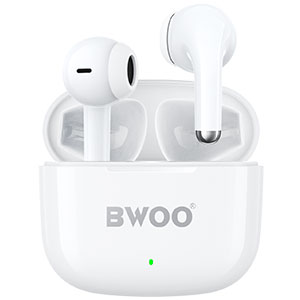
Our Recommendation: BWOO ANC In-Ear Wireless Earbuds with Digital Display
If you are looking for a well-rounded ANC TWS earbud that delivers strong adaptive noise cancellation, long battery life, and premium sound quality at a competitive price, the BWOO ANC In-Ear Wireless Earbuds with Digital Display is an excellent choice.
Key Specifications
Feature | Specification |
ANC Type | Self-Adaptive ANC — automatically adapts to your ears and surroundings, up to -42dB noise cancellation depth, eliminates 95% of ambient noise |
Audio | Hi-Res certified, 3D stereo sound with powerful bass, immersive soundstage |
Wireless Version | BT 5.3 — advanced connectivity with fast transfer rate, low latency, and strong anti-interference performance |
Battery Life | 5 hours (earbuds) + 25 hours (charging case) = 30 hours total |
Charging Case | 400 mAh with LED digital power display — check earbud and case battery status at a glance |
Touch Controls | Sensitive touch control for playback, volume, ANC toggle, and voice assistant |
Comfort | Tailored ergonomic design with acoustic fit and multiple eartip sizes |
Why It Stands Out
The BWOO ANC In-Ear Wireless Earbuds deliver a compelling combination of features that make them a standout choice in the mid-range ANC segment.
Self-Adaptive ANC. Unlike fixed-level ANC implementations, these earbuds use a self-adaptive noise cancellation system that automatically adjusts to your ears and surroundings. This means you get deep, effective noise reduction — up to -42dB depth, capable of canceling 95% of ambient noise — without needing to manually toggle between modes. Whether you are on a subway platform, walking down a busy street, or sitting in a noisy airport terminal, the ANC adapts in real time to mute the world around you.
Hi-Res Certified Audio. ANC is only half the equation. When the noise disappears, you want what remains to sound excellent. The BWOO ANC earbuds carry Hi-Res audio certification, ensuring that the 3D stereo soundstage delivers the detail, clarity, and bass depth that casual listeners and audiophiles alike will appreciate. The immersive sound profile makes these earbuds equally suited for music, podcasts, gaming, and voice calls.
30-Hour Total Battery with Smart Digital Display. Each earbud holds a 40 mAh battery delivering 5 hours of continuous playback. The charging case packs a generous 400 mAh battery — enough for five full recharges, totaling 30 hours of entertainment before you need to find a USB-C cable. The standout feature is the LED digital power display on the case itself: a glance tells you exactly how much charge remains in both the case and the earbuds. No more guessing, no more dead-battery surprises before a long flight or commute.
BT 5.3 with Low-Latency Performance. The BT 5.3 chipset delivers three times faster transfer rates than previous generations, with strong anti-interference performance and reduced power consumption. Paired with low-latency technology, these earbuds handle gaming and video streaming without the audio sync delays that plague older wireless codecs.
The BWOO ANC In-Ear Wireless Earbuds are available directly through BWOO, a pure B2B brand that operates zero direct-to-consumer channels. BWOO focuses exclusively on serving global wholesalers, distributors, and retailers with private-label mobile accessories — so you can source with confidence knowing the brand will never compete with your own customer relationships.
Explore the full product details here: BWOO ANC In-Ear Wireless Earbuds with Digital Display
Conclusion
Passive noise cancellation and Active Noise Cancellation are not competitors — they are partners. Passive isolation provides the foundation by blocking high-frequency noise through a physical seal. ANC extends that foundation by actively canceling low-frequency noise that passive isolation cannot touch.
For commuters, frequent flyers, and open-office workers, hybrid adaptive ANC with transparency mode is the sweet spot. It gives you deep, adaptive noise reduction when you need it and environmental awareness when you want it. For sports and outdoor use, passive isolation with moderate seal is the safer and more practical choice.
When shopping for ANC earbuds, look beyond the marketing claims. Check the ANC depth and whether it is adaptive, confirm Hi-Res audio certification for sound quality, verify total battery life with ANC enabled, and — most importantly — make sure the earbuds fit your ears well. Even the most advanced ANC system cannot perform if the earbud does not seal properly in your ear canal.
The BWOO ANC In-Ear Wireless Earbuds with Digital Display check all these boxes: self-adaptive ANC, Hi-Res certified sound, BT 5.3 connectivity, 30-hour total battery, and a practical LED digital display that eliminates battery anxiety. They represent exactly the kind of value that modern ANC technology should deliver.


