

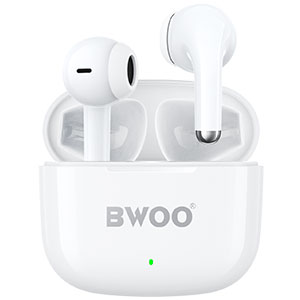



The world of personal audio is evolving rapidly. From the early days of over-ear headphones to today's compact in-ear buds, users are constantly seeking better comfort, safety, and natural listening experiences. Among the newest trends is the open-ear earbud, a design that keeps your ears open to the world around you. But with this innovation comes a common question: Can other people hear what you're listening to?
This article explains what open-ear earbuds are, whether they leak sound, their pros and cons, who they're best suited for, and how BWOO's BO-BW39 model minimizes sound leakage to protect your privacy.
What Are Open-Ear Earbuds?
Open-ear earbuds are designed not to block your ear canal. Unlike traditional in-ear or over-ear headphones that isolate you from external sounds, open-ear earbuds rest gently outside or near the ear, allowing air and ambient sound to pass through naturally.
There are two main types:
Air-conduction open-ear earbuds - These use small directional speakers placed near your ears that project sound directly toward the ear canal without sealing it.
Bone-conduction earbuds - These transmit sound vibrations through the bones around your ear, keeping the ear completely open.
The result is a safer and more comfortable listening experience that lets you stay aware of your surroundings - ideal for jogging, cycling, or commuting.
Do Open-Ear Earbuds Leak Sound?
Yes, they can - but the extent depends on the design, volume, and environment.
Because open-ear earbuds don't seal your ear canal, some sound waves escape into the air. This means that people nearby - especially in quiet spaces - might hear faint music or voices coming from your earbuds.
Here's what affects leakage:
Volume level:
Higher volume increases the chance of others hearing your audio.
Earbud placement:
A poor fit or misalignment directs more sound outward.
Ambient noise:
In quiet environments, leakage is more noticeable; in busy or outdoor spaces, it's often masked.
Design quality:
Well-engineered open-ear models use directional sound beams or acoustic chambers to focus sound toward your ear and reduce leakage.
In short, yes, open-ear earbuds can be heard by others, but it's rarely a problem if the volume is moderate and the design is optimized.
Pros and Cons of Open-Ear Earbuds
Advantages
1. Situational awareness:
Stay alert to traffic, conversations, and environmental sounds - perfect for outdoor and office use.
2. Comfort and breathability:
No in-ear pressure or ear fatigue, even during long listening sessions.
3. Hygienic and less intrusive:
No ear-tip insertion means fewer hygiene concerns and better comfort for people sensitive to in-ear designs.
Disadvantages
1. Sound leakage:
Others may hear your audio in quiet environments.
2. Lower noise isolation:
Not suitable for noisy places where you want full immersion.
3. Reduced bass response:
Because there's no seal, deep bass may be softer than with in-ear or over-ear models.
Best for
Runners, cyclists, and commuters needing awareness of surroundings.
Office workers or people who multitask while listening.
Users who dislike the "plugged-in" feel of in-ear earbuds.
Not ideal for libraries, quiet offices, or airplanes - places where privacy or noise blocking is more important.
How BWOO BO-BW39 Minimizes Sound Leakage
BWOO's BO-BW39 Open-Ear Earbuds are engineered to deliver immersive sound while protecting your privacy. Our design tackles leakage at its source:
Directional sound technology:
Custom acoustic chambers focus sound toward the ear, reducing outward diffusion.
Optimized speaker angle:
The BO-BW39's curved driver directs audio precisely to your ear canal for a clearer and more private listening experience.
Volume optimization:
The earbuds automatically adjust output based on ambient noise to maintain clarity without unnecessary loudness.
Secure fit:
The lightweight ear-hook design ensures stable placement, reducing stray sound reflections.
Smart listening guidance:
Our app and manual recommend optimal volume levels and usage habits for privacy in quiet environments.
Together, these design choices make the BO-BW39 one of the most balanced open-ear earbuds - offering freedom, safety, and comfort without excessive sound leakage.
Conclusion
So, can other people hear open-ear earbuds?
Technically yes - but only in specific conditions. When designed and used properly, open-ear earbuds like the BWOO BO-BW39 provide excellent sound quality, situational awareness, and comfort with minimal sound leakage.
Open-ear earbuds represent the next evolution in personal audio - combining freedom and functionality that traditional in-ear or over-ear headphones simply can't match. If you're looking for a secure, breathable, and privacy-friendly listening experience, BWOO's open-ear solution is worth exploring.
Related readings:
How do Wireless Earphones Work?


