



At first glance, most charging cables look perfectly fine.
Yet after months of daily use, many users encounter the same problem:
the cable jacket cracks at the connector (SR area), wires become exposed, and charging becomes unstable.
This failure is rarely accidental.
In reality, the surface material of a charging cable plays a decisive role in its durability, flexibility, and lifespan.
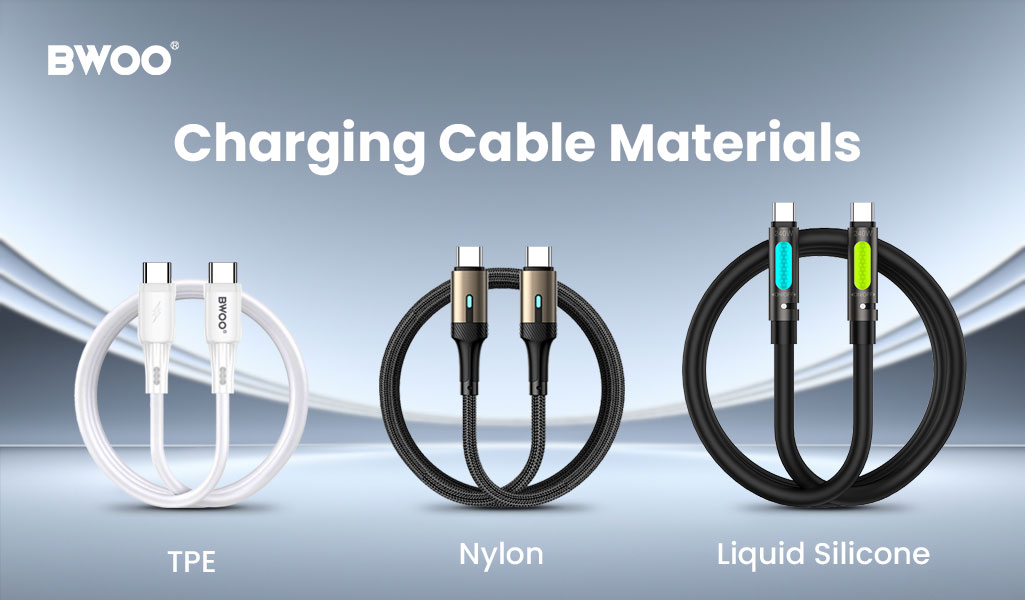
In this article, we take a deep, objective look at the three most common charging cable materials on the market today—TPE, nylon braided, and liquid silicone—explaining their real-world performance, structural weaknesses, and ideal use cases.
Material Breakdown: Which Cable Is Really Right for You?
1. TPE Cables: Soft, Familiar, but Fragile
Material Overview
TPE (Thermoplastic Elastomer) is the material used in many original charging cables from major smartphone brands.
It combines plastic and rubber properties and is widely adopted due to its cost efficiency.
Key Advantages
Very soft and flexible hand feel
Good elasticity in short-term use
Moderate manufacturing cost
Environmentally compliant and recyclable
Critical Weaknesses
Despite its popularity, TPE has a well-known limitation:
it degrades over time when exposed to skin oils, sweat, heat, and UV light.
Common aging symptoms include:
Yellowing of the outer jacket
Hardening and loss of elasticity
Micro-cracks near the SR (strain relief) area
Eventual brittle fracture and cable breakage
Best For
Users who prioritize softness and original-cable feel
Light usage scenarios with careful handling
Entry-level or price-sensitive markets
2. Nylon Braided Cables: Rugged and Long-Lasting
Material Overview
Nylon braided cables add a high-strength woven fiber layer around the internal cable jacket.
This external armor significantly improves mechanical protection.
Key Advantages
Excellent tensile strength and pull resistance
Strong anti-bending and anti-fraying performance
Reduced tangling in bags or pockets
Resistant to pet bites and accidental yanking
Among all mainstream materials, nylon braided cables are widely recognized as the hardest to physically break.
Trade-Offs
Stiffer hand feel compared to TPE or silicone
Lower-quality nylon may fray or fuzz over time
Less comfortable for bedside or portable use
Best For
Heavy users and frequent travelers
Consumers who throw cables into backpacks
Households with pets or children
High-volume e-commerce and retail markets
3. Liquid Silicone Cables: Soft Touch Meets High Durability
Material Overview
Liquid silicone cables use high-elasticity silicone rubber as the outer jacket, offering a very different tactile and mechanical profile compared to plastic-based materials.
Key Advantages
Extremely soft, skin-friendly texture (often compared to baby skin)
Outstanding rebound elasticity
Naturally resistant to oils, sweat, and temperature changes
After bending or coiling, the cable quickly returns to a straight shape
Why the Market Is Shifting
Liquid silicone effectively solves two major pain points:
The aging and cracking issues of TPE
The stiffness and rigidity of nylon braided cables
As a result, it has become a preferred material in the mid-to-high-end charging cable market, especially for premium devices and business users.
Best For
Users who value comfort and premium feel
Office, bedside, and daily carry scenarios
Brands targeting higher ASP and perceived quality
Beyond Materials: The Hidden Design Factors That Define Cable Lifespan
Strain Relief (SR) Design
The SR area—the short flexible section near the connector—is where most cable failures occur.
Even the best material can fail if:
The SR is too short
The hardness transition is poorly designed
The bending angle is not properly distributed
A well-engineered SR gradually disperses stress instead of concentrating it at one point.
Internal Structure: The Cable’s “Skeleton”
Inside every durable charging cable is a reinforced tensile core, often made from materials such as aramid fiber (commonly known as Kevlar).
This internal structure:
Absorbs pulling force
Protects the copper conductors
Maintains signal stability during repeated bending
For professional buyers, internal construction is just as important as the outer jacket material.
B2B Procurement Insights: Choosing the Right Material for Your Market
For Budget-Oriented Markets
Optimized reinforced TPE cables offer a practical balance between cost and acceptable durability when combined with improved SR design.
For E-commerce & Retail Channels
Nylon braided cables remain top sellers.
Their visual toughness directly reduces consumer doubts and contributes to lower return rates.
For Premium & Business Segments
Liquid silicone cables are increasingly preferred due to:
Superior tactile experience
Longer perceived lifespan
Stronger justification for higher pricing and margins
BWOO’s Commitment: Solving Cable Failure at the Material Level
At BWOO, cable durability is not determined by appearance alone.
Material Testing Lab
Each cable formulation undergoes 10,000+ bend and fatigue tests, simulating real-world daily use scenarios before mass production.
Full Material Customization
BWOO supports a complete range of solutions—from reinforced TPE and high-density nylon braiding to high-rebound liquid silicone—tailored to different market needs.
Design-Driven Quality
Every BWOO charging cable is engineered with a focus on material selection, internal structure, and SR optimization, not just surface aesthetics.
Conclusion:
Choosing the right charging cable material is not about trends—it is about long-term reliability.
In simple terms:
Want maximum durability? Choose nylon braided
Want premium feel and comfort? Choose liquid silicone
The right material can save users years of frustration—and help brands build lasting trust.
Related readings:


