




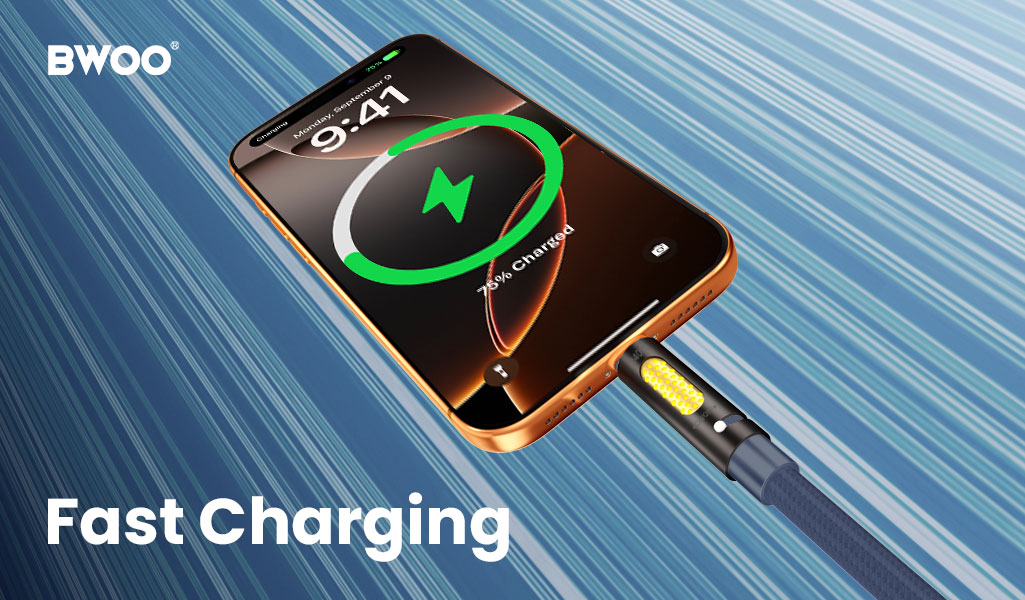
A 1-meter charging cable works fine on a desk—but barely reaches the bed or sofa.
So you switch to a 2-meter or even 3-meter cable. The charging icon lights up, but the battery percentage creeps up painfully slowly.
This leads to a common question asked by consumers and professional buyers alike:
Does cable length really kill fast charging?
And if so, why do some long cables still charge fast, while others perform terribly?
This article explains the real physics behind charging cables—specifically voltage drop—and shows how to choose a cable that is both long and fast, without compromising safety or performance.
Why Length Affects Charging Speed
Resistance Increases with Length
In electrical engineering, one rule is fundamental:
Electrical resistance is directly proportional to conductor length.
In simple terms, the longer the cable, the higher its resistance—if everything else stays the same.
The Water Pipe Analogy
Think of a charging cable as a water pipe:
A short pipe delivers water with strong pressure.
A long pipe causes more friction along the way.
More friction means less pressure at the end.
In electrical terms, this loss of pressure is called voltage drop.
What Is Voltage Drop?
Voltage drop occurs when part of the supplied voltage is lost as heat due to resistance in the cable.
When voltage loss becomes significant:
The smartphone detects unstable input voltage
Built-in protection circuits reduce charging current
Fast charging protocols automatically downgrade power
This is the real reason why some long cables charge slowly—not because they are long, but because voltage drop exceeds safe thresholds.
The Deciding Factor: AWG Wire Gauge
(What You See vs. What Really Matters)
What Is AWG?
AWG (American Wire Gauge) is a standard used to measure wire thickness.
Lower AWG number = thicker copper core
Higher AWG number = thinner wire, higher resistance
Why AWG Matters More Than Length
Cheap Long Cables
Many low-cost 2m or 3m cables use the same thin internal wires as 1m cables to save material cost.
Result:
Resistance increases sharply
Voltage drop worsens
Charging speed may drop by 30–50%
High-Quality Long Cables (e.g., BWOO)
Well-engineered long cables compensate for length by:
Using thicker copper conductors (lower AWG)
Optimizing internal structure for power transmission
Key Conclusion
Length itself is not the problem.
The real problem is increasing length without increasing conductor thickness.
Buying Guide: Two More Factors That Matter (Beyond Length)
1. Conductor Material
Not all “copper” cables are equal.
Material | Resistance | Reliability |
Pure Copper | Low | Excellent |
Tinned Copper | Very Low | Excellent (anti-oxidation) |
Copper-Clad Aluminum (CCA) | High | Poor |
CCA cables are lighter and cheaper but perform significantly worse—especially in long lengths.
For 2m+ cables, CCA dramatically increases voltage drop and accelerates performance degradation.
2. E-Marker Chip (For High-Power USB-C)
For USB-C cables supporting over 60W (PD 3.0 / PD 3.1):
An E-Marker chip is mandatory
It communicates power capability to the charger and device
Prevents unsafe current negotiation over long distances
Without E-Marker, long cables may be restricted to low power levels regardless of charger output.
B2B Purchasing Advice: How to Stock Cable Lengths Strategically
1m – The Efficiency Standard
Office desks
Power banks
Travel kits
Focus: maximum charging efficiency
2m – Home Essentials
Bedside charging
Sofa and living room use
Requirement: thicker wire gauge is critical
3m – Special Scenarios
Rear-seat car charging
Workshops or shared power outlets
Recommendation:
Pair with high-power chargers
Clearly specify supported wattage
Avoid entry-level cables entirely
For distributors and retailers, clearly differentiating cable grades by internal specification, not just length, reduces returns and improves customer trust.
The BWOO Solution: Long Cables Without Speed Loss
BWOO designs long charging cables with performance first—not just appearance.
Thicker Copper Core Design
All BWOO cables of 2 meters and above use:
Enlarged copper conductors
Optimized AWG selection per length
Voltage drop controlled within ≤5%
Laboratory Verification
BWOO cables undergo:
Full-load current testing at different lengths
PD fast-charge stability tests
Heat and resistance consistency validation
This ensures that even a 2m cable can still deliver full-speed PD fast charging, not “theoretical compatibility.”
Real Materials, No Shortcuts
No copper-clad aluminum
High-purity tinned copper for lower resistance
Better oxidation resistance for long-term performance
Conclusion: Distance Is Not the Enemy—Wrong Specs Are
A charging cable can be long—but the core must be thick.
When wire gauge, material quality, and power management are properly engineered, cable length no longer limits charging speed.
For both consumers and professional buyers, understanding these technical fundamentals is the key to choosing cables that deliver real fast charging—at any distance.
Related readings:
A Deep Analysis: Main Charging Cable Materials on the Market


