




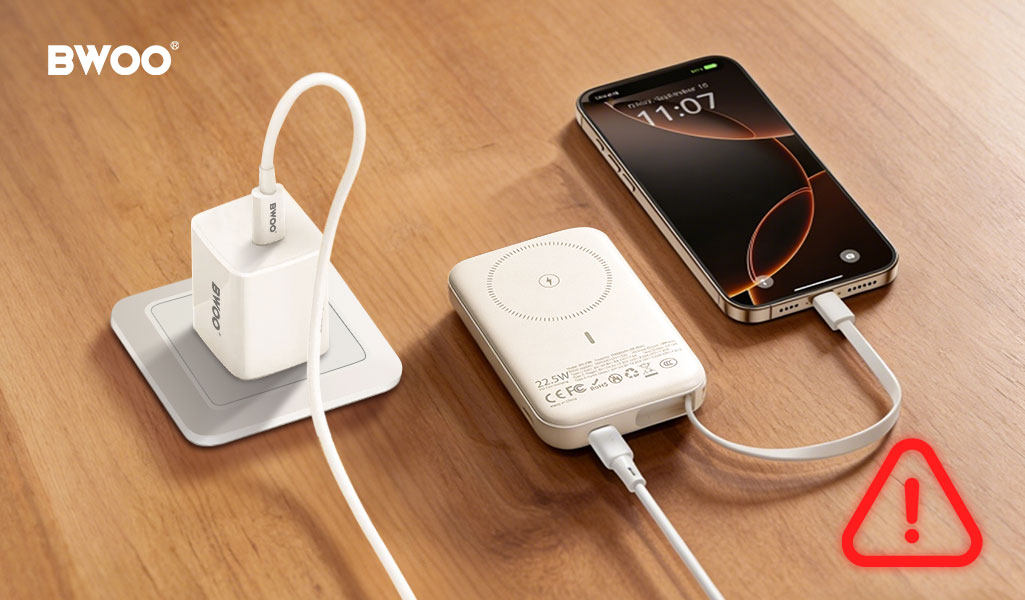
(BWOO BO-P80 Magnetic Power Bank Built-in Charging Cable)
Imagine you are staying in a hotel room with only one wall outlet available. Your phone battery is low, and your power bank is almost empty. Should you charge the power bank first, or plug in your phone directly?
Many users hope that a power bank can work like a power strip—charging itself while simultaneously charging a phone. This function is often described as "charging and discharging at the same time", or pass-through charging.
But is this function truly safe? And why do some brands discourage it?
This article explains the technical principles, efficiency trade-offs, and safety considerations behind this feature, from a professional power electronics perspective.
What Does "Charge and Discharge at the Same Time" Actually Mean?
To understand this function, we need to look at how energy flows inside a power bank.
The Core of Energy Management: PMIC (Power Management IC)
In power banks that support pass-through charging, the PMIC acts as a traffic controller for electricity.
When an external power source is connected, the PMIC dynamically allocates current:
One portion is routed directly to the external device (such as a smartphone), known as bypass output
The remaining current is used to charge the internal lithium battery cells
This process happens automatically and continuously, based on input power, output demand, and internal temperature conditions.
Efficiency Loss and the Law of Energy Conservation
Electrical energy conversion is never 100% efficient.
In a pass-through charging scenario, energy typically goes through multiple stages:
AC to DC conversion (wall charger)
DC regulation and battery charging
Battery discharge and voltage boost for device output
Each stage introduces conversion loss, which appears as heat. The more conversion steps involved, the more thermal energy is generated inside the enclosure.
Why Many Professional Brands Do Not Recommend Frequent Pass-Through Charging
From an engineering standpoint, pass-through charging involves several unavoidable trade-offs.
Thermal Stress from Heat Accumulation
Charging lithium battery cells generates heat.
Supplying power to an external device—especially through voltage boosting—also generates heat.
When both processes occur simultaneously inside a compact enclosure, heat accumulation becomes significant. Elevated temperature is widely recognized as the primary factor that accelerates lithium battery degradation.
Accelerated Battery Cycle Wear
Frequent switching between charging and discharging states keeps the battery in an unstable electrochemical condition.
Over time, this increases internal resistance, reduces usable capacity, and shortens the overall cycle life of the battery cells.
Input Power Bottlenecks
In many real-world scenarios, the input power is limited.
For example:
Input power: 10W
Phone charging demand: ~10W
In this case, there may be no remaining power to charge the power bank's internal battery. In some situations, the internal battery may even slowly lose charge due to system overhead.
How BWOO Achieves Safer and More Stable Pass-Through Charging
For professional manufacturers, the focus is not only on functionality but also on redundant safety design.
Smart Power Path Management
BWOO's high-end power bank models use PMICs with Smart Power Path technology.
This design prioritizes external device charging first. Once the connected device approaches full charge and current demand drops, the system gradually increases charging current to the internal battery, ensuring stable and predictable energy flow.
Real-Time Temperature Monitoring with NTC Sensors
BWOO power banks integrate NTC (Negative Temperature Coefficient) thermistors for continuous thermal monitoring.
If internal temperature exceeds predefined safety thresholds (typically around 45°C), the system will automatically:
Reduce charging current
Or temporarily disable pass-through operation
This prevents overheating and protects battery health.
High-Efficiency Synchronous Rectification Circuits
To minimize unnecessary heat generation, BWOO employs synchronous rectification designs that reduce internal resistance and conversion loss.
By improving electrical efficiency at the circuit level, less energy is wasted as heat, directly improving thermal stability during pass-through charging.
Practical Usage Recommendations
Use pass-through charging only when necessary, such as during travel or when outlets are limited
Avoid high-temperature environments, including under pillows or inside parked vehicles
Choose reputable brands, as low-quality power banks often lack proper current routing and thermal protection, increasing the risk of overheating or battery swelling
Conclusion
Yes, a power bank can charge and discharge at the same time—but it is not a feature designed for everyday use.
Pass-through charging involves real physical and thermal trade-offs. Understanding these limitations helps users make safer decisions and avoid unnecessary battery degradation.
As a manufacturer specializing in power management solutions, BWOO designs power banks with safety-oriented architecture, allowing pass-through charging to function as a controlled emergency feature rather than a default habit.


