



When traveling for work, many people carry a laptop to stay productive on the go. However, laptop chargers are often bulky and heavy, taking up valuable space in a backpack.
At the same time, modern laptops increasingly use USB-C ports—the same connector found on most smartphone chargers.
This naturally raises a common question:
Can a phone charger charge a laptop?
And more importantly: Will using a low-power charger damage the laptop or its battery?
The short answer is: Yes, it can work—but only if the charger meets specific power and protocol requirements.
From a manufacturer's perspective, compatibility depends not on the connector alone, but on charging protocols and output power.
As a professional charger manufacturer, BWOO explains the real technical requirements behind phone-to-laptop charging in this article.
The Core Requirement: Do Your Charger and Laptop "Speak the Same Language"?
1. Physical Interface: USB-C Is the Entry Ticket
First, the laptop must support charging via its USB-C (Type-C) port.
Not all USB-C ports are equal—some support data transfer only, while others support full power input.
Tip: Most modern ultrabooks, business laptops, and MacBooks support USB-C charging, while some gaming laptops still rely on proprietary DC ports.
2. Charging Protocol: USB Power Delivery (PD)
Having a USB-C port is not enough. The charger and laptop must also support the same charging protocol, specifically USB Power Delivery (USB-PD).
How It Works (In Simple Terms)
When you plug a charger into a laptop, they perform a digital handshake:
The laptop asks:
"Can you provide 20V power?"
The charger responds with its available voltage and current profiles.
If the charger only supports 5V or 9V (typical for phone chargers), the laptop will reject the request—or limit charging.
Manufacturer Insight from BWOO
All BWOO high-power chargers support USB-PD 3.0 / PD 3.1, with backward compatibility for older PD versions and common fast-charging protocols.
This ensures stable negotiation with mainstream laptops from Apple, Dell, HP, Lenovo, and more.
Power Matters: Can a Small Charger Handle a Big Device?
1. Wattage Comparison: Phone vs. Laptop
Most phone chargers output:
18W – 30W (5V / 9V / sometimes 12V)
Typical laptop power requirements:
Ultrabooks: 45W – 65W
Performance laptops: 90W – 100W+
The basic formula applies:
Power (W)=Voltage (V)×Current (A)
Laptops generally require 20V, which many phone chargers cannot provide.
2. Three Possible Charging Outcomes
Depending on charger capability, one of three things will happen:
Normal Charging
Charger power ≥ laptop requirement
→ Stable charging, normal performance
Slow Charging
Charger power < laptop requirement
→ Laptop may display "Slow charging"
→ Battery may charge slowly or not increase during heavy use
No Charging
Charger does not support 20V or PD
→ Laptop refuses to draw power
This behavior is normal and designed for safety, not a malfunction.
Safety Concerns: Will It Damage the Laptop Battery?
This is the biggest concern for users—and a key indicator of charger quality.
1. Intelligent Power Management
High-quality chargers, including BWOO models, are equipped with smart control chips.
They never force power into the device. Instead, they:
Detect the laptop's real-time demand
Adjust voltage and current dynamically
Stop output if conditions exceed safe limits
2. Built-In Protection Mechanisms
Even when underpowered, a certified charger will:
Operate within rated output
Avoid overload or overheating
Shut down safely if abnormal conditions occur
3. BWOO Lab Perspective
In BWOO's internal testing:
NTC thermistors monitor temperature in real time
Synchronous rectification chips improve efficiency and reduce heat
Chargers are stress-tested under continuous full-load output for up to 10 hours
This ensures safe operation and protects sensitive laptop components such as the motherboard and battery cells.
BWOO's Professional Advice: How to Choose One Charger for Phone & Laptop
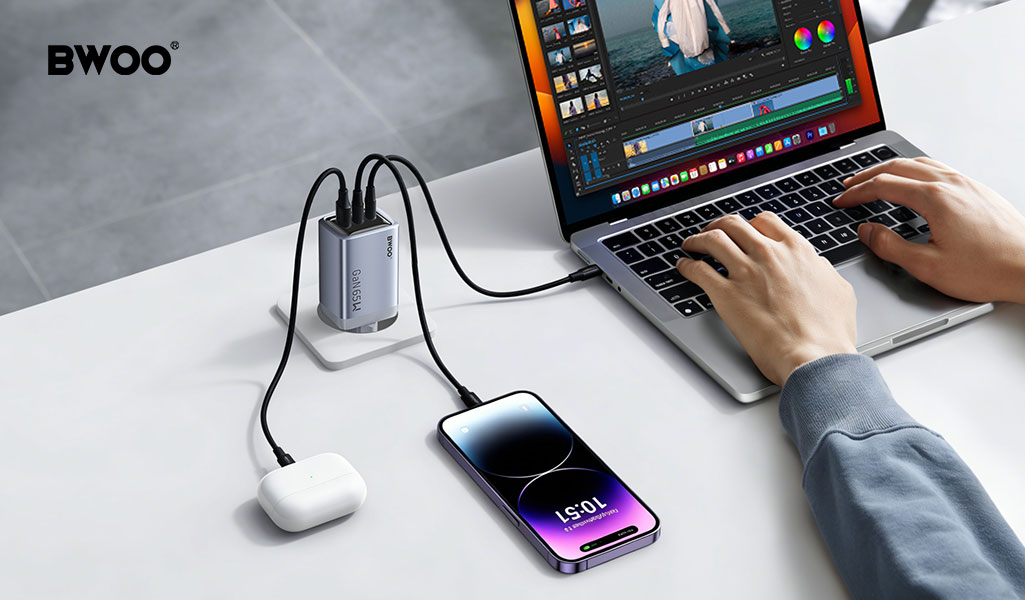
1. Choose a GaN Charger
Gallium Nitride (GaN) technology allows chargers to be:
Smaller and lighter
More efficient
Capable of higher power (65W–100W)
A GaN charger is the foundation for true multi-device compatibility.
2. Pay Attention to Multi-Port Power Allocation
Not all multi-port chargers distribute power equally.
A professional charger should clearly specify:
Single-port maximum output
Power distribution rules when multiple devices are connected
BWOO chargers use intelligent port allocation, ensuring laptops receive priority power when needed.
3. Don't Ignore the Cable
Even with a powerful charger, the wrong cable can limit performance.
For laptop charging, use:
USB-C to USB-C cable
Rated for 100W (5A)
With E-Marker chip
A low-quality cable can cause slow charging, instability, or heat buildup.
Conclusion
Yes, a phone charger can charge a laptop—but only when:
The laptop supports USB-C charging
The charger supports USB-PD with 20V output
The power rating meets the laptop's requirements
A proper high-power cable is used
From a manufacturer's standpoint, compatibility is not guesswork—it is a matter of protocol, power, and protection design.
As a professional charger brand, BWOO focuses on real-world safety, efficiency, and cross-device compatibility, helping users and B2B buyers simplify their charging setups without compromise.


