



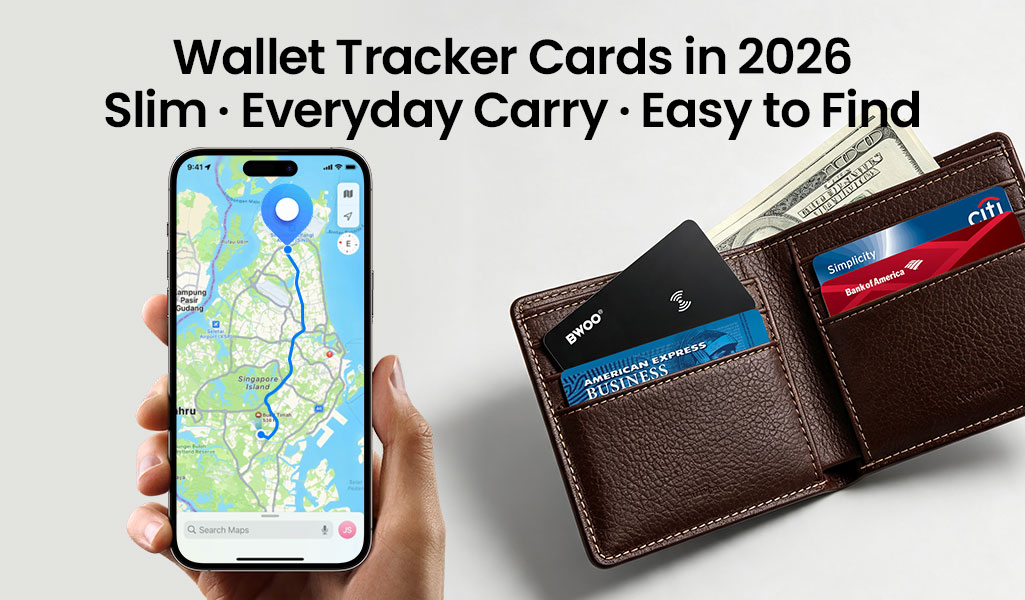
A wallet is one of the easiest everyday items to misplace because it is carried frequently, moved between locations, and often left behind in offices, restaurants, cars, or at home.
This has created demand for wallet tracker cards—thin tracking devices designed to fit inside a wallet without the bulk of a traditional tracker tag.
The category already has measurable marketplace demand. Amazon US keyword data for “wallet tracker card” recorded approximately 7,584 searches in the week of July 26–August 1, 2026, while a leading product in the category was estimated at around 10,000 units sold per month.
Global market research also estimates the smart tracker tag market to grow from approximately US$632 million in 2025 to US$875 million by 2032, representing a projected CAGR of about 5%.
For B2B buyers, the question is no longer whether trackers have a use case. It is how to choose the right form factor, finding network, battery design, and user experience.
1. What Is a Wallet Tracker Card?
A wallet tracker card is a thin electronic tracker designed to fit into a wallet or card holder.
Compared with a conventional key-ring-style tracker, the card format focuses on:
Thinness
Card-sized dimensions
Low carrying bulk
Everyday portability
Integration with a compatible finding ecosystem
A traditional tracker tag is often optimized for keys, bags, luggage, or other items with a loop or attachment point.
A tracker card is designed around a different problem:
How can tracking functionality fit naturally into a wallet?
BWOO currently lists the BO-FD02 Wallet Tracker Card in its Other product portfolio.
2. How Do Find My Trackers Work?
Finding-system compatibility is one of the most important specifications to verify before sourcing a tracker.
Apple supports certain third-party products through the Find My app. Compatible products can be paired with an Apple Account and located through the Find My system if they are lost or misplaced.
On Android, Google's Find Hub can also support compatible tracker tags and accessories. Google explains that tracker tags can help users find items such as keys, luggage, and bikes, with supported devices and tags potentially providing additional directional-finding functions.
This means the tracker hardware itself is only part of the product.
The complete experience depends on:
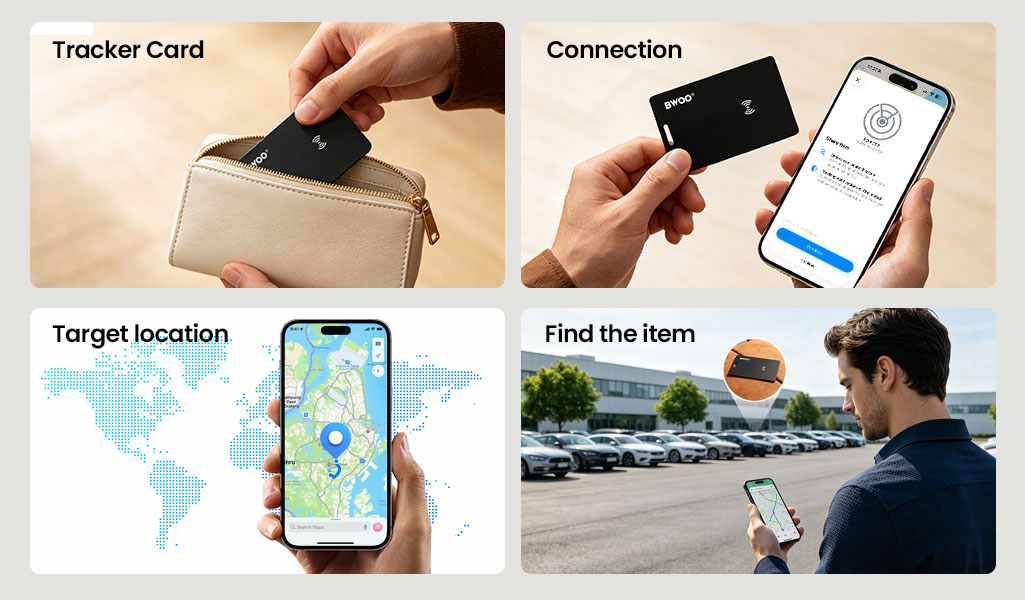
Tracker Hardware → Wireless Connection → Finding Network → Smartphone App → Location Experience
3. Why the Tracker Card Form Factor Matters
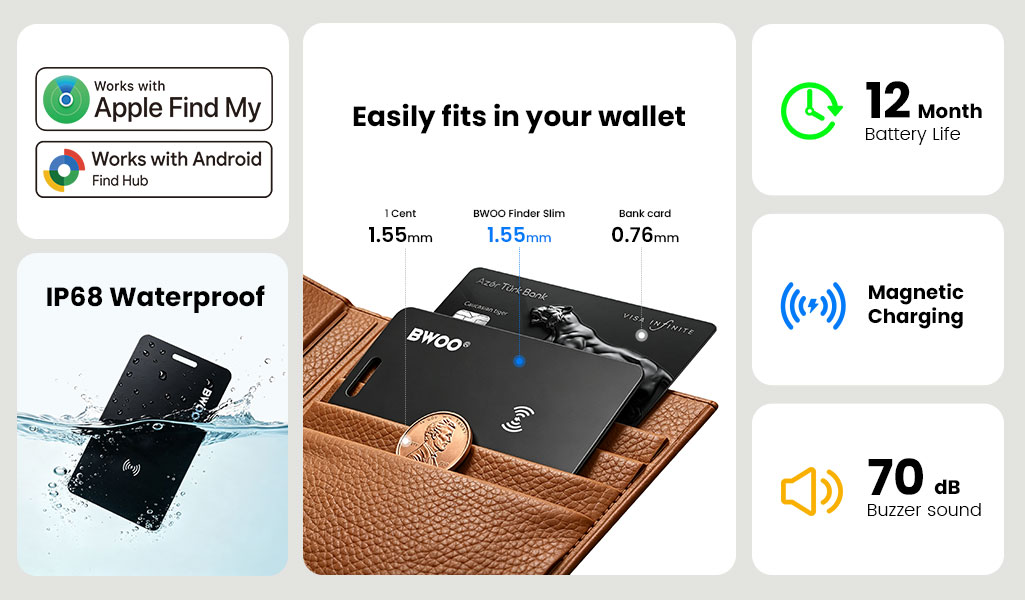
Traditional trackers often have a thickness and shape that are acceptable on keys or bags but inconvenient inside a wallet.
A card format changes the product evaluation criteria.
Feature | Why It Matters for Wallet Trackers |
Thickness | Determines whether the card remains comfortable in everyday wallets |
Card footprint | Should fit standard wallet compartments |
Battery | Determines replacement or charging frequency |
Speaker | Helps locate the wallet nearby |
Finding network | Determines the compatible smartphone ecosystem |
Material | Affects durability and daily handling |
App compatibility | Influences user onboarding |
Privacy/security features | Important for responsible tracking use |
For buyers, thinness should not be evaluated alone.
A thinner product with poor battery performance may not provide a better user experience than a slightly thicker but more practical model.
4. Battery Design Is an Important Sourcing Decision
Tracker products can use different battery architectures.
The two broad approaches are:
Replaceable Battery
The user replaces the battery after it reaches the end of its service life.
Advantages may include:
Longer product lifecycle
No charging cable required
Simple battery replacement
Considerations include:
Replacement battery availability
Battery access design
Waterproof sealing
User replacement experience
Rechargeable Battery
The user recharges the tracker when needed.
Advantages may include:
No disposable battery replacement
Potentially simpler long-term ownership
Considerations include:
Charging interface
Charging time
Battery cycle life
Charging convenience
For B2B buyers, the correct choice depends on the target market and product positioning.
5. Finding Network Compatibility Should Be Verified Before Ordering
A common sourcing mistake is treating “tracker” as a universal compatibility term.
It is not.
Apple's Find My platform and Google's Find Hub are different ecosystems. Apple explicitly states that only certain third-party products can be added to Find My, while Google provides its own compatibility requirements for Find Hub tracker tags.
Therefore, buyers should confirm:
Supported operating systems
Required app
Supported finding network
Pairing process
Firmware update method
Regional availability
Privacy and unwanted-tracker protections
Android also provides unknown-tracker alerts for supported devices, reflecting the growing importance of anti-stalking and privacy protections in the tracker category.
6. What Should B2B Buyers Look for in a Wallet Tracker Card?
A practical supplier evaluation framework can be built around six questions.
1. Does the card fit a standard wallet?
Check thickness, dimensions, edge design, and long-term bending resistance.
2. Does it work with the required finding ecosystem?
Confirm compatibility at the exact model and firmware level.
3. How does the battery system work?
Review battery type, service life, charging method, and replacement requirements.
4. Can the user locate the card nearby?
Check the audible alert and app-based locating experience.
5. Is the product comfortable for everyday use?
A tracker card is used continuously, so thickness and weight matter more than they do for many other electronics.
6. What privacy protections are available?
Tracker products should be designed and positioned for legitimate lost-item recovery rather than unauthorized tracking.
7. BWOO Wallet Tracker Card as a Product Example
BWOO currently lists the BO-FD02 Wallet Tracker Card alongside its Smart Tracker Tag BO-FD01 and other connected accessories.
For distributors considering the category, a card-form tracker can complement other everyday-carry products such as:
Wallet + Tracker Card + Digital Organizer + Power Bank
This also creates an opportunity to position trackers as part of a broader mobile lifestyle accessory assortment rather than as a standalone gadget.
Conclusion
Wallet tracker cards solve a very specific problem: adding item-finding capability without the bulk of a conventional tracker.
The category has measurable marketplace demand, and the broader smart tracker market is expected to continue growing through the early 2030s.
For B2B buyers, the most important sourcing factors are ecosystem compatibility, card thickness, battery design, locating performance, privacy protection, and everyday usability.
The key is not simply to ask whether a tracker can locate a wallet, but whether the complete product experience is practical enough for everyday use.
FAQ
What is a wallet tracker card?
A wallet tracker card is a thin electronic tracking device designed to fit inside a wallet or card holder.
How does Apple Find My support third-party trackers?
Apple allows certain compatible third-party products to be added to the Find My app and linked to an Apple Account for locating lost or misplaced items.
Can all tracker cards work with iPhone and Android?
No. Compatibility depends on the product's supported finding ecosystem, app, hardware, and software configuration.
What is the difference between a tracker card and a tracker tag?
A card is optimized for wallets and card holders, while traditional tags are usually designed for keys, bags, luggage, and other objects where a loop or attachment point is useful.
Why is thickness important?
A wallet is carried every day, so even a small increase in thickness can affect comfort and the ability to fit several cards together.
What should buyers verify before placing a wholesale tracker order?
Verify the finding network, supported OS versions, battery type, thickness, dimensions, speaker performance, privacy features, certification, and firmware update process.


