



Cables are the most misunderstood and most frequently failed component in a charging setup. For a USB C cable wholesale buyer, the difference between a proper PD fast charging cable and a data-only cable is not visible on the outside — it lives in the E-Marker chip, the wire gauge, and the connector engineering. This guide explains the specs that matter for sourcing from a phone cable manufacturer.
Charging Protocol and Connector Fundamentals
USB-C and Power Delivery (PD)
USB-C is a connector shape, not a charging standard. Power Delivery (PD) is the protocol that negotiates voltage and current over that connector. PD 3.1 EPR extends output to 240W at 48V/5A, covering laptops, monitors, and even some appliances. A cable must support the right PD version and carry an E-Marker chip to unlock power above 60W.
Lightning and MFi
Apple's Lightning connector still ships in significant volume. Legitimate Lightning cables require MFi certification — unlicensed cables trigger warnings and fail on many iPhones. Wholesalers selling into Apple-heavy markets must stock MFi-certified cables or face returns and brand damage.
The E-Marker Chip Explained
The E-Marker is a tiny chip embedded in USB-C cables that tells the charger and device the cable's rated current and voltage. Cables rated 5A (100W+) must carry an E-Marker; 3A cables may omit it. For business buyers, E-Marker presence is the clearest signal of a cable's true power capability.
Cable Spec Comparison
Specifications | USB-C PD 3A | USB-C PD 5A(E-Marker) | Lightning MFi | PD 3.1 EPR |
Maximum Power | 60W | 100W | Maximum 60W | 240W |
E-Marker | Optional | Required | Not Applicable | Required |
Data Rate | Maximum USB 3.2 | Maximum USB 3.2 | USB 2.0 | Maximum USB 3.2 |
Certifications | CE/FCC | CE/FCC | MFi+CE | CE/FCC/UL |
Typical Applications | Mobile Phones/Tablets | Laptops/Mobile Phones | iPhone | Laptops/Workstations |
B2B Sourcing Selection Criteria
Gauge, Copper, and Durability
Wire gauge determines both charging efficiency and heat. 5A cables need thicker copper — look for tinned copper conductors and aluminum-mylar shielding for signal integrity. Nylon braiding and reinforced strain reliefs measurably reduce breakage at the connector, the most common failure point.
Testing and Compliance
Require CE/FCC plus TID (USB-IF Type-C certification) for USB-C cables and MFi for Lightning. A reputable phone cable manufacturer provides certification documents and passes bend-test and insertion-cycle benchmarks before shipment.
The BWOO Cable Portfolio
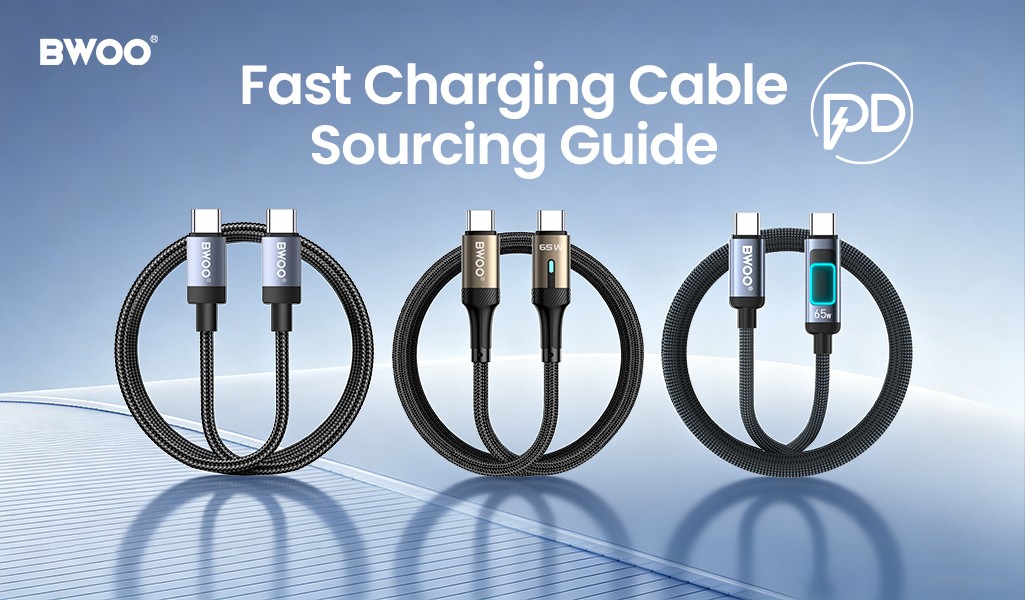
BWOO's BO-X330CC and BO-X401CC USB-C cables support 65W PD with E-Marker, delivering fast charging for phones, tablets, and thin laptops. Both use tinned copper conductors, nylon braiding, and reinforced connectors rated for 10,000+ insertion cycles.
Cable Construction Deep Dive
A cable's performance is determined by its internal architecture. The conductor — typically tinned copper — carries current, and its gauge (AWG) determines resistance. Lower AWG numbers mean thicker wire: 22-24 AWG is common for charging lines in fast-charging cables, while 28-30 AWG is used for data lines. Thicker power conductors reduce voltage drop and heat, enabling sustained high-current delivery.
The shielding layer (usually aluminum-mylar braid) prevents electromagnetic interference that degrades data transfer. The outer jacket — PVC, TPE, or nylon braiding — determines flexibility, tangle resistance, and durability. Nylon-braided cables cost slightly more but measurably reduce breakage and are the fastest-growing style among consumers.
Common Wholesale Pitfalls
The most common sourcing mistake is buying on connector alone. A cable with a USB-C plug on both ends can still be a 60W or even 480Mbps data-only cable if it lacks the right chip and conductors. Always verify the power rating, data speed, and E-Marker presence from the supplier's spec sheet, not just the product image.
Certification Verification
For MFi products, verify the manufacturer's Apple license number and cross-check on Apple's public MFi database. For USB-C, USB-IF TID numbers confirm the cable passed compliance testing. A supplier that cannot produce these numbers on request is selling uncertified product — which will fail compatibility tests and generate returns. (内部链接:BO-X330CC/X401CC 数据线产品页)
Cable Length and Application Guide
Cable length is not a cosmetic choice — it directly affects charging performance and use case fit. 0.3m cables pair with power banks and desk hubs, minimizing clutter and voltage drop. 1m is the daily-carry default for phones and tablets. 2m serves bedroom, sofa, and desktop setups where reach matters. 3m+ is for in-car rear-seat use or conference rooms, but requires thicker gauge to offset resistance over distance.
For wholesale assortment, 1m and 2m should be your volume anchors, with 0.3m as a low-cost basket add-on. Avoid stocking only one length — different retail channels sell different lengths disproportionately. Online marketplaces skew toward 2m and multi-packs, while physical retail and carrier stores favor 1m single units.
Multi-Pack and Bundling Strategy
Multi-packs (2 or 3 cables per pack) are the fastest-growing cable SKU because consumers now charge phones, earbuds, and power banks simultaneously. Bundling a USB-C cable with a GaN charger also lifts average order value and reduces returns by ensuring compatible components. This combo strategy is especially effective for online channels where free-shipping thresholds encourage add-ons.
When building multi-packs, include different lengths (e.g., one 1m and one 2m) rather than duplicates. This covers both desk and travel use and feels like better value to the consumer. Color variety — black plus white or a neutral gray — also widens appeal without increasing SKU complexity.
FAQ
Q1: Do I need an E-Marker chip in my USB-C cables?
Yes, if you want power above 60W (100W/240W). E-Marker cables are the safe choice for business buyers.
Q2: What is PD 3.1 EPR?
The extended Power Delivery standard supporting up to 240W at 48V/5A, covering laptops and high-power devices.
Q3: Is MFi certification required for Lightning cables?
Yes, for legitimate retail sales. Unlicensed Lightning cables trigger compatibility errors and high return rates.
Q4: What cable length is optimal for wholesale?
1m and 2m are the volume sweet spots; add 0.3m for power banks and 3m for in-car or desktop use.
Source cables that won't come back as returns. Send Inquiry to BWOO for BO-X330CC/X401CC samples and certification documents.


