



A counterfeit phone charger looks like a bargain — until it destroys a $600 phone or worse, causes a fire. The global counterfeit charger problem is vast: industry estimates suggest 15-25% of chargers sold on major online marketplaces are uncertified or counterfeit, and safety testing labs consistently find that the majority of these fail basic electrical safety requirements. The good news: counterfeit chargers leave detection clues that any consumer can learn to recognize. Here is how to spot the fakes before they cause real damage.
Why Fake Chargers Are Dangerous
Authentic chargers are engineered with multiple layers of protection: overvoltage protection (stops charging if voltage exceeds safe limits), overcurrent protection (limits current to prevent overheating), short-circuit protection (immediately cuts power on detected short), temperature monitoring (reduces or stops charging if internal temperature rises), and isolation between mains (110-240V AC) and the USB output (5-20V DC). Safety testing by organizations like Electrical Safety First found that 98% of counterfeit Apple chargers tested failed basic electric strength tests — meaning the isolation barrier between mains voltage and your phone's charging port could fail, potentially delivering a lethal electric shock. Less dramatically but more commonly, fake chargers lacking proper voltage regulation slowly degrade phone battery health through inconsistent power delivery, causing capacity loss and swelling over months of use.
Visual Signs of a Counterfeit Charger
Check the Text and Markings
Authentic chargers have clean, sharp, consistently spaced text printed directly onto the plastic or on a precisely applied label. Counterfeits often show: blurry or misaligned text, inconsistent font weights within the same line, spelling errors (check every word — including small regulatory text), missing or incorrect certification marks (CE, FCC, UL, UKCA). The USB connector text on Apple chargers, for example, should read 'Designed by Apple in California' with specific spacing. Counterfeits frequently have slightly wrong wording or formatting that is detectable in direct comparison.
Weight and Physical Construction
Power adapters contain transformers, capacitors, and heatsinks — authentic chargers have noticeable heft for their size. Counterfeit chargers are often significantly lighter because they contain fewer or smaller components, or use lower-quality materials. A genuine Apple 20W USB-C charger weighs approximately 58 grams. Counterfeit versions routinely weigh 35-45 grams. The physical construction differences extend to: USB port alignment (off-center or misaligned on fakes), prong quality (thin, bendable metal prongs on fakes versus solid, properly shaped prongs on authentic), and seam quality (inconsistent, poorly finished seams versus precise, minimal-seam construction).
Packaging Quality
Counterfeit chargers often come in packaging that looks authentic at a glance but fails closer inspection. Check for: inconsistent or dull color reproduction, low-resolution images with visible pixelation, poorly aligned or missing barcodes, and missing or incorrect serial number format. Authentic Apple accessory packaging, for instance, uses specific paper stock with a particular texture, precise die-cut edges, and consistent color profiles that counterfeits struggle to replicate.
Electrical and Certification Checks
Certification Mark Verification
Major certification marks can be verified through public databases. CE marking on products sold in the EU should be accompanied by a Declaration of Conformity document — if a product has a CE mark but the seller cannot provide the DoC, the mark is likely falsified. UL certification can be verified by searching the UL file number (beginning with 'E' or 'MH') on UL's online certification directory. FCC certification for US-market products can be verified by searching the FCC ID (format: XXX-XXXXXX) on the FCC OET database. The presence of these marks alone is not verification — counterfeits print them routinely. The absence of verifiable certification records is the red flag.
USB Power Delivery and Protocol Behavior
Advanced users can use USB power meters (available for under $20) to verify charger behavior. An authentic USB-C PD charger will negotiate power levels in the correct sequence: initial 5V connection, protocol handshake, then step up to negotiated voltage (9V, 15V, 20V). Counterfeit chargers often deliver inconsistent voltage that fluctuates during charging, or fail to properly negotiate PD profiles. If a USB-C charger delivers the wrong voltage to a device that has successfully negotiated a specific PD profile, the charger's power management is compromised.
The Price and Seller Test
If a charger is priced at 30-50% below the authentic retail price from an unauthorized seller on a marketplace platform, the probability of it being counterfeit is extremely high. Genuine chargers have minimum cost structures driven by certification testing, quality components, and safety margins that legitimate manufacturers cannot bypass. A $3 'Samsung 25W fast charger' is not a deal — it is almost certainly a fake. Buy from authorized retailers, the brand's direct online store, or reputable accessory brands with public certification records. The few dollars saved on a cheap charger are not worth the potential cost of a damaged phone battery, lost data, or fire risk.
Choosing Safe Chargers from Reputable Brands
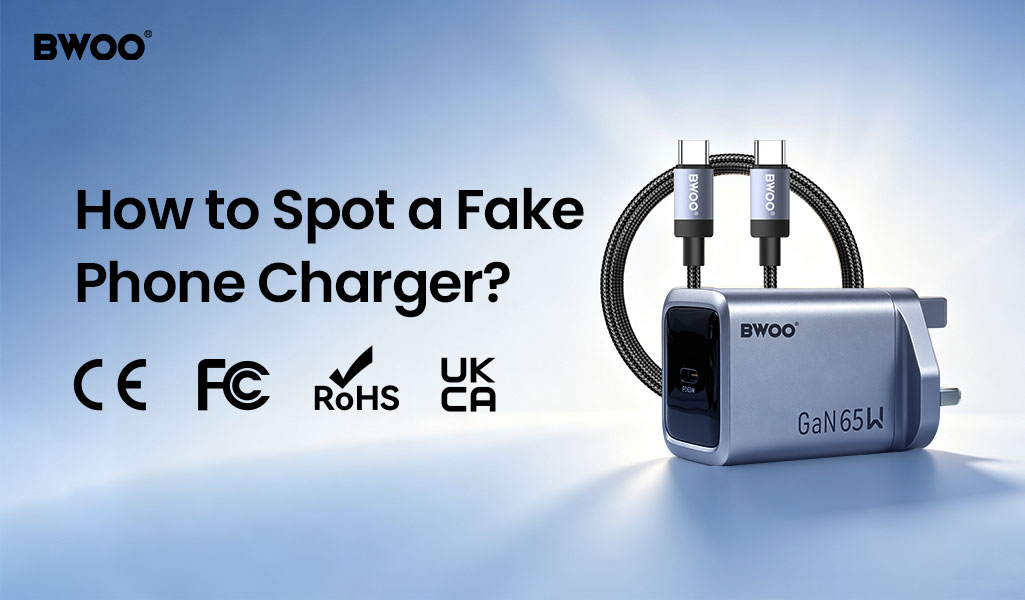
BWOO designs and manufactures its charger products with the full safety architecture that counterfeit chargers skip: UL94 V-0 rated enclosures, multi-layer protection circuits (overvoltage, overcurrent, short-circuit, overtemperature), certified power components from tier-1 suppliers, and full certification compliance (CE, FCC, RoHS, UKCA as applicable). When you buy from a legitimate accessories brand with verifiable certifications and an established supply chain, you are paying for safety engineering that you cannot see — but that protects your devices every time you plug in.
Conclusion
Spotting a fake charger comes down to five checks: read the markings carefully, weigh it, inspect physical construction, verify certifications in public databases, and never trust a price that seems too good to be true. The charger is the only component standing between mains electricity and your expensive phone — that is not the place to cut corners. Choose certified chargers from reputable brands, and if you suspect a charger might be counterfeit, replace it immediately. The cost of a genuine charger is a fraction of the cost of the damage a fake one can cause.


