




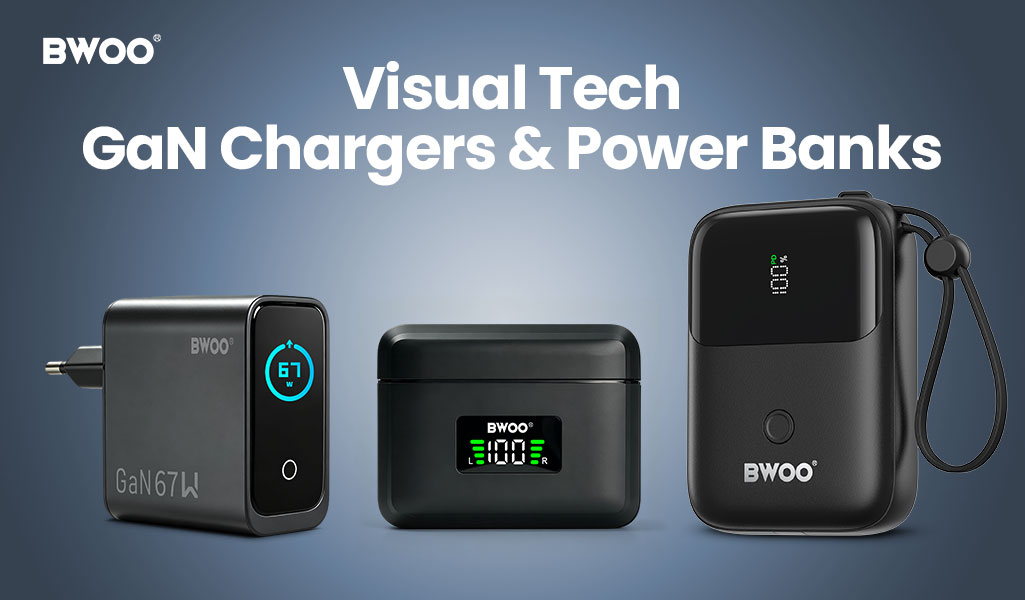
When a Charger Became a Screen
For two decades, chargers were invisible appliances — functional black boxes you plugged in and forgot. In 2026, that anonymity is being replaced by smart displays that show real-time wattage, voltage, charging status, and battery health metrics. The charger is no longer just a charger. It is becoming a data dashboard.
This transformation carries profound implications for B2B wholesalers. Products with integrated smart displays command higher retail prices, generate lower return rates, and create stronger brand recall than their screen-less equivalents.
Why Smart Displays Are Resonating With Consumers
Visibility Builds Trust
The single most common consumer complaint about charging is uncertainty: "Is this actually fast-charging?" "Why does the speed feel slower today than yesterday?" Smart displays eliminate this ambiguity. When a user can see "65W → Laptop / 30W → Phone" on the charger screen, the invisible process becomes visible — and visible processes build trust.
BWOO's internal product data supports this: their smart display-equipped chargers, including the BO-CDA267 140W 4-Port GaN Smart Display Charger and BO-CDA265 67W 3-Port GaN Smart Display Charger, demonstrate return rates below the category average. When consumers understand what their charger is doing, they are less likely to assume it is defective.
Social Media Amplification
Smart display chargers generate organic social media content in a way that conventional chargers cannot. A photo of a charger screen showing "105W to MacBook + 15W to iPhone + 5W to AirPods" is inherently shareable — it communicates "I have a sophisticated charging setup" as a subtle status signal.
This organic amplification lowers customer acquisition costs for retailers and creates a self-reinforcing demand cycle. In the HAVIT 2026 GaN Charger Wholesale Guide, smart display functionality is identified as a key differentiator driving B2B buyer interest, though most competitors have yet to dedicate a full product line to the category.
Real-Time Troubleshooting
Smart displays surface charging problems before they become returns. If a cable is limiting wattage, the display will show the restricted output, telling the user to upgrade their cable — not return the charger. This reduces support burden for retailers and distributors.
The B2B Opportunity: Higher Margins, Lower Returns
Smart display chargers and power banks occupy a pricing tier roughly 30-50% above equivalent non-display models. For B2B buyers, this translates to:
Higher absolute margin dollars per unit sold
A differentiated product that cannot be easily price-compared with generic chargers
Lower return rates reducing reverse logistics costs
Stronger trade-up momentum: consumers who buy a display charger become reluctant to go back to "blind" charging
BWOO's Smart Display Portfolio
BWOO has committed to smart display technology across both its charger and upcoming power bank lines:
BO-CDA267: 140W 4-Port GaN Smart Display Charger — real-time per-port wattage readout, total power display, USB-PD 3.1 and QC 5.0 support
BO-CDA265: 67W 3-Port GaN Smart Display Charger — compact form factor with full display functionality
BO-CDA266: Additional GaN smart display configurations in the pipeline
The smart display product line extends BWOO's charger category, which also includes multi-port GaN models optimized for desktop and travel use.
The 2026-2027 Outlook
Smart display technology in mobile accessories is following the same adoption curve that touchscreens followed in smartphones: initially a premium novelty, rapidly becoming a consumer expectation. Early wholesale adopters who build smart display inventory now will capture market share before the category becomes commoditized.
The charger that shows you what it's doing is the charger consumers will buy. The charger that hides its operation behind a featureless plastic shell is the charger they'll scroll past.


