




Understanding rated capacity vs. advertised capacity, voltage conversion loss, and how to read power bank specs honestly.
1. The Most Common Power Bank Misconception
You buy a 20,000mAh power bank expecting it will charge your 5,000mAh phone battery four times. You take it on a trip, charge your phone twice, and the power bank is dead. Did the manufacturer lie? Not exactly — but the number on the box is not the number you actually get. This gap between advertised capacity and real-world performance is the single most common source of consumer disappointment with power banks, and understanding the physics behind it can help you make better purchase decisions and set realistic expectations. According to product review analysis by BasinLens Research on mobile accessories, battery life and charging capacity are consistently among the top sources of negative consumer reviews, with users reporting that "actual battery life is far below claimed" and that products "fail to deliver on core promises of long-term use" when real-world capacity does not match marketing claims.
2. Advertised mAh vs. Usable mAh: The Three-Layer Loss
The Battery Cell Voltage Mismatch
The core of the problem is voltage. The mAh (milliamp-hour) rating on a power bank refers to the capacity of the internal lithium battery cells, which operate at 3.7V nominal voltage. But USB charging outputs at 5V minimum — and USB-C PD fast charging can output at 9V, 12V, 15V, or 20V. Since energy (watt-hours) is the product of voltage and current, when voltage increases, the milliamps available decrease proportionally. A 20,000mAh battery cell at 3.7V stores: 20,000mAh × 3.7V = 74Wh of energy. When you output at 5V USB, the theoretical maximum becomes: 74Wh ÷ 5V = 14,800mAh. Just the voltage step alone reduces the "20,000mAh" by over 25%. This is why reputable power bank manufacturers list a "rated capacity" — the actual capacity available at USB output voltage — separately from the battery cell capacity.
Boost Converter Efficiency Loss
The power bank internal circuitry must boost the 3.7V battery voltage to the 5V (or higher) USB output voltage. This boost conversion is not 100% efficient — typical conversion efficiency for quality power banks ranges from 80% to 92%, with 85% being a reasonable average for mid-range products. The remaining 15-20% is lost as heat in the circuit board inductor, MOSFET switching transistors, and PCB traces. Low-quality power banks can have conversion efficiency as low as 65-70%, meaning more than 30% of the battery energy is wasted as heat before reaching your device.
Device Charging Circuit and Cable Loss
Even after the power bank delivers power at USB voltage, the phone own charging circuit also incurs loss when it converts the input voltage to the battery charging voltage (typically 4.2V for lithium-ion). This adds another 5-10% loss. Additionally, the charging cable itself has resistance — thinner cables with higher AWG numbers lose more energy as heat along the wire. The total chain: Battery (3.7V) → Boost to USB (5V+) → Cable transmission → Phone charger IC → Phone Battery (4.2V). Each arrow represents an energy conversion loss.
3. The Real-World Calculation
The practical formula for estimating real-world charging capacity from a power bank is: Usable Capacity (mAh @ 5V) = Advertised Capacity × 3.7V / 5V × Conversion Efficiency. For a 20,000mAh power bank with 85% efficiency: 20,000 × 3.7 / 5 × 0.85 = 12,580mAh usable at the USB port. If your phone has a 5,000mAh battery, you get roughly 2.5 full charges — not the 4 charges that naive division would suggest. The table below shows the calculation for common power bank capacities.
Advertised Capacity | Stored Energy (Wh) | Usable @ 5V (85% Eff.) | Phone Charges (4,500mAh Phone) | Phone Charges (5,000mAh Phone) |
5,000mAh | 18.5Wh | 3,145mAh | 0.7× | 0.6× |
10,000mAh | 37.0Wh | 6,290mAh | 1.4× | 1.3× |
15,000mAh | 55.5Wh | 9,435mAh | 2.1× | 1.9× |
20,000mAh | 74.0Wh | 12,580mAh | 2.8× | 2.5× |
26,800mAh (max airline) | 99.2Wh | 16,860mAh | 3.7× | 3.4× |
4. Other Factors That Affect Real Charging Count
Phone Battery Health
A phone with 85% battery health (common after 2 years of use) has effectively become a smaller battery — 3,825mAh instead of 4,500mAh. This paradoxically means a power bank can charge an older phone more times than a new one, since there is less capacity to fill. However, aging batteries also have higher internal resistance, which increases charging loss.
Charging While Using the Phone
If you charge while watching video or using GPS navigation, the phone is consuming power simultaneously. A phone drawing 3W during active use while receiving 10W from the power bank effectively only nets 7W toward battery charging. Over a 2-hour charge session while streaming video, this can reduce effective charging by 20-30%.
Temperature Effects
Lithium batteries are least efficient at extreme temperatures. Charging at below 5°C or above 45°C significantly reduces effective capacity. Power banks left in a hot car in summer can lose 10-15% of deliverable capacity due to increased internal resistance.
Fast Charging vs. Standard Charging
Fast charging at higher voltages (9V, 12V) has slightly lower end-to-end efficiency than standard 5V charging because the power bank boost converter is optimized for a narrower voltage range and the phone step-down converter also sees more loss. A power bank specified for 20,000mAh at 5V may deliver noticeably less total energy if used exclusively for 9V fast charging.
5. How to Read Power Bank Specs Honestly
When comparing power banks, look for the rated capacity (Rated Capacity), not the advertised battery cell capacity (Battery Capacity). Rated capacity is typically printed in smaller text on the power bank body or in the detailed specifications — it is the capacity measured at the USB output, usually at 5V/2A or 5V/3A. For example, a quality 10,000mAh power bank will have a rated capacity of approximately 6,000-6,500mAh (at 5V/3A). This is the honest number. If a power bank does not list a rated capacity at all, or if the rated capacity is suspiciously close to the advertised capacity (e.g., "20,000mAh rated"), it is likely either misleadingly labeled or using the battery cell capacity as the rated figure.
Also check the watt-hour (Wh) rating — this is an absolute energy measure that bypasses the voltage ambiguity of mAh. A 74Wh power bank is 74Wh regardless of whether it is advertised as 20,000mAh at 3.7V or 14,800mAh at 5V. For airline travel, the 100Wh limit for carry-on is the definitive constraint, and watt-hours are what airline security checks for.
6. BWOO P85: Honest Capacity on a Flagship Magnetic Power Bank
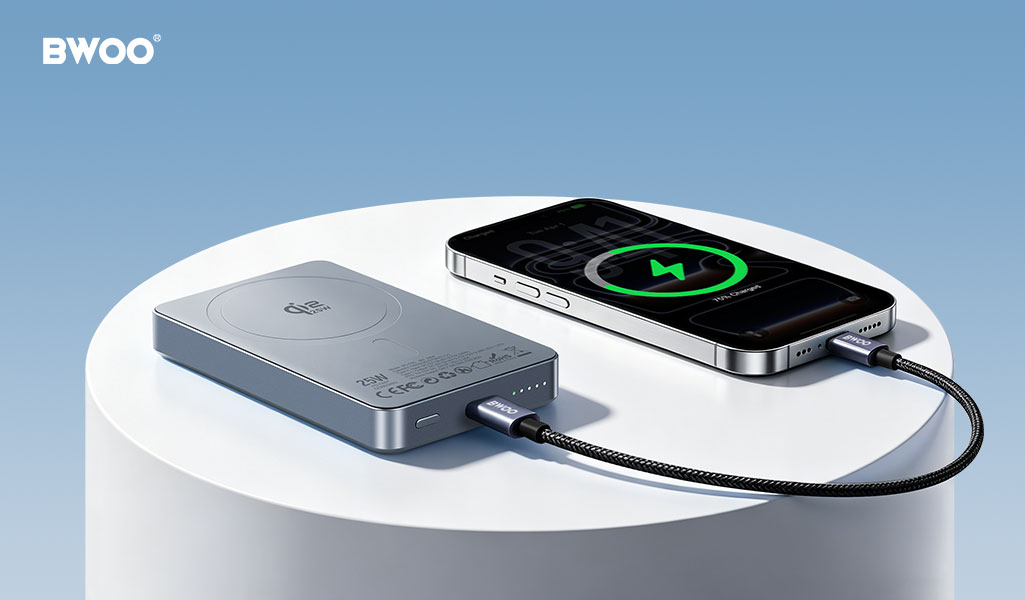
For consumers who want a magnetic power bank that delivers what it promises, the BWOO BP-P85 Qi2.2 25W 10,000mAh magnetic power bank is designed with honest specs. The P85 carries a rated capacity of approximately 6,200mAh at 5V/3A output — consistent with the 85% efficiency calculation for a 10,000mAh cell — clearly labeled on the product. With Qi2.2 25W magnetic wireless charging, you get the convenience of cable-free snap-on charging without sacrificing charging speed to misalignment (Qi2.2 magnetic alignment eliminates the "coil not centered" efficiency loss that plagues non-magnetic wireless chargers). The P85 also includes a USB-C port for wired PD charging at full 25W, giving you the flexibility to choose the most efficient path for any situation. For consumers burned by power banks that dramatically underdeliver on charge count, the P85 honest rated capacity labeling means you can plan your charges realistically — about 1.3 full charges for a 5,000mAh phone, not the 2 charges a naive mAh comparison might suggest. Because BWOO chooses to sell honestly, P85 customers know what to expect and are not disappointed by the gap between marketing and reality. Explore the full BWOO charging solutions.


