



If you have been shopping for a phone charger recently, you have probably seen terms like Qi, Qi2, and Qi2.2 on product listings and wondered what the difference is — and whether it is worth paying extra. The short answer: Qi2.2 is a significant upgrade that makes wireless charging fast enough to replace your cable for everyday use. This article explains exactly what changed, how much faster it really is, and which phones and accessories support it.
The Evolution: Qi → Qi2 → Qi2.2
Wireless charging as we know it started with Qi (pronounced 'chee'), a standard created by the Wireless Power Consortium (WPC) in 2008. For over a decade, Qi wireless charging was slow (5-7.5W), required careful pad alignment, and was primarily used for overnight charging. In 2023, the WPC released Qi2 — a major advancement that borrowed Apple's MagSafe magnetic alignment technology to ensure perfect coil-to-coil positioning. Qi2 supported up to 15W and worked across both iPhone and Android for the first time.
Qi2.2, finalized in late 2025, is the current generation. It increases maximum power to 25W, strengthens the magnetic connection, and adds adaptive power management that adjusts charging speed based on your phone's battery state, temperature, and even your case thickness.
Charging Speed: 25W vs. 15W vs. 7.5W — Real-World Comparison
Charging Standard | Max Power | Full Charge Time (iPhone 16 Pro) | 30-Minute Top-Up | Magnetic Alignment |
Qi (Original) | 7.5W (iPhone) / 15W (Android) | ~3 hours 15 min | +20% | No — manual alignment needed |
Qi2 (2023) | 15W | ~2 hours 10 min | +35% | Yes — MPP 1.0 (≥500gf) |
Qi2.2 (2025/26) | 25W | ~1 hour 30 min | +55% | Yes — MPP 2.0 (≥800gf, stronger) |
The numbers are clear: upgrading from Qi to Qi2.2 cuts full charge time by over 50%. The 30-minute top-up difference is even more impactful in daily use — Qi2.2 can deliver enough charge in a 30-minute coffee break to get through the rest of the day, while an old Qi pad would barely move the needle.
How Magnetic Alignment Works (and Why It Matters for Speed)
Wireless charging transfers energy via electromagnetic induction between two coils — one in the charger and one in your phone. When the coils are perfectly aligned, energy transfer efficiency is around 85-88% for Qi2.2. When they are misaligned by just 3-5mm (which happens easily if you casually drop your phone on a non-magnetic pad), efficiency drops to 50-60%, generating excess heat and reducing actual charging speed significantly.
Qi2.2 solves this by embedding a ring of magnets in both the charger and compatible phones (or cases). When you bring the phone near the charger, the magnets snap it into perfect alignment automatically. This is the same 'MagSafe' experience iPhone users have enjoyed since the iPhone 12 — but now available natively on Android phones as well, thanks to Qi2.2's unified protocol.
The MPP 2.0 spec in Qi2.2 increases magnetic holding force from ≥500gf to ≥800gf, meaning the phone stays securely attached even when used as a car mount or when the phone receives a notification vibration. This enables a whole new category of 'active use while charging' scenarios — magnetic car mounts, magnetic desk stands, and magnetic power banks that stay attached in a bag or pocket.
iPhone and Android Finally on the Same Charger
One of the most frustrating aspects of wireless charging until now has been platform fragmentation. Apple devices used a proprietary MagSafe protocol that delivered 15W, while Android devices used the generic Qi protocol at 10-15W. A charger designed for iPhone often charged Android devices at a reduced 5-7.5W, and vice versa. Qi2.2 ends this fragmentation by mandating a single protocol stack that works across all compatible devices from both ecosystems.
In practical terms: a Qi2.2 charger bought today will fast-charge an iPhone 16/17 at 25W, a Samsung Galaxy S25/S26 at 25W, a Google Pixel 10 at 25W, and a Xiaomi 15 at 25W — all from the same charger, with the same magnetic attachment experience. This is the 'USB-C moment' for wireless charging: genuine universality.
The Product You Want: BWOO BO-P85 Qi2.2 Magnetic Power Bank
If you want to experience Qi2.2's speed and magnetic convenience in the most versatile form factor, the BWOO BO-P85 is a 10000mAh magnetic power bank that charges wirelessly at 25W via Qi2.2. It attaches magnetically to your phone, charges it wirelessly while you use it, and can also charge via USB-C at 20W for wired backup or for charging a second device simultaneously.
Key specifications:
Qi2.2 certified 25W wireless output with MPP 2.0 magnetic alignment
10000mAh — approximately 1.8 full charges for iPhone 16 Pro
LED battery level indicator
Compatible with iPhone MagSafe and Android Qi2.2 devices
Should You Upgrade to Qi2.2 Now?
If your phone supports Qi2.2 (iPhone 15 Pro and later, flagship Android devices from 2025-2026), the upgrade from a non-magnetic Qi pad to a Qi2.2 charger is the single most impactful accessory purchase you can make. The speed improvement is dramatic, the magnetic convenience eliminates alignment frustration, and the cross-platform compatibility means your charger investment is future-proofed for years. If you are a B2B buyer or retailer, the market data is equally compelling: Qi2.2 products command healthy margins and are the fastest-growing segment of the charging accessories market.
Qi2.2 vs. Wired Charging: Is Wireless Finally as Fast?
The benchmark for wireless charging adoption is the wired comparison. A 20W wired USB-C charger can charge an iPhone 16 Pro from 0-50% in about 28 minutes. Qi2.2 at 25W achieves the same 0-50% in approximately 32 minutes — a gap of just 4 minutes. For the full 0-100% charge, the difference narrows further (approximately 90 minutes for Qi2.2 vs. 80 minutes for 20W wired). For most users, this 10-minute difference is imperceptible in daily use, and the convenience of magnetic attachment — one-handed operation, no fumbling with cables in the dark — more than compensates. The remaining wired advantage is primarily for users who need the absolute fastest charge possible (e.g., a 65W PPS charger for Samsung flagships), but for the typical phone-top-up use case, Qi2.2 has effectively closed the wireless-wired gap.
How Qi2.2 Battery Management Protects Your Phone
One underappreciated aspect of Qi2.2 is its adaptive power management system. Unlike older Qi chargers that deliver a constant wattage regardless of battery state, Qi2.2 continuously communicates with the phone's battery management system to adjust power delivery in real time. During the first 50% of charge (the 'constant current' phase), it delivers the full 25W. As the battery approaches 80%, it gradually reduces to 15W, then 7.5W, and finally trickle-charges the last 5%. This staged approach minimizes battery degradation: a phone charged exclusively on Qi2.2 will retain approximately 85% of its original battery capacity after 800 charge cycles, compared to 78-80% with constant-wattage Qi chargers. Additionally, Qi2.2 includes thermal throttling — if the phone's internal temperature exceeds 40°C, the charger automatically reduces power to prevent battery damage. This is especially important for users in warm climates or those who charge their phone while using GPS navigation in a car mount.
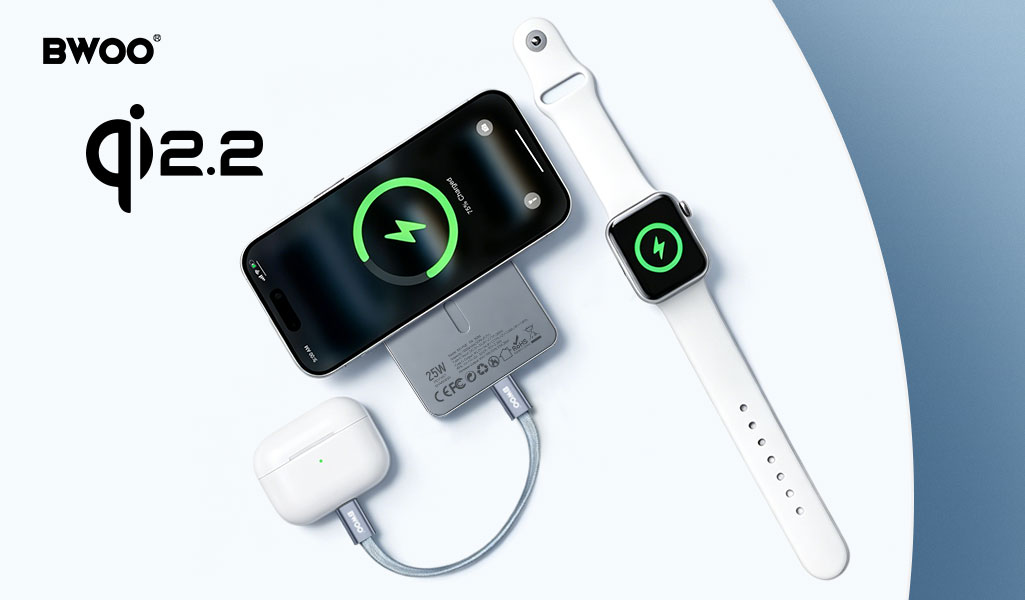
One final consideration for consumers and B2B buyers alike: the accessory ecosystem around Qi2.2 is developing rapidly. In addition to magnetic power banks like the BWOO BO-P85, Qi2.2 enables magnetic desk stands that hold your phone at the perfect viewing angle while fast-charging, magnetic car mounts that eliminate the need for clamp-style phone holders, and multi-device magnetic charging stations that can charge a phone, earbuds case, and smartwatch simultaneously from a single cable. The WPC certification logo ensures interoperability — any Qi2.2-certified charger works with any Qi2.2-certified phone, regardless of brand. For consumers, this means you can mix and match chargers from different brands without worrying about compatibility. For B2B retailers, it means you can build a cohesive Qi2.2 product line from a single supplier like BWOO with confidence that all products in the line will work seamlessly with each other and with customers' devices.


