



A consumer-friendly guide to why your charging cables fail, how connector design affects durability, and what to look for when buying a cable built to last.
1. The Frustrating Truth: Why Cables Die So Often
If you have ever found yourself wiggling a charging cable at a specific angle to get your phone to charge, you have experienced one of consumer electronics most universal frustrations. Charging cable failure is so common that analysis of Amazon customer reviews shows cable durability is consistently one of the top complaints across the charging accessories category. According to review analysis data published by AMZ123 covering 151,295 reviews across popular wireless earphone and accessory listings on Amazon US, a significant percentage of negative reviews cite accessories that "stopped working" or "died" within months of purchase — and charging cables are among the product categories with the highest complaint rates. Common real-user complaints include: "stopped charging after 3 months," "only works at a certain angle," and "the cable literally fell apart at the connector."
2. Why Do Charging Cables Fail? The Root Causes Ranked
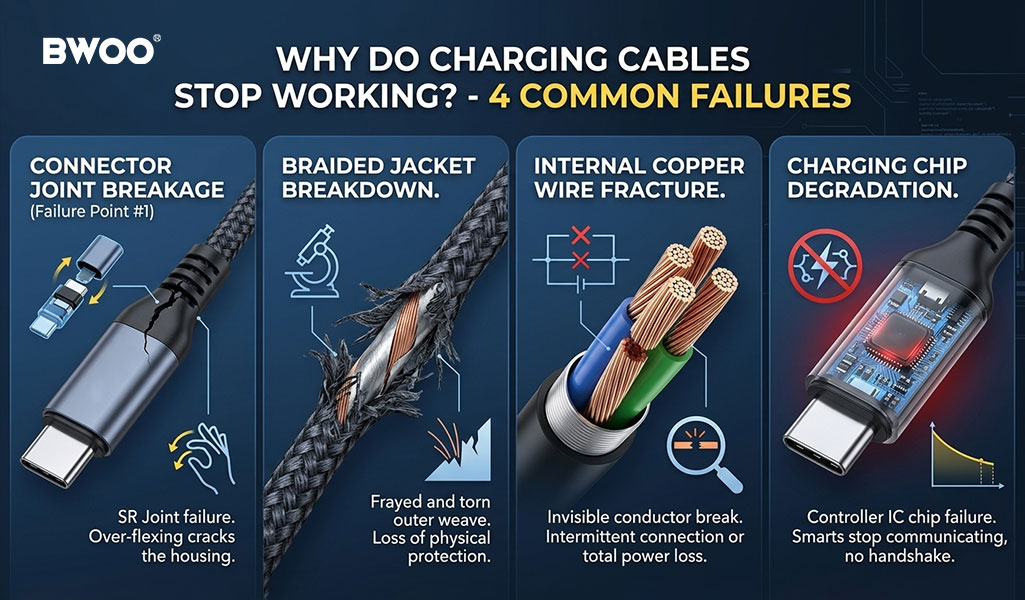
Analysis of thousands of Amazon and retailer product reviews reveals that charging cable failures cluster around four primary causes. Understanding these failure modes helps consumers recognize quality signals before they buy.
Connector Joint Breakage: The Number One Failure Point
The point where the cable meets the USB connector is the single most common failure location. This is a mechanical stress concentration zone: every time you plug or unplug the cable, every time it bends while charging with the phone in hand, and every time the cable is coiled for storage, the connector joint absorbs repeated bending force. Cheap cables typically reinforce this joint with a thin plastic strain relief that cracks or separates from the connector housing within weeks of daily use. Once the outer jacket separates, the internal copper wires are exposed to bending without protection, and fraying follows quickly. Analysis of negative reviews by BasinLens Research on related accessory categories found that products described as "flimsy" or that "broke within two weeks" nearly always failed at the connector junction.
Braided Jacket Breakdown: When the Outer Shield Gives Up
Nylon braided jackets are the most common premium cable material, but not all braiding is created equal. Lower-quality braided cables use loose-weave polyester that frays and separates after repeated coiling. Once the braided jacket is compromised, the TPE (thermoplastic elastomer) inner jacket beneath it is directly exposed to friction and bending. The best braided cables use high-density nylon or aramid fiber weaves that maintain structural integrity through 10,000+ bend cycles. The braid density — measured in threads per inch — directly correlates with abrasion resistance.
Internal Copper Wire Fracture: The Invisible Failure
Underneath the external jacket, all USB cables contain thin copper wires that carry power and data. Repeated bending at the same point — typically 1-2 cm from the connector — eventually causes metal fatigue and micro-fractures in these copper strands. Once multiple strands fracture, the effective conductor cross-section shrinks, increasing electrical resistance. Higher resistance means: slower charging, intermittent connection, and eventually complete failure. This failure mode is invisible from the outside and is the reason a cable can "look fine" but stop working. Higher-quality cables use thicker-gauge copper wires (lower AWG number) and stranded wire (multiple thin strands that share bending stress) rather than a single solid conductor.
Charging Chip Degradation: When the Smarts Fail
Modern USB-C to USB-C and Lightning cables contain embedded e-marker chips and authentication ICs that communicate with the charger and device to negotiate the correct charging protocol and voltage. These chips can degrade or fail due to: voltage spikes from poor-quality chargers, moisture ingress into the connector housing, or repeated thermal cycling from fast charging heat. When the chip fails, the cable may still physically connect but the device and charger cannot negotiate a charging protocol, causing the dreaded "this accessory may not be supported" error message or complete charging failure even though the cable has no visible damage.
3. Connector Design: Why the Joint Is the Weakest Link
To understand why connectors fail, it helps to look inside. A typical USB-C connector contains 24 pins soldered to a PCB, enclosed in a metal shell, with the cable jacket terminated into a strain relief boot. The strain relief boot is the crucial design element: it tapers the transition from rigid connector to flexible cable, distributing bending stress over a longer distance to prevent concentration at a single point. Budget cables often use a short, hard plastic boot that concentrates stress at the junction. Premium cables employ: a graduated TPE overmold boot that progressively softens (transitioning from hard connector housing to flexible jacket), an internal wire stress relief slot that anchors the wire assembly to prevent it from pulling out of the connector, and a reinforced metal connector shell with extended cable grip tabs.
A useful consumer inspection: hold the cable by the connector and gently flex the cable near the boot. On a well-designed cable, you should feel smooth, progressive resistance with no sharp bend point. On a poorly designed cable, the cable will kink sharply at the junction — that kink point is exactly where the copper wires will fracture first.
4. Cable Material Comparison: Durability Testing Results
Jacket Material | Bend Cycles (Typical) | Tensile Strength | Abrasion Resistance | Flexibility | Best For |
Nylon Braided | 10,000-50,000+ | High | Excellent | Medium | Daily use, travel, heavy wear |
TPE (Thermoplastic Elastomer) | 5,000-15,000 | Medium-Low | Medium | High | Light use, desk charging |
Silicone | 15,000-30,000 | Medium | Medium-High | High (lint-prone) | Travel, flexible setups |
5. Certification Matters: MFi, USB-IF, and Why They Protect Your Purchase
For cables carrying power and data to expensive devices, certification is not just a sticker — it is a guarantee that the cable meets minimum safety and performance standards. Apple MFi (Made for iPhone/iPad) certified cables include an authentication chip that verifies compatibility and protects against voltage mismatches that can damage the charging IC in your device. Uncertified Lightning cables often use counterfeit chips that work initially but fail after an iOS update or cause "this accessory is not supported" errors. USB-IF (USB Implementers Forum) certification for USB-C cables verifies that the cable meets the power delivery specification it claims — a USB-IF certified 100W cable has been tested to actually deliver 100W (20V at 5A) without overheating or voltage drop. Non-certified cables may physically fit but fail to deliver rated power, causing slow charging or, worse, overheating at the connector that damages both the cable and the device port.
6. Consumer Buying Guide: How to Spot a Durable Cable
Check the connector reinforcement: Look for a long, flexible strain relief boot (at least 8mm in length) with graduated flexibility. Avoid cables where the cable exits the connector at a hard right angle with minimal overmolding.
Inspect the braid density: For braided cables, the weave should be tight and uniform with no gaps showing the inner jacket beneath. Run your fingernail along the braid — loose weaves will snag and fray over time.
Look for certification marks: For Lightning cables, verify MFi certification. For USB-C cables, look for the USB-IF certified logo on the packaging or check the USB-IF product search database.
Check the wire gauge specification: 20 AWG or lower (thicker) for power delivery wires. Higher AWG numbers mean thinner wires — 28 AWG cables will charge significantly slower and fail earlier than 22 AWG cables at the same length.
Length matters for durability: Longer cables experience more bending torque at the connector because of the longer lever arm. A 2-meter cable used at an angle will put more stress on the connector than a 1-meter cable in the same position. Choose the shortest length that fits your use case.
Test the connector fit: A USB-C or Lightning connector should insert with a firm, clean click and require noticeable pull force to remove. Loose connectors indicate poor manufacturing tolerances that will only worsen with use.
7. The BWOO Solution: Cables Designed for Longevity
For consumers tired of replacing cables every few months, BWOO offers a durable cable lineup engineered to address each failure point. The BWOO BO-X330CC 65W USB-C to USB-C cable features a reinforced nylon braided jacket tested to 10,000+ bend cycles, a graduated TPE strain relief boot with internal wire anchoring, 22 AWG power delivery wires for minimal resistance, and USB-IF compliant e-marker chip. The BWOO BO-X401CC 65W fast charging USB-C cable extends the same durability engineering to a 1.2-meter daily-use cable. For multi-device households, the BWOO BO-X410 65W 4-in-1 data cable combines USB-C, Lightning, and Micro-USB tips in a single cable with the same braided durability, eliminating the need for multiple cables. Unlike budget cables that prioritize low cost over longevity, BWOO cables are designed for the realistic daily use patterns that cause most failures. Explore the full BWOO cable catalog to find a durable charging solution.


