




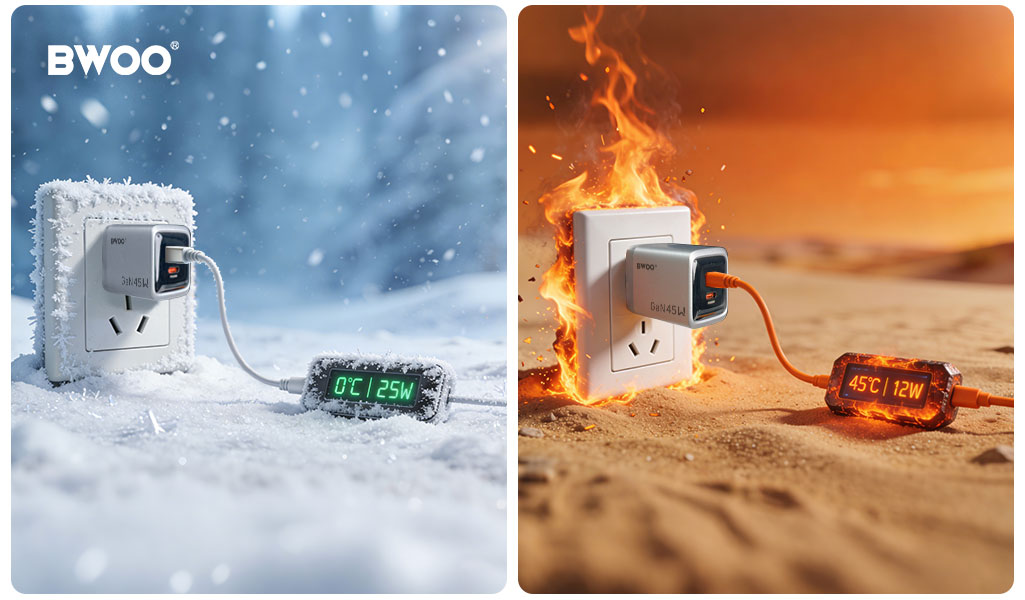
Have you ever noticed that your phone charges extremely slowly outdoors in winter? Or that in summer, when you're charging while using the phone, the battery level barely goes up—or even drops?
Many consumers have reported to BWOO that charging efficiency seems to vary significantly across seasons. This isn't a coincidence, nor is it a device defect. Temperature directly affects lithium battery activity and charging behavior.
As a professional charging accessory brand, BWOO explains how environmental temperature influences charging efficiency—and how you can protect your devices year-round.
The Science Behind Charging Speed: How Temperature Takes Control
1. The "Comfort Zone" of Lithium Batteries
Lithium-ion batteries perform best within a specific temperature range.
Optimal Operating Range:
Most lithium batteries operate most efficiently between 15°C and 35°C (59°F–95°F).
Low-Temperature Effect (Cold Contraction)
When temperatures drop below 0°C (32°F):
The electrolyte becomes more viscous
Lithium-ion movement slows down
Internal resistance increases
To prevent permanent battery damage, the system automatically limits charging current, resulting in noticeably slower charging speeds.
High-Temperature Effect (Thermal Expansion)
At elevated temperatures:
Chemical reactions accelerate
Charging may appear faster initially
However, excessive heat also:
Triggers unwanted side reactions
Accelerates battery aging
Reduces long-term capacity
This is why modern devices aggressively control charging speed in hot conditions.
2. Thermal Stress on Chargers and Cables
Even advanced chargers are affected by ambient temperature.
How GaN Chargers Behave in Heat
GaN (Gallium Nitride) technology offers:
Higher efficiency
Smaller size
Better heat tolerance
That said, when environmental temperatures rise too high, even GaN chargers will activate thermal protection, deliberately reducing output to maintain safety and stability.
Why Wireless Magnetic Charging Heats Up Faster in Summer
Wireless magnetic charging systems are particularly sensitive to heat in hot weather.
Dual Heat Sources:
1. Energy loss during wireless power transfer naturally generates heat
2. High ambient summer temperatures compound that heat buildup
FOD & Overheat Protection Explained
When temperatures exceed approximately 45°C (113°F):
Foreign Object Detection (FOD)
Battery swelling prevention logic
Fire-risk protection mechanisms
These systems may slow charging or stop it entirely to avoid battery damage or safety hazards.
How BWOO Minimizes Temperature Impact on Charging
1. NTC Dynamic Thermal Control System
All BWOO chargers integrate NTC thermistors that monitor temperature multiple times per second.
Instead of abrupt shutdowns, BWOO devices intelligently reduce power output smoothly, ensuring stable and predictable charging—even under thermal stress.
2. Efficient Heat Dissipation Materials
BWOO charging products use:
High-conductivity aluminum alloy housings or
Fire-resistant PC materials with enhanced thermal coatings
These materials help disperse heat more evenly, reducing localized hotspots during extended use.
3. Extreme Environment Stress Testing
BWOO products undergo laboratory testing across a wide temperature range—from -20°C to 60°C (-4°F to 140°F).
This ensures reliable performance whether you're charging in Nordic winters or Middle Eastern summers.
Practical Charging Tips for Different Seasons
Winter Charging Tips
Avoid charging outdoors below freezing temperatures
Let your phone warm up indoors before connecting power
Summer Charging Tips
Remove thick, poorly ventilated phone cases while charging
Avoid wireless magnetic charging on dashboards or under direct sunlight
Universal Best Practices
Keep devices away from heat sources like laptop exhaust vents
Use chargers with intelligent temperature control, such as genuine BWOO accessories
Conclusion
Charging efficiency is governed by physical laws—but well-designed charging equipment can significantly reduce temperature-related losses.
When choosing a charger, power rating alone isn't enough. Thermal management strategy matters just as much.
BWOO is committed to keeping every charge calm, efficient, and safe—no matter the season.
BWOO GaNex 45W Dual Ports USB-C GaN Charger
45W PD Fast Charging for phones, tablets, and USB-C laptops
Dual USB-C outputs with balanced power distribution
Advanced GaN technology for higher efficiency and reduced heat
Multi-layer protection against voltage, current, and temperature risks
Fire-resistant PC housing for long-term safety


