








What Is the "Barrel Effect" in Fast Charging?

2026-01-27 14:37
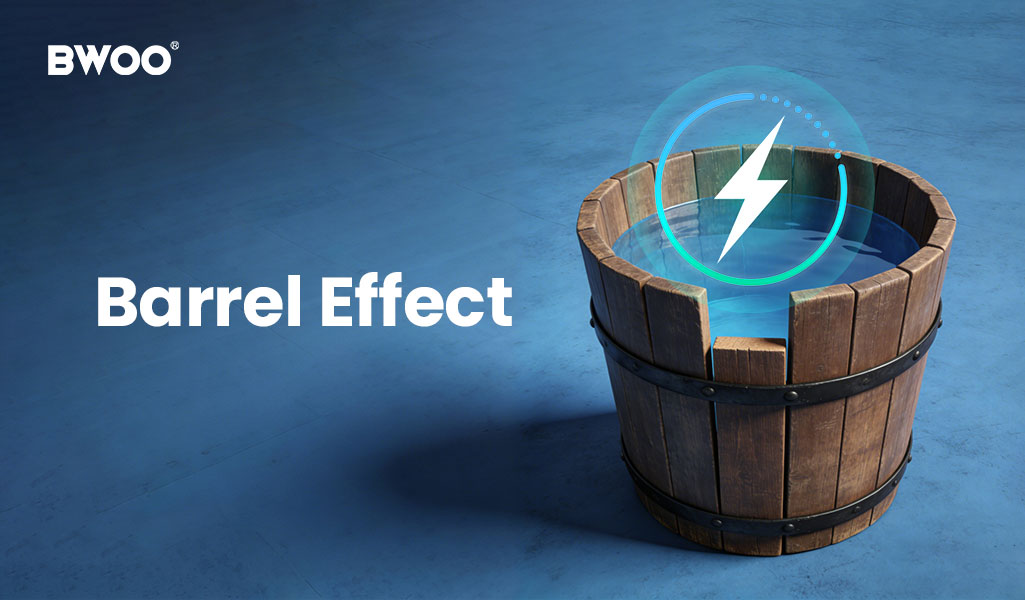
You buy an expensive 100W fast charging cable, connect it to a 100W charger, and plug it into your phone—yet the charging speed feels no different from a standard charger.
All the hardware specs look impressive, so why doesn't the speed increase?
The answer lies in what we call the "Barrel Effect" of charging.
In this article, BWOO explains how this principle applies to modern fast charging systems—and why matching matters more than raw numbers.
What Is the "Barrel Effect" in a Charging System?
The Basic Principle
A wooden barrel can only hold as much water as its shortest plank allows—not the tallest one.
The same logic applies to fast charging.
The Four "Planks" of a Charging System
A complete charging setup consists of four key components:
Charger (Power Adapter)
The energy source that determines maximum output capability.
The energy carrier that defines transmission capacity and current limits.
Phone or Device
The energy receiver with a fixed maximum input power.
Fast Charging Protocol
The communication language that allows devices to negotiate power safely.
If any one of these becomes the "short plank," the entire system slows down.
Why Your Charging "Barrel" Is Leaking
1. Protocol Mismatch: When Devices Can't Communicate
Fast charging relies on protocol negotiation, such as:
USB Power Delivery (PD)
Qualcomm Quick Charge (QC)
PPS
Brand-specific protocols (Huawei SuperCharge, OPPO SuperVOOC, etc.)
Real-world scenario:
Using a 100W PD charger to power a phone that only supports a proprietary protocol.
Without a shared "language," the system falls back to a basic 10W–12W safe charging mode.
Key takeaway:
Charging protocols act like an access card. Without the right one, high power simply cannot pass through.
2. A 100W Cable Without an E-Marker Chip
For safety reasons, USB-C standards require an E-Marker chip in cables carrying currents above 3A (typically above 60W).
What happens without it?
If the charger cannot detect an E-Marker, it will automatically limit current output to prevent overheating.
Result:
Your 100W charger throttles itself—even if the cable looks capable on the outside.
3. The Phone's Input Limit
No matter how powerful your charger is, your phone can only accept what it is designed for.
If a phone supports 65W max input, connecting it to a 140W GaN charger will not make it charge faster than 65W.
This is a hard physical limit set by the device's internal power management system.
Environmental Temperature: The Invisible Short Plank
Fast charging is not static—it adapts in real time.
When the phone gets hot or the ambient temperature rises, the system automatically reduces charging speed to protect battery health.
This thermal throttling often explains why charging slows down during gaming, navigation, or hot summer conditions.
BWOO's Solution: Building a Balanced Fast-Charging Barrel
BWOO focuses on eliminating short planks through a complete, system-level approach.
1. Multi-Protocol Compatibility at Chip Level
BWOO high-performance chargers integrate intelligent protocol recognition chips that automatically match mainstream fast charging standards across brands.
2. Built-In E-Marker as Standard
All BWOO 100W and 240W cables include certified high-performance E-Marker chips, ensuring full power delivery without artificial limits.
3. Smart Power Allocation for Multi-Port Chargers
BWOO multi-port chargers dynamically distribute power, ensuring each port remains a "long plank" even when multiple devices are connected.
4. End-to-End Thermal Control
From chargers to cable connectors, low-resistance materials and optimized internal layouts reduce heat buildup and prevent speed throttling.
Buying Guide: How to Build a Complete Fast-Charging Setup
Follow these three steps to avoid the barrel effect:
1. Check the protocol
Match your phone's fast charging standard with a compatible charger.
2. Check the cable
For high power, choose cables clearly labeled 100W or higher with built-in chips.
3. Check the brand
Select professional brands like BWOO that provide certifications, real-world testing, and transparent specifications.
Conclusion
Fast charging is not about chasing the biggest numbers—it's about compatibility and balance.
A perfectly matched charging system will always outperform mismatched high-end components.
Don't pay for excess power you can't use—pay for the right combination.


Comment
Leave a Reply
Your email address will not be published. Required. Required fields are marked*


Comment
There are no comments yet!