







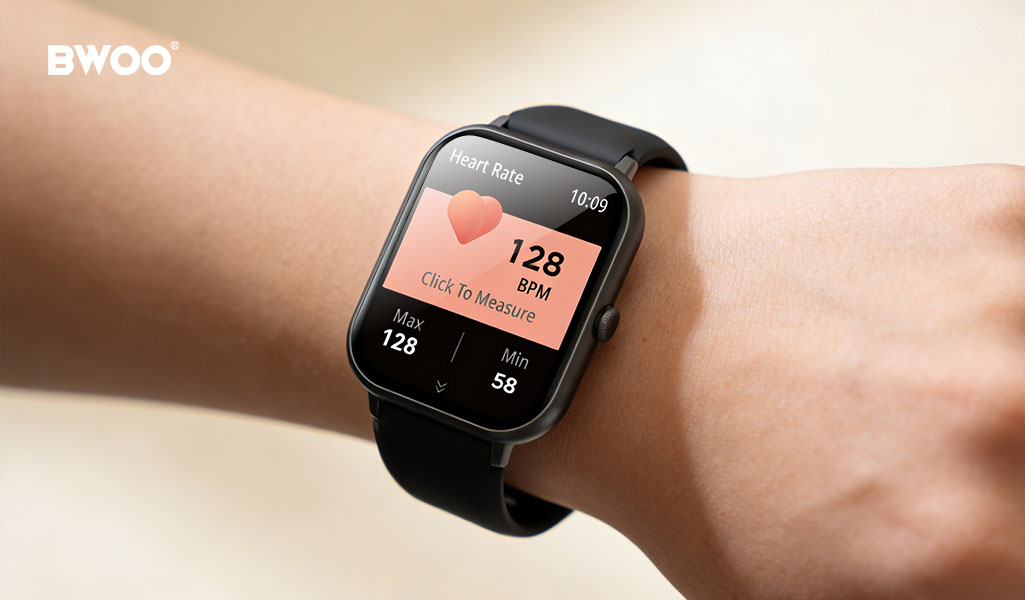
Heart rate monitoring has become a core feature of modern smartwatches.
Many users—especially those considering a purchase—often ask: How does a smartwatch measure heart rate, and how accurate is it?
As an experienced smartwatch supplier, BWOO provides a clear and practical explanation of the technology behind wrist-based heart rate monitoring, helping users better understand the data they rely on every day.
The Green Light on the Back of Your Watch
If you remove a smartwatch while it is actively monitoring heart rate, you will notice a blinking green light on the back.
This is not a decorative feature—it is the result of a mature biomedical optical technology called PPG, short for Photoplethysmography.
PPG allows a smartwatch to calculate your beats per minute (BPM) by analyzing how light interacts with blood flow beneath the skin.
What Is PPG Technology?
PPG is based on optical and physiological principles:
1. Optical Foundation: Beer–Lambert Law
A = ε × c × l
A = Absorbance
ε = Molar absorptivity, L·mol⁻¹·cm⁻¹
c = Concentration, mol/L
l = Path length, cm
The Beer–Lambert Law explains that the absorption of light by a substance is proportional to its concentration.
In simple terms, changes in blood volume affect how much light is absorbed.
2. Light Interaction With Blood
Blood reflects red light more easily and absorbs green light more effectively.
This property makes green light particularly useful for detecting blood volume changes in surface capillaries.
3. Pulse-Induced Signal Changes
With each heartbeat, the heart pumps more blood into the wrist, increasing vascular volume and absorbing more green light.
Between beats, blood volume decreases, and less light is absorbed.
Result:
By tracking the peaks and valleys of reflected green light, the smartwatch calculates heart rate in real time.
Why Green Light Instead of Red or Blue?
The choice of green light is based on performance, not aesthetics.
Blue light:
Penetrates too shallowly and is limited to the skin surface.
Red light:
Penetrates too deeply and is more affected by underlying tissues.
Green light (around 525 nm):
Offers the optimal balance of penetration depth and signal clarity, with minimal environmental interference.
This makes green light the most reliable wavelength for wrist-based heart rate monitoring.
Why Smartwatch Heart Rate Readings Can Vary
Even with advanced technology, certain factors can affect accuracy:
Motion artifacts:
Arm movement during running or workouts can introduce noise.
Skin tone differences:
Higher melanin levels absorb more light, reducing signal strength.
Loose fit:
External light can leak into the sensor area.
Poor circulation:
Cold environments can reduce blood flow in the wrist.
Understanding these factors helps users interpret data more realistically.
How BWOO Improves Heart Rate Accuracy
BWOO smartwatches are designed to address these real-world challenges through both hardware and software optimization.
Multi-Channel Optical Design
Multiple LEDs and sensor arrays capture signals from different angles, reducing motion-related interference.
AI-Based Noise Reduction
Advanced signal-processing algorithms separate motion signals from true pulse signals in real time.
Adaptive Light Intensity Control
The watch automatically adjusts LED brightness based on skin tone and wearing tightness to maintain signal clarity.
Medical-Grade Benchmark Testing
During development, BWOO devices are tested against professional ECG chest straps, with deviations kept within a very small range under controlled conditions.
Conclusion
Once you understand how heart rate monitoring works, it becomes clear that a smartwatch is far more than a timekeeping device.
It is a compact, continuously operating biometric sensor system designed to support everyday health awareness.
BWOO remains committed to transforming complex sensing technology into reliable, easy-to-understand data—delivered directly on your wrist.


